

Josh Brown
CEO & Founder, Josh Brown Consulting

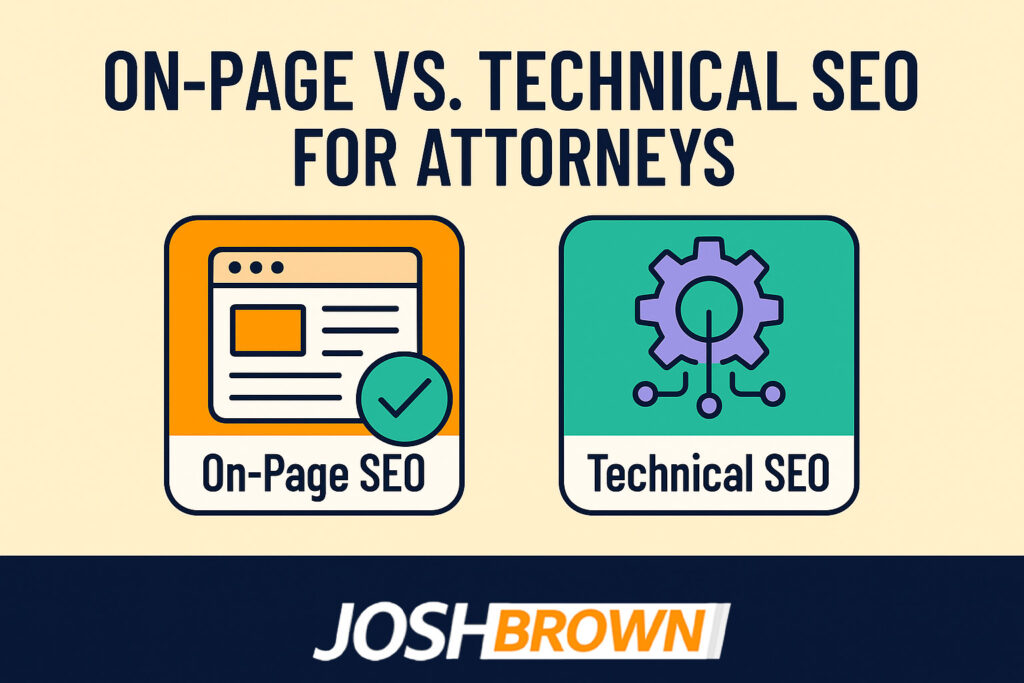
On-page SEO for attorneys is the optimization of website content, headings, meta tags, keywords, and internal linking to improve visibility and client engagement, while technical SEO focuses on backend improvements like site speed, mobile responsiveness, crawlability, structured data, and security. The difference between on-page and technical SEO is that on-page enhances visible content and user experience, while technical SEO ensures search engines properly index and rank the website.
A 2025 study by Josh Ternyak, “The Impact of Page Speed on SEO: 10 Key Statistics,” found that pages loading in under 3 seconds reduce bounce rates by 32% and boost conversions by up to 7%. Quick-win free SEO tools for attorneys include Google Search Console, Screaming Frog, and Ahrefs Webmaster Tools to detect crawl errors and broken links. Technical SEO improves navigation, Core Web Vitals compliance, and indexing for higher ranking potential. On-page strategies include optimizing practice area pages, publishing case results, FAQs, client testimonials, and schema markup for legal services.
Lawyers improve rankings through consistent blogging, keyword research, link building, and local SEO with Google Business Profiles. SEO helps law firms gain visibility, qualified leads, trust, and a competitive advantage while reducing long-term acquisition costs compared to PPC. The best SEO strategies for 2025 include voice search optimization, AI-driven keyword clustering, video SEO, and local-first content.
What is on-page SEO for attorneys?
On-page SEO for attorneys is the practice of optimizing law firm website content, meta tags, keyword placement, and internal linking to improve visibility and client engagement. On-page SEO for attorneys involves creating high-quality practice area pages, using targeted keywords naturally in headings and text, and structuring internal links to guide users and search engines.
Meta tags such as titles and descriptions define relevance, while well-written content builds authority. On-page SEO is important because it directly influences rankings, user experience, and conversion rates, helping attorneys attract qualified clients through search engines.
What is technical SEO?
Technical SEO is an optimization process that improves a website’s backend performance to ensure proper crawlability, indexing, and ranking by search engines. Technical SEO involves enhancing site speed for faster load times, implementing mobile responsiveness for usability across devices, and maintaining clear site structures supported by XML sitemaps. Structured data is added to help search engines interpret law firm content accurately, improving visibility in rich results. Technical SEO ensures that websites meet performance standards, remain accessible, and deliver a seamless experience that supports stronger rankings.
What are the differences between on-page and technical SEO for attorneys?
The differences between on-page and technical SEO for attorneys are found in their focus on visible content optimization versus backend performance.
The table below shows the On-Page SEO vs. Technical SEO for Attorneys.
Aspect | On-Page SEO | Technical SEO |
Definition | Optimizing visible elements like legal content, keywords, meta tags, headers, and internal linking to improve relevance for search queries. | Ensuring law firm websites are crawlable and indexable through site speed optimization, mobile-friendliness, structured data, and secure HTTPS. |
Focus | Content quality, keyword placement, and user experience. | Site architecture, performance, and backend compliance with search engine standards. |
Goal | Attract and engage users with relevant, optimized legal content. | Enable search engines to properly crawl, index, and rank law firm websites. |
Examples | Practice area pages, case results, client testimonials, optimized headings. | XML sitemaps, HTTPS, mobile responsiveness, Core Web Vitals, schema markup. |
What free SEO tool gives attorneys a quick win by identifying broken links and crawl errors?
A free SEO tool that gives attorneys a quick win by identifying broken links and crawl errors is Google Search Console. Attorneys use this tool to identify broken links, review crawl reports, and resolve coverage issues that prevent pages from being indexed.
Marketers identify broken links and crawl errors with free SEO tools like Search Console to maintain site health and improve rankings. A 2024 study by FasterCapital, “SEO Audit: Crawl Errors,” shows that fixing crawl errors boosts visibility and rankings by ensuring search engines index your content properly.
What role does technical SEO play in law firm websites?
Technical SEO plays a role in law firm websites by ensuring proper indexing, strong ranking signals, and user trust through optimized performance. The role of technical SEO in law firm website optimization includes improving site speed, enabling mobile-friendly design, and maintaining secure HTTPS connections. These elements enhance visibility, strengthen credibility, and help search engines rank attorney websites higher in competitive markets.
What on-page SEO techniques work best for law firm websites?
On-page SEO techniques that work best for law firm websites are optimizing title tags, adding schema markup, and using local keywords. Attorneys apply on-page SEO techniques for optimizing law firm content to improve visibility, rankings, and client engagement.
Listed below are the 5 main techniques.
- Optimizing title tags: include primary legal keywords and keep titles within 50–60 characters.
- Adding schema markup: Use legal service schema to enhance search appearance with rich snippets.
- Using local keywords: target city-specific and practice area terms to attract local clients.
- Internal linking: connect practice area pages, blogs, and resources to guide users and distribute authority.
- Publishing FAQs: address common client questions with structured answers to improve relevance and rankings.

How can lawyers improve their website SEO rankings?
Lawyers can improve their website SEO rankings by writing client-focused content, building backlinks, optimizing site speed, and using local SEO.
Listed below are the 5 main methods.
- Writing client-focused content: publish blogs, case results, and resources that answer client questions.
- Building backlinks: earn links from legal directories, guest posts, and reputable industry sites.
- Optimizing site speed: improve load times to meet Core Web Vitals and increase engagement.
- Using local SEO: optimize Google Business Profiles and target city-specific keywords for visibility.
- Updating regularly: refresh content and pages to maintain relevance and rankings.
What does SEO help law firms achieve online?
SEO helps law firms achieve online visibility, attract qualified leads, build brand authority, and increase client acquisition. Optimized law firm websites rank higher in search results, connecting attorneys with people actively seeking legal services. Strong SEO strategies also establish trust by showcasing expertise through content, improving click-through rates, and sustaining long-term digital growth in competitive legal markets.
How do attorney websites benefit from SEO optimization?
Attorney websites benefit from SEO optimization by gaining higher rankings in local search, increasing organic traffic, and driving more conversions. Local SEO ensures attorneys appear in searches like “lawyer near me,” while optimized pages highlight reviews and trust signals. Clear call-to-actions on practice area pages improve lead generation by turning visitors into consultations, helping law firms grow their client base effectively.
What are the best SEO strategies for lawyers in 2025?
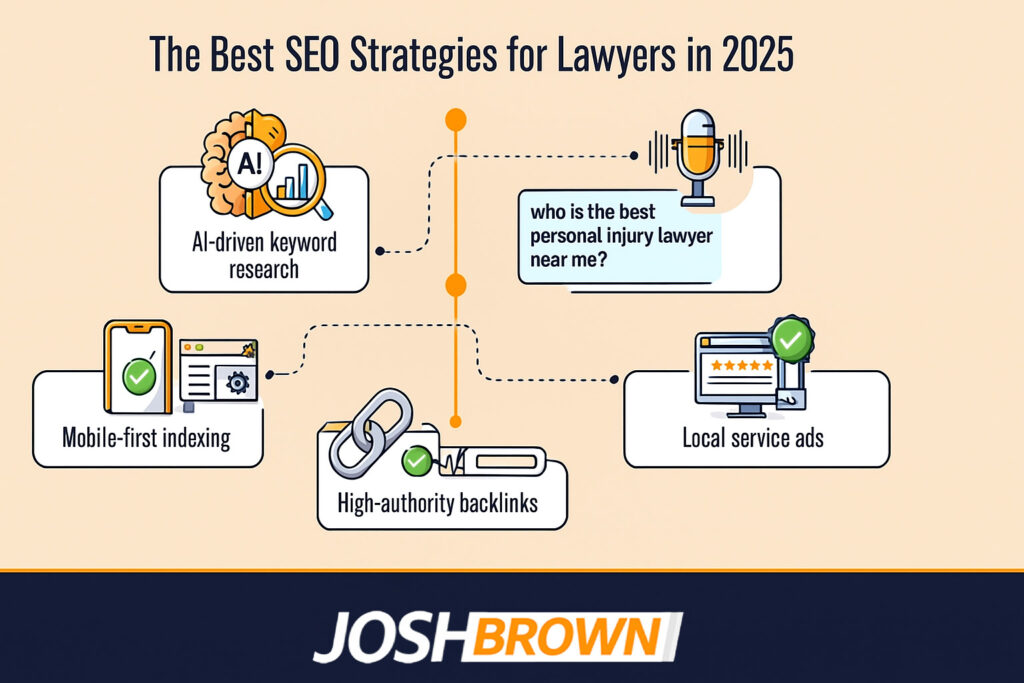
The best SEO strategies for lawyers in 2025 are AI-driven keyword research, voice search optimization, mobile-first indexing, and local service ads.
Listed below are the 5 main strategies.
- AI-driven keyword research: Use clustering tools to uncover high-value legal terms and intent-based queries.
- Voice search optimization: adapt content for conversational queries like “Who is the best personal injury lawyer near me?”
- Mobile-first indexing: design responsive websites that meet Google’s mobile performance and usability standards.
- Local service ads: run Google LSAs to capture immediate, high-intent local leads.
- High-authority backlinks: build credibility through links from legal directories, guest posts, and trusted industry sites.
Why On-Page SEO Matters for Law Firms and Attorneys?
On-page SEO matters for law firms’ attorneys because it improves rankings, enhances readability, and delivers client-focused content that drives conversions. Optimized headings, keywords, and internal links help law firm websites rank higher and engage users effectively. A 2024 study by Ravi S. Patel et al., titled “Exploring the Effectiveness of On-Page SEO for Webpage Ranking”, found that strong on-page SEO boosts search visibility and traffic.
How does SEO for solicitors differ from SEO for other businesses?
SEO for solicitors differs from SEO for other businesses because it focuses on legal-specific keywords, compliance with advertising rules, and high E-E-A-T standards. Unlike e-commerce or B2B SEO, solicitor SEO prioritizes local intent searches such as “solicitor consultation near me” and requires strict adherence to bar regulations on legal content. Legal SEO emphasizes authority, trust, and accuracy, ensuring that law firms rank while maintaining compliance and credibility in highly regulated markets.
What are the top SEO keywords for lawyers and solicitors?
Top SEO keywords for lawyers and solicitors are lawyer near me, personal injury attorney, family solicitor, criminal defense lawyer.
Listed below are 5 common examples.
- Lawyer near me
- Personal injury attorney
- Family solicitor
- Criminal defense lawyer
- Employment attorney
How does link building impact an attorney’s website SEO?
Link building impacts an attorney’s website SEO by increasing authority, improving rankings, and driving referral traffic from credible sources. Strategies such as guest posting on legal blogs, gaining citations from local listings, and being featured in legal directories strengthen domain trust.
Marketers mention how link building boosts an attorney’s website SEO through external validation that signals relevance to search engines. Strong backlink profiles help law firms compete in saturated markets by improving visibility and attracting qualified leads.