

Josh Brown
CEO & Founder, Josh Brown Consulting
SEO for lawyers is a client-acquisition system that improves a law firm website’s visibility in Google Search, organic search results, the Local Pack, and Google Business Profile listings. Legal search intent connects prospective clients with practice-area pages that match a defined legal problem, location, and service need. Technical SEO gives Google access to crawl, render, index, and evaluate the website. Legal content answers client questions and explains available representation. Backlinks, online reviews, attorney credentials, and consistent business information build authority and local prominence.
Clio reports that 57% of clients searched independently for a lawyer, and 16% used independent research alongside referrals. Law firm SEO services range from several thousand dollars to $10,000–$15,000+ per month based on market competition, geography, content production, backlink work, and technical scope. Google states that established SEO practices remain relevant for AI Overviews and AI Mode.
Law firm SEO operates across three performance levels. Visibility means the firm appears for relevant legal searches. Qualification means the page attracts users with the correct legal need, jurisdiction, and service intent. Acquisition means the visit produces a qualified call, consultation request, or signed matter.
Rankings support the process but do not represent the final business objective. Qualified clients and retained cases measure commercial performance. Legal SEO differs from generic SEO because practice area, geography, attorney experience, professional trust, advertising rules, and jurisdiction-specific accuracy shape every strategy.
Josh Brown helps law firms improve search rankings by aligning technical SEO, legal content, local visibility, website authority, and client search intent with the firm’s practice areas and growth goals. Contact Josh Brown for law firm SEO audits, ranking strategy, content planning, and organic client acquisition support. Josh Brown maps legal keywords to practice-area pages, reviews crawlability and indexing, strengthens internal linking, improves local search signals, evaluates backlink quality, tracks ranking movement, measures lead attribution, and connects organic visibility with consultations, signed cases, and marketing return.
What is Law Firm SEO?
Law firm SEO is the process of improving a law firm website and local search presence so potential clients find legal services in unpaid search results. Technical optimization improves website access. Legal content answers client queries. Local signals support geographic visibility. Website authority strengthens rankings. Performance measurement tracks qualified traffic, calls, and consultation requests.
Why Does Law Firm SEO Matter For Attorneys?
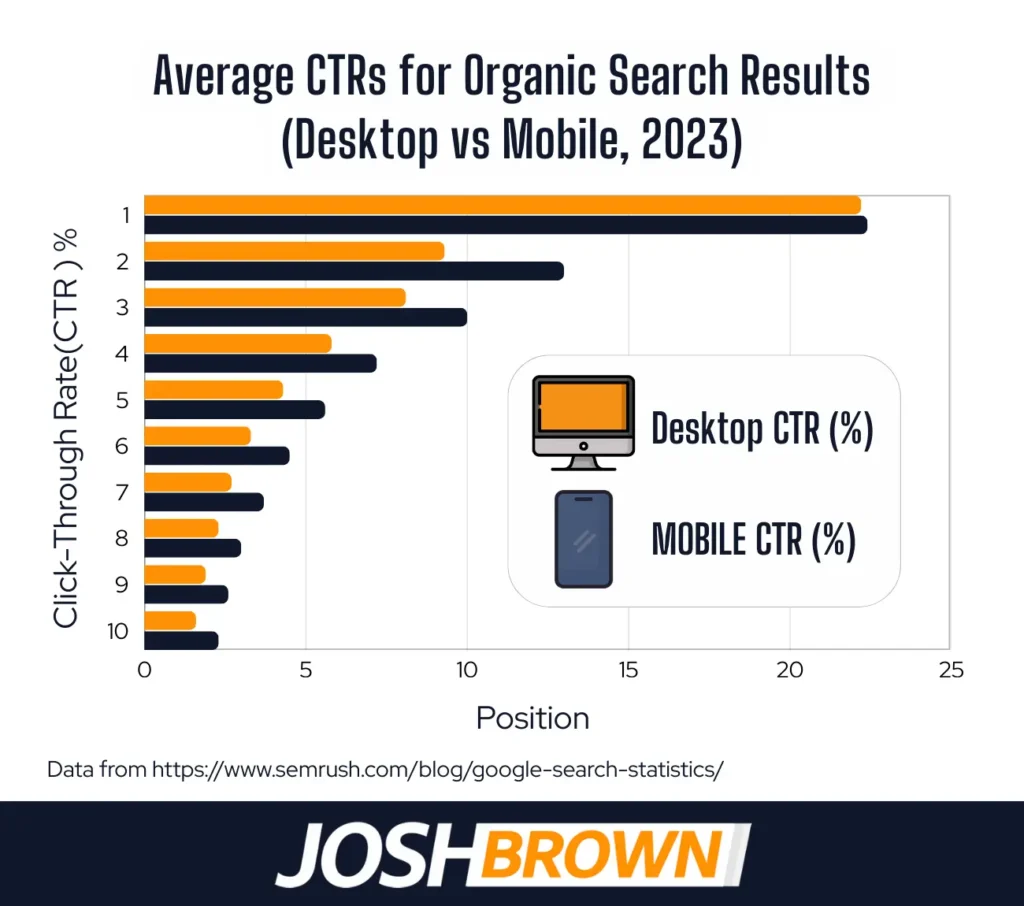
Law firm SEO matters for attorneys because it increases search visibility, supports client discovery, and attracts qualified traffic from people seeking legal services. High-ranking practice pages build trust. Local search results connect attorneys with nearby prospects. Organic visibility supports long-term client acquisition. SEO also reduces dependence on paid advertising and keeps legal services visible throughout the client decision process.
How Does Law Firm SEO Differ From General Business SEO?
Law firm SEO differs from general business SEO in terms of strict ethics, content precision, and user urgency. Legal SEO follows professional advertising standards set by state bar associations, requiring disclaimers and barring misleading claims, unlike broader promotional business SEO. User intent in legal SEO reflects high-stakes, urgent searches for legal help, compared to casual product or service research in other industries.
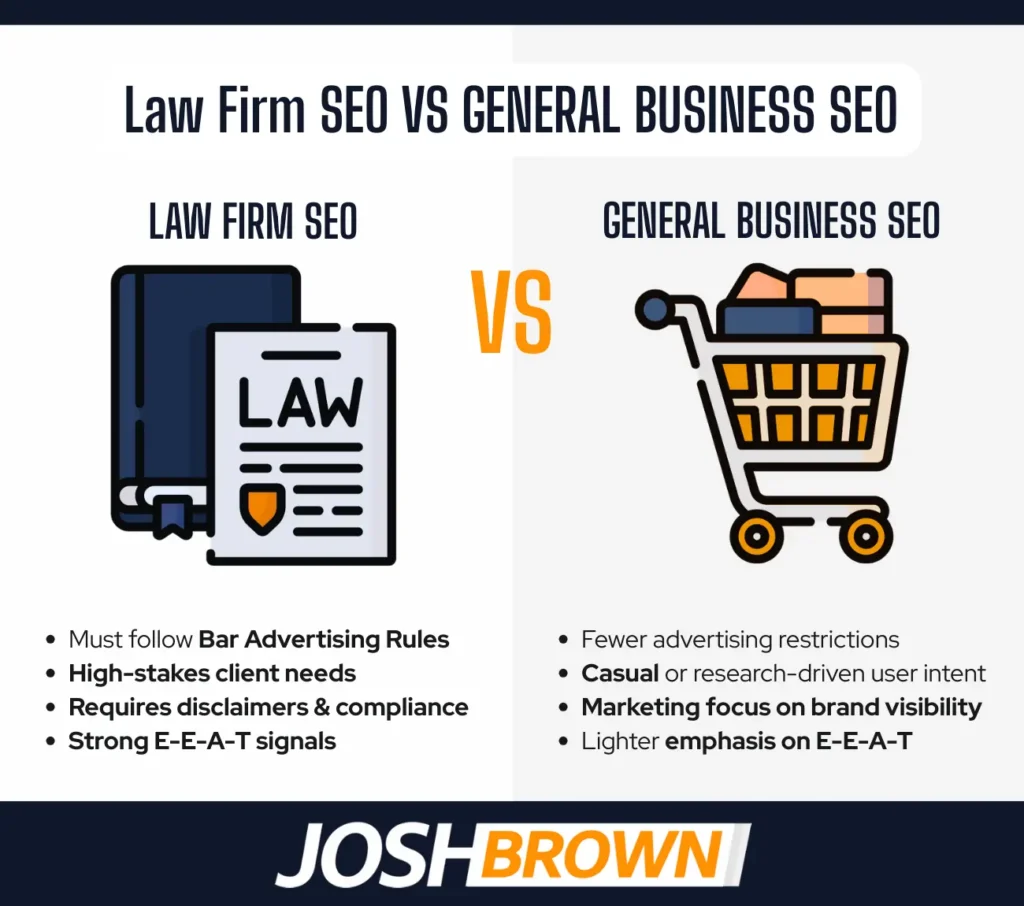
According to a report by LawLytics, titled How to View Traffic Sources (no formal publication year provided, published online in their knowledge base), law firms relying primarily on content marketing should expect 70–80% of their website traffic to come from search engine or direct traffic sources. Professional service SEO demands stronger E-E-A-T signals than general brand marketing.
What Are the Main Types of Law Firm SEO?
The main types of law firm SEO are local SEO, on-page SEO, off-page SEO, and reputation SEO. Each type improves a different part of a law firm’s search visibility, website performance, and client acquisition process.
Listed below are the 6 main types of law firm SEO.
- Local SEO: Local SEO improves a law firm’s visibility for location-based searches. It covers Google Business Profile optimization, local keywords, map rankings, reviews, citations, and location pages.
- On-Page SEO: On-page SEO connects each webpage with a legal service, location, and search intent. It covers title tags, meta descriptions, headings, internal links, URLs, image text, and keyword placement.
- Technical SEO: Technical SEO improves how search engines crawl, render, and index a law firm website. It covers website speed, mobile usability, HTTPS, structured data, sitemaps, redirects, crawl errors, and Core Web Vitals.
- Content SEO: Content SEO uses legal information to answer prospective clients’ search queries. It includes practice-area pages, legal guides, FAQs, case studies, attorney biographies, and blog articles.
- Off-Page SEO: Off-page SEO builds authority through signals published outside the law firm website. It covers backlinks, legal directories, professional associations, news mentions, sponsorships, digital PR, and guest contributions.
- Reputation SEO: Reputation SEO manages public feedback and branded search results connected to the law firm. It covers review acquisition, review responses, directory accuracy, attorney profiles, branded content, and negative-result management.
1. Local SEO
Local SEO improves a law firm’s visibility for location-based searches. These searches include terms such as “personal injury lawyer in Miami” or “divorce attorney near me.”
Local SEO for lawyers covers Google Business Profile optimization, local keywords, map rankings, location pages, client reviews, and business citations. Consistent law firm names, addresses, and phone numbers support local search accuracy.
2. On-Page SEO
On-page SEO optimizes the content and HTML elements on each law firm website page. The process connects each page with a defined legal service, location, and search intent.
On-page SEO covers title tags, meta descriptions, headings, internal links, image text, URL structure, and keyword placement. A personal injury page targets personal injury queries. A criminal defence page targets criminal law queries.
3. Technical SEO
Technical SEO improves the way search engines access, crawl, render, and index a law firm website. Technical performance also affects user experience and conversion rates.
Technical SEO covers website speed, mobile usability, HTTPS security, structured data, XML sitemaps, crawl errors, duplicate pages, redirects, and Core Web Vitals. A technically sound website helps search engines identify practice-area pages, attorney profiles, office locations, and legal resources.
4. Content SEO
Content SEO uses legal information to answer prospective clients’ search queries. The content establishes topical relevance across practice areas, legal problems, procedures, costs, deadlines, and case expectations.
Content SEO includes practice-area pages, service pages, legal guides, frequently asked questions, case studies, attorney biographies, and blog articles. Each content asset targets a defined query and guides the reader toward consultation or intake.
5. Off-Page SEO
Off-page SEO builds the law firm’s authority through signals published outside its website. Search engines use these signals to assess the firm’s prominence and credibility.
Off-page SEO covers backlinks, legal directory profiles, digital public relations, professional associations, local sponsorships, news mentions, and guest contributions. Links from relevant legal, government, academic, and local websites carry greater contextual value than unrelated links.
6. Reputation SEO
Reputation SEO manages the search results and public feedback connected to the law firm’s name. Prospective clients often examine ratings, reviews, attorney profiles, and branded search results before making contact.
Reputation SEO covers review acquisition, review responses, branded content, directory accuracy, attorney profile optimization, and negative-result management. Strong review signals support local visibility and client trust.
How Does Law Firm SEO Work?
Law firm SEO works by connecting search demand with website crawlability, legal relevance, authority, organic visibility, and lead conversion. Prospective clients create search demand when legal problems prompt searches for attorneys, practice areas, and local services. Search engines crawl and index the law firm website, evaluate how closely each page matches the query, assess the website’s authority, and rank relevant pages in search results. Strong visibility then brings qualified visitors into consultation and intake pathways.
Listed below are the 5 steps Law firm SEO works.
- Crawl and Index the Website: Search engines crawl the law firm website through internal links, XML sitemaps, and accessible navigation. Crawlers process legal pages, structured data, and indexing directives. The search index stores eligible practice-area pages, attorney profiles, location pages, and legal guides.
- Match Legal Search Intent: Search intent connects each legal query with the page that best answers the request. Legal guides answer informational queries, practice-area pages present legal services, and location pages target geographic searches. Accurate intent matching connects indexed content with relevant prospective clients.
- Build Practice-Area and Location Relevance: Practice-area content connects the law firm with legal services, case types, procedures, and client concerns. Location content connects those services with cities, counties, courts, and office locations. Internal links, local citations, and Google Business Profile data strengthen these entity relationships.
- Establish Trust and Website Authority: Attorney credentials, legal citations, client reviews, secure pages, and transparent firm information establish trust. Backlinks from legal publications, universities, bar associations, and local institutions establish external authority. Strong relevance and authority increase the page’s eligibility for prominent organic visibility.
- Convert Organic Visitors Into Qualified Leads: Search visibility brings prospective clients to relevant law firm pages. Consultation forms, tracked calls, live chat, scheduling tools, and calls to action connect visitors with the intake process. Analytics connect keyword rankings and organic traffic with consultations, retained cases, and revenue.
1. Crawl and Index the Website
Search engines must access a law firm website before any page appears in organic search results. Search demand creates ranking opportunities, but crawlability allows search engines to discover those opportunities. Search crawlers follow internal links, read page content, process structured data, and add eligible pages to the search index.
A website developer supports crawlability through clean navigation, XML sitemaps, internal linking, mobile compatibility, HTTPS, canonical tags, and accurate indexing directives. Broken links, blocked resources, duplicate pages, and slow server responses restrict discovery. Effective crawlability connects legal search demand with content stored across practice-area pages, attorney profiles, location pages, and legal guides.
2. Match Legal Search Intent
Indexed content must satisfy the purpose behind each legal query. Search intent explains whether a person seeks legal information, an attorney, a local office, a case evaluation, or guidance about a legal process. A query such as “car accident settlement timeline” reflects informational intent. A query such as “car accident lawyer near me” reflects local transactional intent.
Law firm SEO assigns each query to the page format that best satisfies the request. Legal guides answer informational searches. Practice-area pages explain representation. Location pages connect services with a geographic market. Consultation pages support immediate contact. Accurate intent matching turns crawlable content into relevant content.
3. Build Practice-Area and Location Relevance
Relevance shows search engines that a law firm provides the legal service requested in the location connected to the search. Practice-area pages describe legal services, case types, statutes, procedures, client concerns, and attorney support. Location pages connect those services with cities, counties, courts, and office locations.
Internal links strengthen relationships between legal topics. A personal injury page links to car accident, truck accident, wrongful death, and local attorney pages where the relationship supports the user journey. Consistent business information, Google Business Profile data, local citations, and geographic content strengthen location relevance. Search engines use these signals to connect indexed pages with suitable legal queries.
4. Establish Trust and Website Authority
Authority determines whether a relevant law firm website deserves prominent search visibility. Search engines assess attorney credentials, editorial accuracy, original legal analysis, client reviews, business information, website security, and backlinks from reputable sources.
Attorney biographies establish professional experience and jurisdictional context. Editorial policies establish content accountability. Legal citations support factual accuracy. Backlinks from bar associations, universities, media organizations, legal publications, and community institutions strengthen external authority. Relevant content earns stronger visibility when trustworthy website and off-page signals support the information.
5. Convert Organic Visitors Into Qualified Leads
Organic visibility brings prospective clients to the law firm website, but conversion turns search traffic into business outcomes. Each page needs a direct path from the visitor’s legal concern to the firm’s intake process. Consultation forms, tracked phone numbers, live chat, appointment scheduling, and clear calls to action support that transition.
Conversion quality depends on alignment between the search query, landing page, legal service, location, and intake offer. A visitor searching for a local divorce attorney needs family-law information, jurisdictional relevance, attorney credentials, and a direct consultation option. Analytics connect rankings and organic traffic with calls, form submissions, consultations, retained cases, and revenue.
The complete relationship follows a measurable sequence: search demand identifies the opportunity, crawlability gives search engines access, relevance matches the legal query, authority supports trust, visibility attracts prospective clients, and conversion produces qualified leads.

What Are the Most Effective Law Firm SEO Strategies?
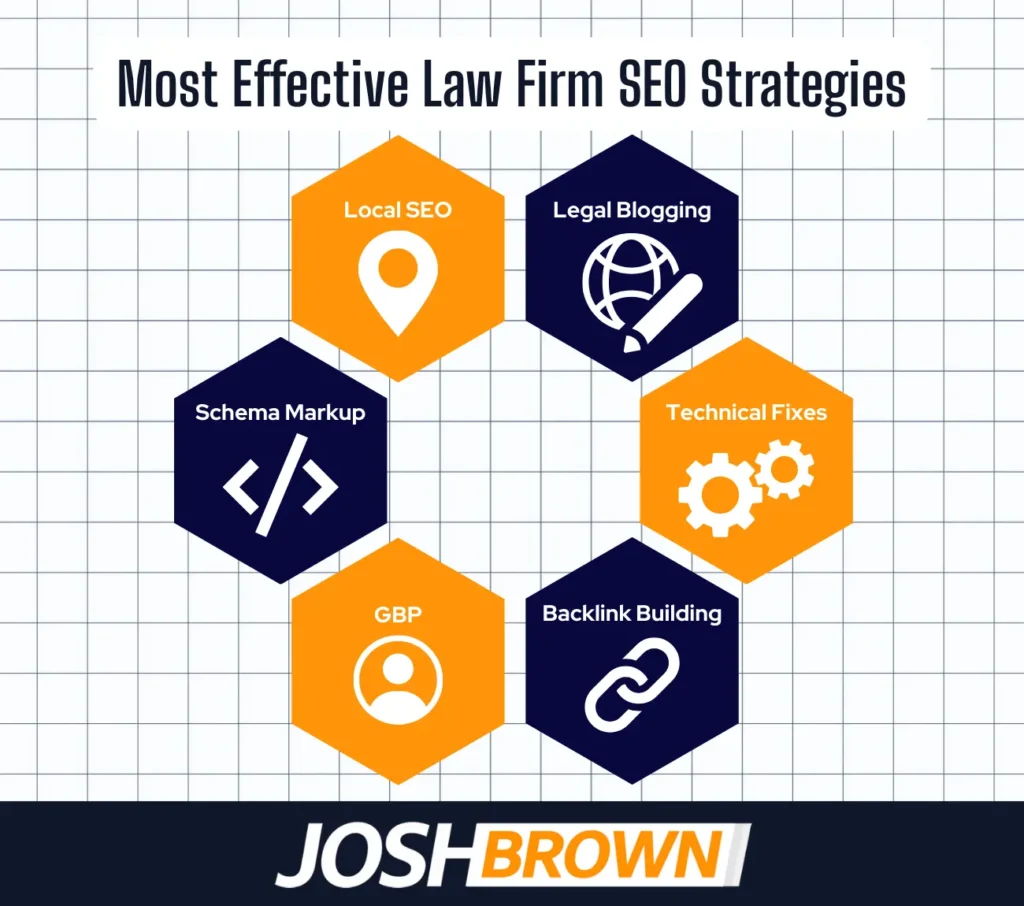
The most effective law firm SEO strategies include targeting local searches, publishing legal blogs, fixing technical issues, building quality backlink and brand mentions , optimizing Google Business Profiles, and applying structured schema.
Listed below are 6 most effective law firm SEO strategies today.
-
- Local SEO: strengthens map pack rankings through reviews, NAP consistency, and local directory citations.
-
- Legal Blogging: supports search intent with practice area updates and client-focused FAQs.
-
- Technical Fixes: improves site speed, mobile usability, and crawlability for stronger rankings.
-
- Backlink Building: earns links from trusted legal sources to build domain authority.
-
- Google Business Optimization: secures local search presence through profile verification and review signals.
-
- Schema Markup: helps search engines interpret legal services through structured data.
What Are the Important SEO Ranking Factors for Law Firms?
The important SEO ranking factors for law firms are content relevance, topical authority, website performance, mobile usability, local prominence, and demonstrable legal expertise. Google uses multiple page-level and site-level signals rather than one fixed ranking factor. Each signal helps Google assess whether a law firm website provides a relevant, reliable, and accessible answer to a legal search.
Listed below are the 5 important SEO ranking factors for law firms.
- Content Relevance and Search Intent: Content relevance connects a legal query with the correct practice area, location, legal issue, and page purpose. Title tags, headings, jurisdictional context, internal links, and original legal analysis help Google match the page with informational, commercial, or local transactional intent.
- Backlink Quality and Topical Authority: Backlink quality connects a law firm website with reputable legal, academic, media, and local sources. Practice-area content clusters, internal links, and relevant earned links establish topical authority and strengthen search visibility.
- Website Performance and Mobile Usability: Website performance determines how quickly users access legal content, attorney profiles, forms, and contact options. Core Web Vitals, responsive layouts, readable text, functional forms, and tappable phone numbers support mobile usability and conversion.
- Local Relevance and Prominence: Local relevance connects a law firm with searches involving cities, counties, courts, service areas, and “near me” terms. Google Business Profile data, staffed office pages, reviews, local citations, and community backlinks strengthen geographic relevance and local visibility.
- Trust, Experience, and Legal Expertise: Trust signals connect legal information with qualified attorneys, verifiable credentials, and accountable law firm entities. Attorney biographies, bar admissions, cited statutes, review dates, office details, and editorial standards strengthen legal authority and user confidence.
1. Content Relevance and Search Intent
Content relevance measures how closely a law firm page matches the legal problem, service, location, and objective expressed in a search query. A page targeting “car accident lawyer in Dallas” needs to discuss car accident representation, Texas claim procedures, local service coverage, attorney support, and consultation options. General personal injury content provides weaker query alignment.
Search intent identifies the result format that the searcher expects. Informational searches require legal explanations. Commercial searches require service comparisons or attorney-selection guidance. Local transactional searches require practice-area pages, location information, attorney credentials, and contact options. Each page needs one defined search purpose.
A law firm establishes relevance through descriptive title tags, direct headings, legal terminology, jurisdictional context, internal links, and complete answers. Original legal analysis strengthens the page. Rewritten competitor content produces limited information gain. Google states that its systems prioritize helpful, reliable, people-first content that provides original information, substantial topic coverage, and value beyond competing pages.
2. Backlink Quality and Topical Authority
Backlink quality reflects the relevance, reputation, and editorial value of websites linking to a law firm. A link from a bar association, university, court resource, recognized legal publication, news outlet, or community organization carries stronger contextual value than hundreds of unrelated directory links.
Google uses links to discover pages and assess page relevance. Descriptive anchor text also helps Google interpret the subject of the destination page. Link schemes, purchased placements, automated directory submissions, and irrelevant guest posts create weaker signals and expose the website to spam-policy risks.
Topical authority develops when a law firm covers a practice area through a connected body of accurate content. A personal injury law firm builds subject depth through pages about car accidents, truck accidents, medical evidence, insurance disputes, damages, claim deadlines, and local court procedures. Internal links establish relationships between these pages. External citations and earned backlinks validate the firm’s subject presence.
3. Website Performance and Mobile Usability
Website performance affects how quickly and smoothly prospective clients access legal information. Slow loading, delayed form responses, unstable page elements, and intrusive pop-ups create friction. Visitors often abandon a page before reading the attorney’s qualifications or submitting an enquiry.
Google evaluates real-world page experience through Core Web Vitals. Largest Contentful Paint measures loading performance and targets 2.5 seconds or less. Interaction to Next Paint measures responsiveness and targets less than 200 milliseconds. Cumulative Layout Shift measures visual stability and targets a score below 0.1. These metrics support search performance and user satisfaction, but perfect scores do not guarantee first-page rankings.
Mobile usability also affects indexing and ranking because Google uses the mobile version of website content for mobile-first indexing. A law firm website needs readable text, responsive layouts, accessible navigation, functional forms, tappable phone numbers, secure HTTPS connections, and consistent desktop-to-mobile content.
4. Local Relevance and Prominence
Local relevance connects a law firm with searches involving a city, county, state, neighbourhood, court district, or “near me” modifier. Google primarily evaluates local results through relevance, distance, and prominence. Relevance measures how closely the firm matches the query. Distance measures proximity to the searcher. Prominence measures how established and recognized the firm appears.
A complete Google Business Profile supports local relevance. The profile needs the correct law firm name, address, phone number, practice category, office hours, website link, service information, photographs, and service area. The website needs matching contact information and a distinct page for each staffed office.
Reviews, local backlinks, legal directory listings, news mentions, and community citations support prominence. Google states that review quantity, positive ratings, and links from other websites contribute to local ranking. Location pages also need original jurisdictional information. Replacing city names across duplicate templates provides little local value.
5. Trust, Experience, and Legal Expertise
Trust signals help Google and prospective clients determine whether legal information comes from an accountable source. Law firm websites address subjects that affect finances, legal rights, safety, family relationships, and personal welfare. These subjects require accurate sourcing and identifiable professional oversight.
Attorney biographies need to present bar admissions, education, practice focus, professional experience, awards with issuing organizations, publications, and relevant case experience. Legal articles need identifiable authors, review dates, cited statutes, jurisdictional limitations, and editorial responsibility. The website also needs transparent office details, contact information, privacy policies, and secure data handling.
Google describes experience, expertise, authoritativeness, and trustworthiness as E-E-A-T. E-E-A-T is not one isolated ranking factor. Google’s systems use a combination of signals that identify these qualities. Trust receives the strongest emphasis, and stronger E-E-A-T alignment receives greater weight for subjects that affect health, financial stability, safety, or social welfare.
A law firm strengthens trust when qualified attorneys create or review legal content, factual claims include reliable sources, and each page accurately represents the firm’s services. Demonstrated legal knowledge supports authority. Consistent professional information supports credibility. Accurate legal guidance supports organic visibility and qualified-client acquisition.
How Should a Law Firm Build a Technical SEO Foundation?
A law firm builds a technical SEO strategy to strengthen site speed, mobile-friendliness, schema markup, crawl error fixes, HTTPS Security, XML Sitemaps, and align with ranking factors.
Listed below are 6 key components of a law firm building a technical SEO Foundation.
-
- Site Speed: Site speed improves load times for visitors and search engines.
-
- Mobile-Friendliness: Mobile-friendliness supports consistent viewing across devices.
-
- Schema Markup: Schema markup helps Google understand legal pages.
-
- Crawl Error Fixes: Crawl error fixes maintain index health.
-
- HTTPS Security: HTTPS secures user data.
-
- XML Sitemaps: XML sitemaps guide search crawlers for better indexing.
How Should a Law Firm Structure Its Website for SEO?
A law firm should structure its website for SEO through practice-area pages, location pages, internal links, attorney profiles, and trust pages. This legal site structure helps search engines crawl related content and helps prospective clients find relevant services.
Listed below are the 6 steps Law firms structure its website for SEO.
- Practice-Area Page Structure: Each legal service needs a dedicated practice-area page with clear headings, service details, jurisdictional context, and consultation options. Supporting pages should connect related case types and legal questions with the parent practice-area page.
- Location and Service-Area Structure: Location pages connect legal services with cities, counties, courts, and staffed office locations. Each page needs original geographic information instead of duplicated content with substituted city names.
- Legal Content Hubs: Legal content hubs organize practice-area pages, guides, FAQs, statutes, procedures, and client questions around one legal topic. The hub establishes topical relationships and guides users from informational content to legal services.
- URL Hierarchy and Breadcrumbs: Clean URLs show the relationship between practice areas, locations, and supporting content. Breadcrumbs help users and search engines identify each page’s position within the law firm website.
- Internal Linking Between Legal Topics: Internal links connect related services, legal guides, location pages, and attorney profiles. Descriptive anchor text explains the relationship between the source page and destination page.
- Attorney Profiles and Trust Pages: Attorney profiles present credentials, bar admissions, education, experience, awards, and practice focus. Trust pages provide office information, reviews, case results, editorial policies, privacy details, and contact information.
How Do Law Firms Improve Local SEO Rankings?
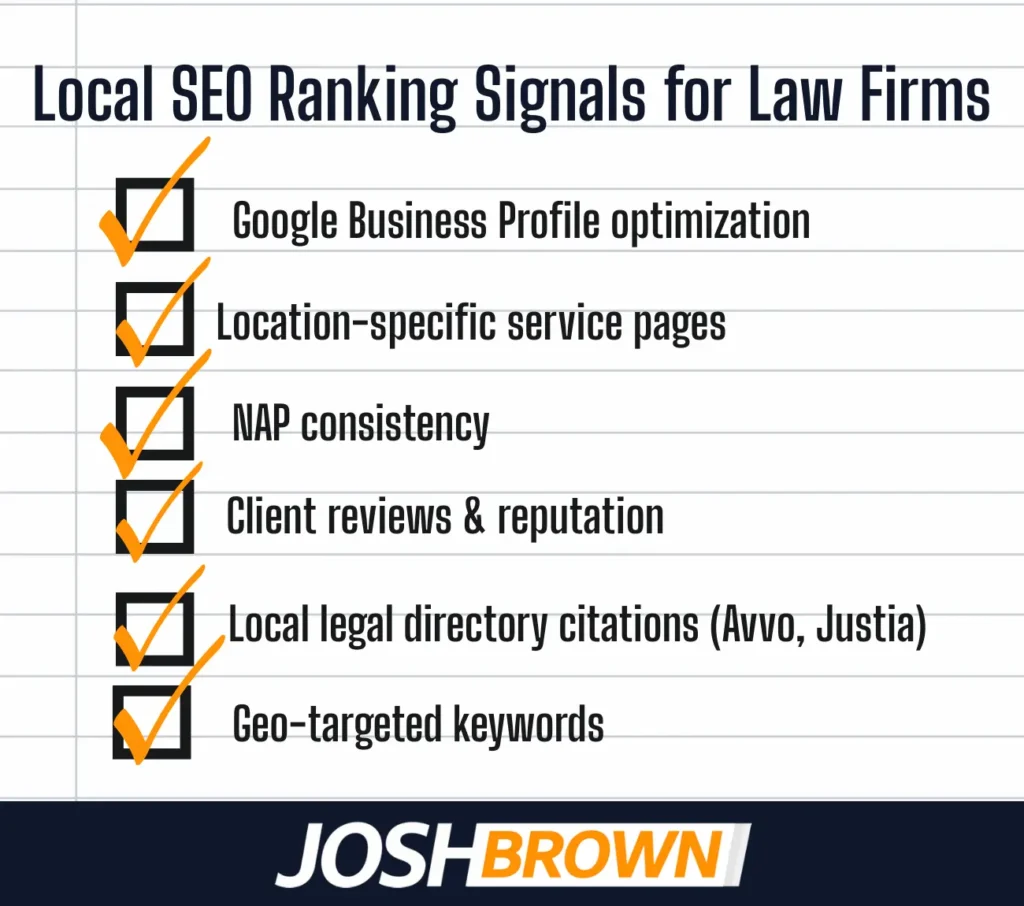
Law firms improve local SEO ranking by strengthening relevance, geographic accuracy, and prominence across Google Business Profile, the law firm website, client reviews, local citations, and backlinks. Google states that local rankings depend mainly on relevance, distance, and prominence. Relevance measures how closely the firm matches the legal search. Distance measures the firm’s proximity to the searcher. Prominence measures how established the firm appears across reviews, links, directories, and other online sources.
Listed below are the 6 main steps law firms improve local SEO rankings.
- Optimize the Google Business Profile: A complete Google Business Profile connects the law firm with legal services, office locations, business hours, photographs, and contact details. Accurate categories and service information strengthen relevance for local legal searches.
- Build Accurate Legal Citations: Legal citations publish the firm’s name, address, and phone number across legal directories and local business platforms. Consistent business information helps Google verify the law firm’s identity and geographic location.
- Generate and Respond to Client Reviews: Client reviews connect past service experiences with the law firm’s public reputation. Review quantity, rating quality, recency, and professional responses support prominence and client trust.
- Create Useful Location Pages: Location pages connect specific legal services with cities, counties, courts, and service areas. Original jurisdictional information strengthens geographic relevance and prevents duplicate location content.
- Build Local Backlinks and Community Signals: Local backlinks connect the law firm website with news outlets, community organizations, chambers of commerce, universities, and local institutions. Relevant local mentions strengthen authority and geographic prominence.
- Track Local Pack Visibility: Local rank tracking measures the law firm’s Google Maps and Local Pack positions across different search locations. Google Business Profile data and local SEO platforms track views, calls, directions, reviews, and ranking movement.
How Do Law Firms Build Content and Backlinks?
Law firms build content and backlinks by identifying legal search demand, organizing related pages, earning editorial links, and measuring search and lead performance.
Listed below are the 12 main content and backlink strategies for law firms.
- Identify Legal Search Demand: Legal keyword research identifies client questions, practice-area terms, location modifiers, commercial searches, and transactional queries. Search intent assigns each query to a legal guide, service page, location page, or consultation page.
- Build Practice-Area Content Clusters: A parent practice-area page connects with case-type pages, legal guides, attorney profiles, and location pages. Internal links establish the relationship between the practice area, legal issue, attorney service, and consultation pathway.
- Publish Attorney-Led Legal Content: Named attorneys write, review, or approve legal resources for accuracy and jurisdictional relevance. Each page includes authorship, review dates, legal sources, applicable limitations, and original explanations.
- Create Original Linkable Assets: Law firms publish research, court-data reports, deadline guides, calculators, checklists, glossaries, and legal process tools. Original resources give journalists, universities, associations, and publishers a reason to cite the law firm website.
- Use Real Legal Experience: Attorneys turn recurring client questions, evidence problems, filing mistakes, and procedural issues into practical content. Anonymous or composite examples protect client confidentiality while adding professional context.
- Earn Backlinks Through Digital PR: Attorneys provide commentary on legislation, court decisions, regulatory changes, and public legal issues. Independent publishers link to the attorney, law firm, or supporting legal resource when the contribution adds value.
- Build Local and Professional Backlinks: Bar associations, universities, chambers of commerce, legal publications, community groups, and local media connect the firm with its practice area and geographic market. Memberships, seminars, research partnerships, scholarships, and community programs create legitimate linking opportunities.
- Conduct Targeted Content Outreach: Law firms contact publishers whose audiences match the subject of a legal resource. Effective outreach explains the relationship, presents a useful fact or tool, and links directly to the relevant page.
- Strengthen Content With Internal Links: Internal links connect articles with practice-area pages, location pages, attorney profiles, and related legal guides. Descriptive anchor text explains the destination and prevents important pages from becoming isolated.
- Avoid Manipulative Link Acquisition: Purchased ranking links, automated directories, private blog networks, mass guest posts, and excessive link exchanges create spam-policy risks. Editorial links from relevant sources provide stronger legal and geographic context.
- Update and Consolidate Existing Content: Law firms revise outdated laws, deadlines, attorney details, broken links, and overlapping pages. Consolidation directs internal links and backlinks toward one accurate resource and reduces keyword cannibalization.
- Measure Content and Backlink Performance: Google Search Console, analytics platforms, backlink tools, call tracking, and CRM data measure impressions, rankings, visits, leads, signed cases, referral traffic, and referring domains. Performance depends on link relevance, content visibility, qualified enquiries, and retained-client revenue rather than backlink quantity alone.
How Long Does SEO Take for a Law Firm?
Law firm SEO usually takes 3–6 months to produce measurable improvements and 6–12 months to generate stronger organic rankings, qualified website traffic, and consistent legal leads. The exact SEO timeline depends on website age, market competition, practice area, location, technical performance, content quality, backlink profile, and previous search engine optimization work.
Google Search evaluates a law firm website through crawling, indexing, content relevance, website authority, user experience, and local search signals. Technical SEO improves website access and page performance. Legal content targets client search intent. Backlinks build website authority. Local SEO connects the law firm with location-based searches. A Google Business Profile supports visibility in Google Maps and local search results.
An empirical study by Ahrefs titled How Long Does It Take to Rank in Google? in 2025 found that only 1.74% of newly published pages reached Google’s top 10 within one year. The study also found that 72.9% of top-10 pages were more than three years old. These findings show that established authority and sustained optimization influence ranking progress.
Google states that search changes take effect within a few hours or several months. Google also recommends waiting several weeks before assessing the effect of SEO work.
SEO differs from paid search advertising. Paid advertising buys immediate visibility. Law firm SEO builds cumulative organic visibility through content, technical improvements, local optimization, and authority development.
How Much Does Law Firm SEO Cost?
Law firm SEO usually costs $2,500–$15,000+ per month in the United States. Smaller firms in less competitive markets often sit near the lower end. Personal injury firms, multi-location firms, and firms in major cities often sit near the upper end. General SEO agency retainers average about $3,209 per month, but legal SEO often costs more because law firms compete for high-value local and practice-area searches.
The final price depends on the campaign scope. Website condition affects technical costs. Practice-area competition affects content and authority costs. Location count affects local SEO costs. Reporting requirements affect analytics and attribution costs.
Listed below are the 8 main pricing models and factors that determine law firm SEO costs.
- Monthly Retainers: Monthly retainers fund ongoing technical SEO, content planning, on-page optimization, local SEO, link acquisition, and reporting. Small law firms often spend $2,500–$5,000 per month, competitive firms spend $5,000–$10,000, and large or multi-location firms spend $10,000–$15,000+. Each agreement needs defined deliverables for pages, content, locations, technical work, outreach, meetings, and reports.
- Project-Based Audits: Project-based audits identify technical problems, content gaps, search-intent conflicts, local SEO weaknesses, and backlink risks. Small website audits often cost $500–$2,500, larger audits cost $2,500–$7,500, and migrations or full website audits cost $5,000–$30,000. The audit provides recommendations, while developers, content teams, and SEO specialists implement the repairs.
- Content Costs: Legal content costs depend on research depth, page length, jurisdiction, attorney review, and search competition. A 2026 survey of 500 freelance writers reported an average rate of $0.42 per word, with many 1,500-word articles costing $250–$399. Practice-area pages, location pages, legal guides, attorney biographies, FAQs, case-result pages, and content updates often cost more because legal accuracy requires source verification and professional review.
- Link Acquisition and Digital PR: Link acquisition and digital PR earn mentions from legal publications, journalists, universities, professional groups, and local organizations. Digital PR retainers often range from $5,000–$10,000 per month, while managed placements cost about $375–$1,500+ per link. Law firms pay for research, media outreach, commentary, data analysis, and campaign management rather than organic rankings themselves.
- Local SEO: Local SEO covers Google Business Profile management, review development, legal citations, location pages, local backlinks, and map-ranking analysis. One-location campaigns often cost $500–$2,000 per month, while competitive or multi-location campaigns reach $3,000+ per month. Each office needs accurate business information, original location content, review management, and local performance tracking.
- Multi-Location Complexity: Multi-location SEO costs more because each office represents a separate geographic market and competitor set. Each location needs its own Google Business Profile, location page, citations, reviews, call tracking, attorney information, and reporting. Shared systems reduce some production costs, but local research and reputation management increase with every market.
- Practice-Area Competition: Competitive practice areas require larger budgets because established law firms invest heavily in content, authority, local visibility, and conversion systems. Personal injury, criminal defence, family law, immigration, and mass tort campaigns often require broader service-page coverage, supporting articles, case evidence, attorney credentials, and relevant backlinks. Case value, competitor authority, and market density influence cost more than search volume alone.
- Reporting and Attribution: Reporting tracks rankings and visibility, while attribution connects organic search with calls, consultations, signed cases, and revenue. Advanced systems combine Google Search Console, analytics, call tracking, forms, CRM records, and intake outcomes. Law firms need to measure qualified leads, consultation bookings, signed clients, lead-to-client rates, cost per signed case, and organic-search revenue.
Is SEO for law firm services worth the investment?
Yes, SEO for law firm services is worth the investment for law firms aiming to grow organic case leads and protect their online reputation. Most remote law firm SEO services have shown that legal SEO provides steady ROI by lowering the cost per client over time and building long-term search visibility.
According to a report by BrightEdge titled “2019 Channel Share Report”, published in 2019, organic search accounts for approximately 53.3% of all website traffic across industries. This shows the significant role of SEO in driving web traffic, particularly for sectors like legal services, where establishing trust and visibility is crucial.
What Do Law Firm SEO Companies and Agencies Offer?
Law firm SEO companies and agencies offer content development, link building, citation management, and analytics reporting to support law firm marketing services. Law firm SEO agencies deliver practice-focused keyword research, technical site audits, legal content writing, Google Business Profile optimization, and monthly performance tracking for attorneys. These services help law firms grow organic visibility, rank on high-intent legal queries, and secure trusted positions in competitive search results.
The report highlights that organic search remains the dominant source of trackable web traffic, surpassing other channels such as paid search, display, and social media. Legal SEO supports sustainable growth by ranking high-intent keywords and reducing reliance on costly advertising.
How Does SEO Change by Law Firm Type?
The ways SEO changes by law firm type are search intent, keyword strategy, geographic targeting, content depth, conversion design, competition level, link acquisition, reputation signals, and client acquisition cycles. Technical SEO principles remain consistent, but content architecture, local SEO, backlinks, calls to action, and performance metrics must match the firm’s practice area, client journey, and revenue model.
Listed below are the 9 ways SEO changes by law firm type.
- Search Intent: Personal injury, criminal defense, and family law SEO target clients seeking immediate legal help. Estate planning, immigration, employment, and business law SEO often serve clients who research procedures, qualifications, costs, and long-term outcomes before contacting a firm.
- Keyword Strategy: Consumer-focused firms target service, problem, and location keywords such as “car accident lawyer near me” or “divorce attorney in Dallas.” Advisory firms target industry terms, legal processes, regulatory questions, and long-tail queries linked to professional expertise.
- Geographic Targeting: Personal injury, family law, criminal defense, and estate planning firms depend heavily on local SEO, Google Business Profile visibility, and city-based service pages. Immigration and business law firms often target wider state, national, international, or industry-specific markets.
- Content Depth: Urgent consumer practices need direct service pages, eligibility information, timelines, and consultation guidance. Business law, employment law, and complex immigration practices need detailed legal analysis, industry-specific resources, regulatory updates, and extended content clusters.
- Conversion Design: Criminal defense and personal injury websites need prominent phone numbers, short forms, live chat, and immediate case-evaluation options. Estate planning and business law websites need consultation scheduling, qualification forms, downloadable resources, and longer lead-nurturing pathways.
- Competition Level: Personal injury SEO often faces high competition because contingency-fee cases carry substantial financial value. Narrow estate planning, employment, immigration, or business law niches face different competition based on location, industry demand, case value, and attorney specialization.
- Link Acquisition: Consumer law firms benefit from local media, community organizations, legal directories, and public-safety resources. Business-focused firms benefit from industry publications, trade associations, universities, professional organizations, and research-based editorial links.
- Reputation Signals: Family law, criminal defense, personal injury, and estate planning clients often rely on reviews, case results, attorney profiles, and local recognition. Business and employment law clients place greater weight on industry experience, representative matters, publications, professional memberships, and organizational credibility.
- Client Acquisition Cycles: Urgent legal matters produce short acquisition cycles because clients often contact attorneys immediately. Advisory, estate planning, employment, and business matters involve longer evaluation periods, so SEO must support repeated visits, lead qualification, expertise assessment, and client lifetime value.
What Are the Current Law Firm SEO Trends?
The latest SEO for Law firm trends and best practices focus on trust AI-powered content Moderation, enhanced Google E-E-A-T signals, voice search optimization, Video SEO for legal topics, real-time local ranking updates, stronger semantic search integration, advanced search signals, and user-centered technology.
Listed below are the 6 latest SEO best practices for law firms in 2026.
-
- AI-Powered Content Moderation
-
- Enhanced Google E-E-A-T Signals
-
- Voice Search Optimization
-
- Video SEO for Legal Topics
-
- Real-Time Local Ranking Updates
-
- Stronger Semantic Search Integration
AI moderation protects accuracy and compliance. E-E-A-T boosts trust through proven expertise. Voice search meets conversational client queries. Video SEO engages and educates. Real-time local tracking monitors map pack ranks. Semantic search rewards topic-rich legal pages.
Frequently Asked Questions About SEO for Lawyers
Does SEO Work for Law Firms?
Yes, SEO works for law firms. SEO connects a law firm website with people searching for legal services. Organic visibility generates website visits. Relevant practice-area pages generate qualified inquiries. Local SEO generates calls from prospective clients within the firm’s service area.
Results depend on search competition, website quality, content accuracy, local visibility, backlinks, and conversion tracking. Rankings alone do not prove success. Retained clients and revenue show whether the SEO strategy supports the law firm’s business goals.
Can a Law Firm Do SEO In-House?
Yes, a law firm can manage SEO in-house. An internal legal marketing team can manage a Google Business Profile, publish legal content, update attorney profiles, perform keyword research, and monitor Google Search Console.
Competitive campaigns require technical SEO, content strategy, link acquisition, analytics, and ongoing website development. A law firm needs enough staff, software, expertise, and weekly production capacity to manage these functions. Smaller firms often manage basic tasks internally and outsource technical or specialist work.
Is Local SEO More Important Than Traditional SEO?
Yes, local SEO is more important for law firms that serve clients within a defined city, county, or state. Local SEO connects the firm with searches such as “divorce lawyer near me” or “criminal defense attorney in Chicago.” A Google Business Profile supports map visibility, calls, directions, reviews, and local consultations.
Traditional SEO still supports practice-area rankings, informational content, backlinks, and website authority. A law firm gains stronger coverage when local SEO and traditional organic SEO operate together.
How Often Should Legal Content Be Updated?
Legal content should be reviewed on a scheduled basis and updated whenever substantive information changes. Practice-area pages often require a review every 3–6 months. Evergreen legal articles require at least an annual review.
An immediate update is required when a statute, court rule, government procedure, filing requirement, deadline, fee, or agency policy changes. The legal reviewer verifies accuracy. The SEO team checks search intent, internal links, page titles, structured data, and conversion elements.
Should Every Practice Area Have Its Own Page?
Yes, each practice area that the law firm wants to promote should have its own page. A dedicated page connects one legal service with one defined search intent. The page explains the legal issue, eligible clients, applicable process, attorney experience, service location, and consultation route.
Related subcategories also need separate pages when the client problem and search intent differ. A personal injury website could separate car accidents, medical malpractice, wrongful death, and premises liability. Each page must contain distinct information rather than duplicated wording.
How Is Law Firm SEO Success Measured?
Law firm SEO success is measured through organic visibility, qualified inquiries, retained cases, revenue, and return on investment. Google Search Console measures impressions, clicks, search queries, and average positions. Google Analytics measures organic sessions, landing-page activity, and completed conversion actions.
Call tracking measures phone inquiries. Form tracking measures consultation requests. Intake software connects each lead with a signed case and case value. Rankings and traffic act as diagnostic metrics. Qualified leads, retained clients, acquisition cost, and revenue show business performance.