

Josh Brown
CEO & Founder, Josh Brown Consulting

Meta tags are HTML elements that provide search engines and users with structured information about a law firm website’s content. Meta titles act as the clickable headlines in search results, serving ranking and branding functions, while meta descriptions appear beneath titles as summaries that influence click-through rate (CTR).
A study by Brian Dean titled “We Analyzed 4 Million Google Search Results. Here’s What We Learned About Organic CTR” in 2023 found that title tags between 40 and 60 characters tend to perform best in terms of click-through rate (CTR), and that longer titles are more likely to be truncated in Google results.
Meta descriptions perform best at 150–160 characters, offering concise and persuasive content that improves visibility. The difference is clear: titles drive keyword relevance while descriptions shape user engagement.
Good SEO titles and descriptions use clarity, relevance, law-related keywords, and persuasive phrasing. Best practices for 2024–2025 include making each title unique, adding local keywords (e.g., “Divorce Lawyer in Chicago”), and avoiding duplication. Keyword placement must be balanced, with primary terms early in titles and secondary terms integrated naturally in descriptions.
Meta keywords are outdated for rankings, but remain useful internally. Editing meta descriptions in WordPress is straightforward with plugins like Yoast SEO or All in One SEO. Avoid mistakes like keyword stuffing, vague copy, or duplication.
Optimized titles and descriptions improve rankings, visibility, and client acquisition by aligning with search intent and boosting CTR, making them foundational to law firm marketing.
What Are Meta Tags for Law Firm SEO?
Meta tags for law firm SEO are snippets of HTML code that provide search engines and users with structured information about a website’s content. The most common include the meta title, which appears as the clickable headline in search results; the meta description, which summarizes page content; the robots tag, which tells search engines what to index; and the viewport tag, which ensures mobile-friendly display. Together, these tags improve visibility, relevance, and user experience for law firm websites.
What Are Meta Titles for Law Firm SEO?
Meta titles for law firm SEO are the page titles that appear as clickable headlines in search results and signal keyword relevance to search engines. Meta titles play a central role in rankings by placing primary keywords at the beginning, while also shaping first impressions for users deciding whether to click. A well-crafted meta title combines relevance, clarity, and branding to improve visibility and attract qualified traffic to law firm websites.
What Is the Ideal Meta Title Length for Law Firm SEO?
The ideal meta title length for law firm SEO is 50–60 characters, which ensures keywords, readability, and branding display properly in search results. Titles longer than this are truncated, reducing clarity and impact.
Keeping titles within this range allows law firm websites to include primary keywords early while maintaining natural readability and strong branding that improves click-through rates.
What Is a Meta Description for Law Firm SEO?
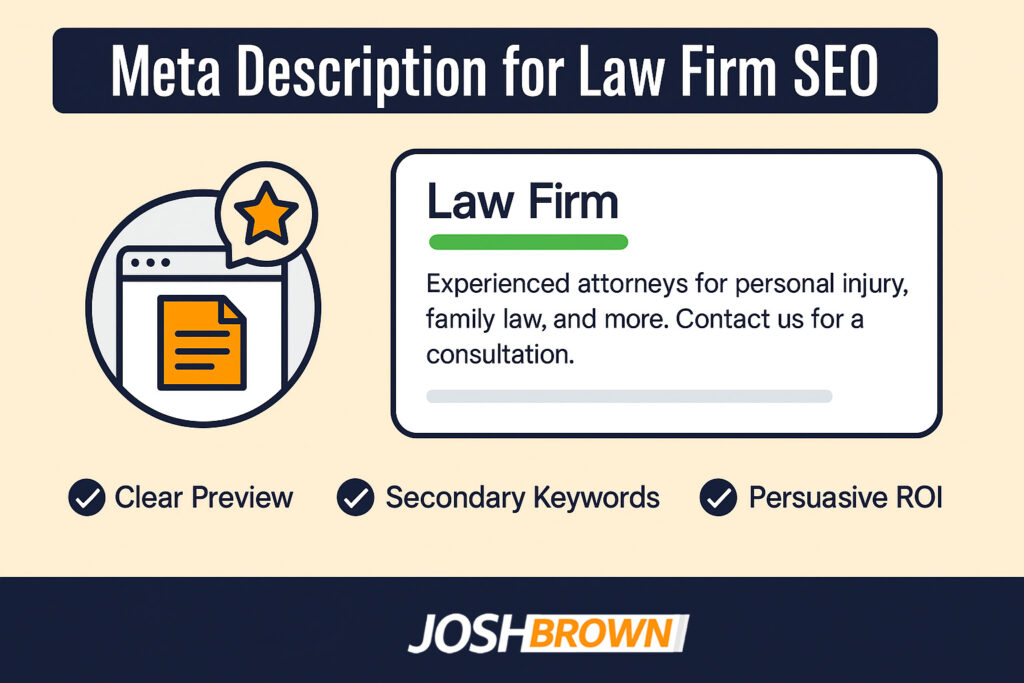
A meta description for law firm SEO is a short summary of a webpage’s content that appears beneath the title in search results and influences click-through rate (CTR). Meta description provides users with a clear preview, integrates secondary keywords naturally, and encourages engagement through persuasive wording.
Meta descriptions are important because they act as the “ad copy” of organic search listings, directly impacting whether potential clients choose to visit a law firm’s website.
What Is the Ideal Length for a Meta Description for Law Firm SEO?
The ideal length for a meta description for law firm SEO is 150–160 characters, which allows concise messaging with keywords while ensuring the full summary displays in search results. Staying within this range improves search visibility, avoids truncation, and maximizes click-through rate (CTR) by presenting a clear and persuasive preview of the law firm’s services.
What Is the Difference Between a Meta Title and a Meta Description?
The difference between a meta title and a meta description is that a meta title is the clickable headline in search results optimized for rankings, while a meta description is the summary beneath it that influences click-through rate.
The table below shows the difference between a meta title and a meta description.
Element | Definition | Role in SEO | Placement |
Meta Title | Clickable headline that appears in search engine results and browser tabs. | Optimized with primary keywords to improve rankings and visibility. | Displayed at the top of search results and the browser title bar. |
Meta Description | Summary of page content shown beneath the title in search results. | Encourages clicks by highlighting relevance and persuading users. | Displayed under the title in search results. |
What Makes a Good SEO Title and Meta Description?
A good SEO title and meta description are those that use target keywords, provide a clear value proposition, apply action-oriented language, and include branding.
Listed below are the elements.
- Target keywords: Include primary keywords in titles and secondary ones in descriptions for search relevance.
- Clear value proposition: Convey what the page offers to meet user intent.
- Action-oriented language: Use persuasive phrasing that motivates clicks.
- Branding: Add the law firm name for credibility and recognition.
- Proper length: Keep titles within 50–60 characters and descriptions within 150–160 characters to avoid truncation.

What Are the SEO Best Practices for Meta Titles in 2025?
SEO best practices for meta titles in 2025 are placing the primary keyword early, keeping the length within 50–60 characters, and adding a brand name.
Listed below are the 5 practices.
- Place primary keyword early: Improves visibility in search results.
- Keep within 50–60 characters: Prevents truncation and preserves readability.
- Add brand name: Builds credibility and recognition.
- Make titles unique: Avoids duplication across multiple pages.
- Use compelling wording: Encourages clicks with clear and persuasive phrasing.
How Do Meta Titles and Descriptions Affect SEO Rankings and Visibility?
Meta titles and descriptions affect SEO rankings and visibility by improving keyword relevance, influencing click-through rate (CTR), and aligning content with user intent. Search engines use meta titles and descriptions as signals of page context, and higher CTR boosts visibility through engagement metrics. Meta titles and descriptions as SEO ranking factors, how optimized tags indirectly improve rankings by attracting more qualified traffic and strengthening relevance in search results.
How Do You Optimize Title Tags and Meta Descriptions for SEO?
You can optimize title tags and meta descriptions for SEO by using target keywords, staying within character limits, and writing persuasive text. Strategies such as optimizing title tags and meta descriptions for law firm SEO ensure titles and descriptions align with search intent and attract qualified clicks.
Listed below are the 5 steps.
- Using target keywords: Place primary keywords in titles and secondary ones in descriptions.
- Staying within character limits: Keep titles at 50–60 characters and descriptions at 150–160 characters.
- Writing persuasive text: Use action-oriented and clear language to encourage clicks.
- Avoiding duplication: Ensure each page has unique tags for stronger SEO.
- Testing CTR impact: Measure performance and refine tags to improve click-through rates.

How Do You Optimize Meta Descriptions for SEO?
You can optimize meta descriptions for SEO by writing clear summaries, adding target keywords, staying under 160 characters, and using CTAs.
Listed below are the 5 steps.
- Writing clear summaries: Provide concise previews of page content.
- Adding target keywords: Integrate secondary keywords naturally for relevance.
- Staying under 160 characters: Prevent truncation in search results.
- Using CTAs: Encourage clicks with phrases like “Learn more” or “Get started.”
- Ensuring uniqueness: Write distinct descriptions for each page to avoid duplication.
How Are Keywords Included in a Meta Title and Description?
Keywords included in a meta title and description are placed naturally at the beginning of titles and woven into descriptions to align with search intent while maintaining readability. Primary keywords appear early in the meta title to improve relevance and rankings, while secondary keywords fit into the description to reinforce context and encourage clicks without disrupting user experience.
What Are Meta Keywords and Do They Still Matter for SEO Law Firm?
Meta keywords for SEO law firm are HTML tags once used to list targeted terms for search engines, but they no longer matter as a ranking factor. Google and other major search engines ignore the meta keywords tag, meaning it has no impact on law firm website rankings. While some firms use it internally for content organization, it provides no SEO value today.
What Are Common Mistakes to Avoid When Writing Meta Descriptions?
Common mistakes to avoid when writing meta descriptions are keyword stuffing, duplicate descriptions, exceeding 160 characters, and writing vague summaries. Issues like common meta description mistakes under Google’s guidelines show how poor optimization reduces visibility and CTR.
Listed below are the 5 mistakes.
- Keyword stuffing: Overloading descriptions with terms makes text unreadable.
- Duplicate descriptions: Using the same summary across multiple pages harms SEO.
- Exceeding 160 characters: Causes truncation in search results.
- Writing vague summaries: Fails to explain content relevance to users.
- Ignoring CTAs: Misses opportunities to drive clicks with action-oriented text.

How Do You Change a Meta Description in WordPress?
You can change a meta description in WordPress by installing an SEO plugin, opening the page editor, editing the meta description field, and saving updates.
Listed below are the 5 steps.
- Installing an SEO plugin: Add Yoast SEO or RankMath. A study by AIOSEO titled “2024 WordPress Statistics” in 2024 reported that multiple WordPress plugins, including WPForms, Elementor, and Classic Editor, are actively used by more than 5 million websites worldwide.
- Opening page editor: Navigate to the specific post or page you want to optimize.
- Editing the meta description field: Enter a summary of 150–160 characters in the plugin’s SEO section.
- Saving and updating page: Apply changes and update the page to ensure the new description is active.
- Checking in SERP preview: Use the plugin’s preview or Google Search Console to confirm display.
What Is the Role of Meta Tags in Search Engine Optimization?
The role of meta tags in search engine optimization is to provide relevance signals for search engines and improve user engagement through clear titles and descriptions. Meta titles influence rankings by aligning with targeted keywords, while meta descriptions boost visibility and CTR by persuading users to click. Together, these tags support stronger relevance, higher rankings, and better traffic quality for law firm websites.