

Josh Brown
CEO & Founder, Josh Brown Consulting
Google’s Helpful Content Update is an algorithm change that prioritizes people-first, value-driven content while demoting pages created mainly for search rankings. For law firms, helpful legal content means original, experience-based, and client-focused writing that addresses specific legal needs, rather than generic, AI-generated, or keyword-stuffed articles. A 2024 study by Website Builder Expert titled Google’s August Update Is Over: How Do Site Owners Feel Now? found traffic drops of 15–21% on the affected sites’ link.
To optimize for Google’s Helpful Content Algorithm, lawyers must publish content with genuine legal insights, avoid mass-produced blog posts, and prioritize user intent over keyword repetition. Helpful content for legal websites includes detailed service pages, clear FAQs, lawyer-authored blogs, case results, and client-focused explainers on legal procedures.
The update impacts law firm SEO by lowering rankings for websites with low-value or untrustworthy content, even if some pages are high quality. Law firms align with Google’s guidelines by auditing existing pages for relevance, depth, and originality, and by improving E-E-A-T (Experience, Expertise, Authoritativeness, Trust). The August 2022 update and the broader “Quality Update” stress transparency, firsthand legal expertise, and fulfilling search intent over surface-level SEO tactics.
What Is Google’s Helpful Content Update?
Google’s Helpful Content Update is an algorithm change that targets low-value, unhelpful content created mainly for search engines rather than real users. For law firms, the update raises the importance of publishing original, experience-based legal content that directly addresses client needs.
Legal websites with thin, generic, or overly optimized articles risk losing visibility, while those offering detailed service pages, lawyer-authored insights, and client-focused resources gain ranking advantages. The update impacts lawyers by rewarding websites that demonstrate expertise, trust, and relevance, making content quality a central factor in legal SEO success.
How Should Lawyers Optimize for Google’s Helpful Content Algorithm?
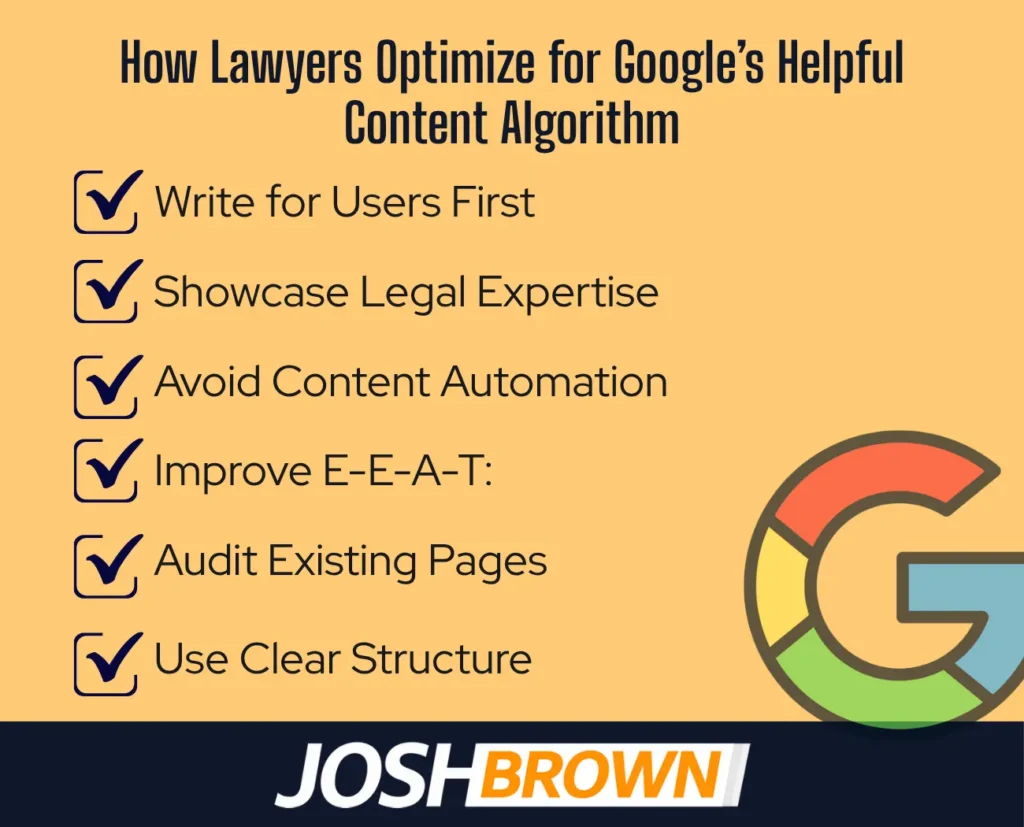
Lawyers should optimize for Google’s Helpful Content Algorithm by writing for users first, showcasing legal expertise, avoiding content automation, improving E-E-A-T, auditing existing pages, and using clear structure.
Listed below are 6 things lawyers must optimize for Google’s Helpful Content Algorithm.
- Write for Users First: Create content that answers client questions and addresses real legal needs.
- Showcase Legal Expertise: Include lawyer-authored insights, case examples, and jurisdiction-specific details.
- Avoid Content Automation: Refrain from mass-producing AI-rewritten or generic articles.
- Improve E-E-A-T: Demonstrate experience, expertise, authoritativeness, and trust through transparent authorship and citations.
- Audit Existing Pages: Remove or rewrite thin, outdated, or irrelevant content.
- Use Clear Structure: Organize content with headings, bullet points, and concise explanations for better readability.
What Is Considered “Helpful Content” for Legal Websites?
Helpful content for legal websites is considered original, clear, legally accurate, and actionable information that delivers direct value to the reader. Understanding what qualifies as helpful content for legal websites involves assessing whether pages provide practical guidance, answer client questions, and offer unique insights from qualified attorneys.
Such content avoids generic or keyword-stuffed text and instead presents jurisdiction-specific details, clear explanations of legal processes, and examples that help potential clients make informed decisions.
How Can Law Firms Create Content That Aligns with Google’s Helpful Content Guidelines?
Law firms can create content that aligns with Google’s Helpful Content Guidelines by identifying user intent, updating outdated content, avoiding fluff, improving readability, showing legal expertise, ensuring originality, and auditing regularly. Law firms create content that aligns with Google’s Helpful Content Guidelines by focusing on user intent, accuracy, and value
Listed below are 7 steps for law firms that create content that aligns with Google’s Helpful Content Guidelines.
- Identify User Intent: Research client search behavior to ensure topics match real legal needs.
- Update Outdated Content: Refresh legal information, case references, and jurisdiction-specific details.
- Avoid Fluff: Remove filler text and focus on concise, relevant explanations.
- Improve Readability: Use clear headings, short paragraphs, and plain language.
- Show Legal Expertise: Include attorney-authored insights and examples from real cases.
- Ensure Originality: Write unique content rather than reusing or rewording competitor material.
- Audit Regularly: Review performance and adjust pages to align legal content with Google’s helpful content guidelines for better ranking and engagement.
What Are the Implications of the Helpful Content Update for Law Firm SEO?
The implications of the Helpful Content Update for law firm SEO are that firms must revamp low-quality pages, focus on user-first writing, and ensure content offers genuine legal value to maintain rankings. Understanding the implications of Google’s helpful content update on law firm SEO means recognizing that pages with thin, generic, or overly optimized text risk visibility loss.
A 2025 study published by Search Engine Journal titled “AI Search Changes Everything, Is Your Organization Built To Compete?” explores how businesses must restructure their SEO strategies to remain visible in AI-driven search environments. For law firms, adapting means prioritizing attorney-authored content, detailed legal explanations, and clear answers to client questions, ensuring the site meets both search intent and quality standards.
How Does Google Define Useful Content for the Legal Industry?
Google defines useful content for the legal industry as information that reflects legal expertise, answers common legal questions, and meets E-E-A-T (Experience, Expertise, Authoritativeness, Trust) standards. Such content is accurate, original, and written or reviewed by qualified attorneys, ensuring it aligns with user intent. It provides clear explanations of legal processes, jurisdiction-specific guidance, and actionable insights that help potential clients understand their rights and next steps.
What Changes Did Google’s August 2025 Algorithm Update Bring for Lawyers?
Google’s August 2025 algorithm update brings lawyers a stronger emphasis on original, user-focused content while penalizing legal pages created solely for SEO gain. The update rewards attorney-authored insights, jurisdiction-specific guidance, and in-depth answers to client questions, while lowering rankings for thin, keyword-stuffed, or AI-rewritten material.
A 2023 case study by Seer Interactive titled “Content Pruning Efforts Help Reverse Traffic Loss” found that a client suffering from -17.3% year-over-year traffic declines since 2018 had over 14,000 pages of low-value or duplicate content. After pruning these pages, the site saw a +23% increase in organic traffic within six months. For lawyers, the change means prioritizing content quality, aligning with user intent, and demonstrating E-E-A-T to maintain search visibility.
How to restore a site hit by the Google Helpful Content update?
To restore a site impacted by Google’s Helpful Content Update, you must prioritize rewriting or removing low-value content and refocus your entire site strategy around genuinely helpful, user-first information that demonstrates expertise and trustworthiness.
Listed below are 10 steps to recover from a helpful content update.
- Remove or rewrite low-quality, unhelpful content
- Focus on content that demonstrates real expertise and trust
- Write for users, not search engines, and avoid keyword stuffing
- Update outdated articles with fresh insights
- Improve site speed and mobile usability
- Reduce intrusive ads and distractions
- Fix broken links and strengthen internal linking
- Track performance metrics like rankings and bounce rate
- Gather user feedback to guide improvements
- Stay updated with Google’s content guidelines
Josh Brown SEO for law firm services helps you recover from a helpful content update and even create new helpful content for your law firm.
What Is the Google Quality Update?
The Google Quality Update is an algorithm change that refines ranking signals to prioritize high-quality, trustworthy, and experience-driven content. For law firms, this means publishing accurate legal information, supported by attorney expertise, that meets user intent and builds trust.
The update is closely related to the Helpful Content system, as both aim to reward original, value-focused pages while reducing visibility for generic or low-value material. Legal websites demonstrating strong E-E-A-T (Experience, Expertise, Authoritativeness, Trust) and delivering detailed, client-focused resources are more likely to maintain or improve rankings under these updates.