


Josh Brown
CEO & Founder, Josh Brown Consulting

Mobile SEO for lawyers means optimizing a law firm’s website and online presence for search visibility and usability on mobile devices, ensuring top ranking for legal services. Legal SEO combines industry-specific content, ethical marketing, and technical best practices to attract qualified, local clients through blogs, backlinks, local keyword targeting, and structured metadata.
Best SEO strategies for law firms include optimizing practice area pages, building high-authority backlinks, applying legal schema markup (e.g., LegalService, LocalBusiness), and targeting local keywords to dominate city-based searches. Lawyers enhance rankings by publishing informative blog content, FAQs, and practice-specific articles addressing client questions and local legal scenarios to develop topical authority.
A 2023 Clio Legal Trends Report found that firms that implement hygiene with tools like online intake and client response workflows experience 50% more incoming potential clients and 50% more revenue on average when optimizing digital client experience, underscoring the value of mobile-first engagement.

Top SEO tactics in 2023 have included Core Web Vitals optimization, mobile-first design, internal linking to service pages, and embedding video content with keyword-rich titles and transcripts. On-page optimization involves titles, meta descriptions, URL structure, headers, and content flow; off-page SEO includes backlinks, directory listings, and reputation management. Local SEO plays a key role via Google Business Profile optimization, local citations, and consistent NAP details to improve visibility in Maps Pack results.
Effective website optimization strategies include boosting page speed, adding client testimonials, implementing responsive design, and ensuring ADA accessibility. Small firms often budget $500–$2,500 per month for SEO marketing, depending on competitive levels and choice of agency or freelancer. Affordable SEO providers include niche legal marketing firms, flat-rate local packages, or hybrid DIY-consultant models. Custom SEO strategies aligned with practice area, location, and client intent yield higher rankings and qualified leads. Emerging trends include AI-assisted content optimization, voice search readiness, zero-click content, and featured snippet targeting for conversion-focused queries.
Why is Mobile SEO Important for a Law Firm’s Google Rankings?
Mobile SEO is important for a law firm’s Google ranking because Google uses mobile‑first indexing; if the mobile site isn’t optimized, rankings will suffer.
Google’s mobile‑first indexing prioritizes the mobile version of a law firm’s website when crawling, indexing, and ranking content. This system launched in 2018 and became the default for all new domains by July 2019. Mobile-first indexing assesses mobile usability, page speed, and content equivalence. Missing or altered mobile content reduces a law firm’s visibility in search results.

Unoptimized mobile sites face direct ranking penalties. Google lowers rankings for legal websites that load slowly, have poor layout on small screens, or deliver incomplete mobile content. These issues affect crawl efficiency and user engagement, signaling low quality to Google’s algorithms.
Mobile rankings strongly influence visibility for local and national legal searches like “divorce lawyer near me.” Google prioritizes mobile‑friendly, responsive sites with relevant content and strong local signals. Law firms without optimized mobile pages lose local leads to competitors with faster, easier-to-use mobile sites.
How Does Mobile UX Affect User Trust, Engagement, and Conversions on Law Firm Websites?
A poor mobile user experience drives users away, harms trust, and diminishes lead conversions.
Mobile UX affects user trust when a slow or hard-to-navigate mobile site creates frustration. Outdated or neglected mobile design signals low credibility, making the law firm appear unprofessional or inactive. Users interpret broken layouts or misaligned text as signs of neglect.

Page load delays above 3 seconds trigger bounce rates over 50%. Users abandon sites that lag or fail to display content immediately. Each delay reduces the chance of form submissions or calls.
Lost leads result from hard-to-tap buttons, unreadable text, and broken forms. If users struggle to interact, they exit without converting, costing the law firm high‑value cases.
What Are the Technical Elements of Mobile SEO for Law Firms?
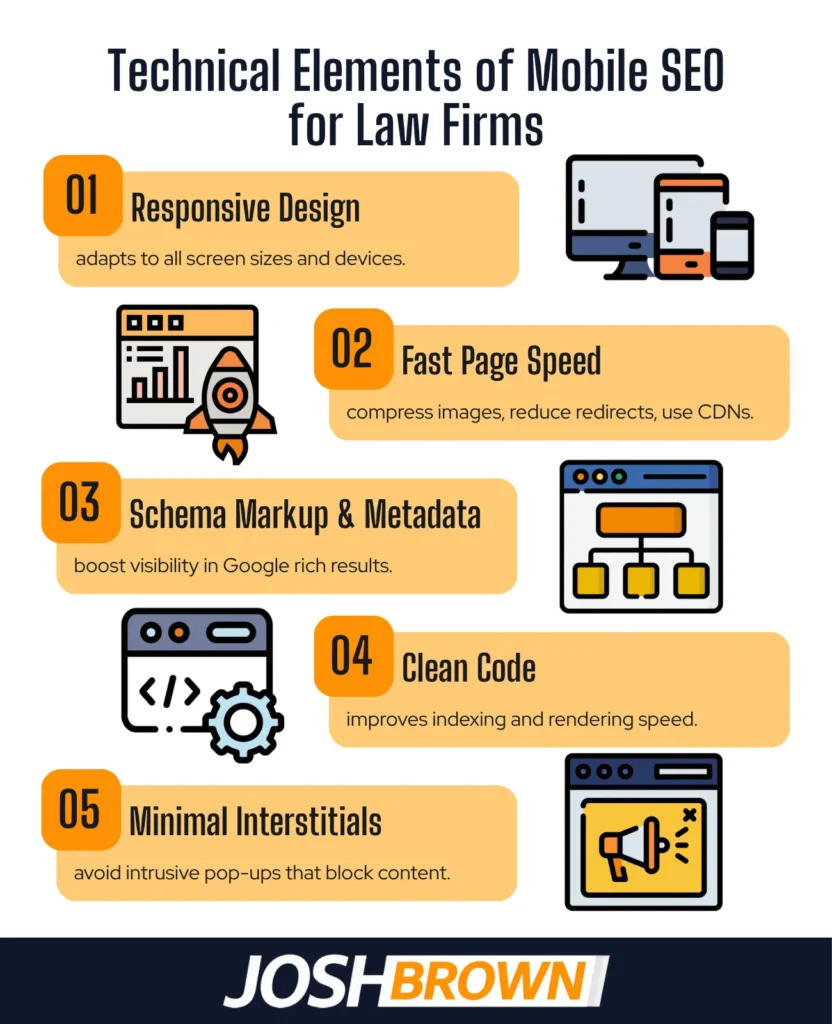
The technical elements of mobile SEO are responsive design, fast page speed, schema markup, clean code, and minimal interstitials.
Listed below are the technical elements of mobile SEO.
- Responsive design ensures the law firm’s website adapts to all screen sizes and devices.
- Speed optimization includes compressing images, minimizing redirects, and using CDNs to reduce load time.
- Schema markup and optimized metadata improve visibility in Google rich results.
- Clean code helps crawlers index content accurately and ensures fast rendering.
- Minimal interstitials remove intrusive pop-ups that block content and violate Google’s mobile-friendly standards.
How Should Legal Content Be Adapted Specifically for Mobile Users?
Legal content for mobile use must use concise, scannable text, larger fonts, thumb-friendly CTAs, and optimized meta tags.
Mobile users scroll quickly and skim for answers. Short paragraphs, bullet lists, and clear headers improve readability and scanability. Readable font sizes with strong contrast prevent eye strain and reduce bounce. Thumb-friendly buttons like click-to-call or consultation links placed within easy reach increase interaction. Mobile‑optimized title tags (50–60 characters) and meta descriptions (about 100 characters) ensure full visibility in search results without truncation.
How Does Mobile SEO Amplify Local “Near Me” Searches to Bring in Clients?
Mobile SEO boosts local optimization visibility in local search and Google’s local 3‑pack for location‑based queries.
“Near me” and city-based legal searches dominate mobile behavior. Mobile-optimized law firm pages with consistent name, address, and phone number (NAP) and schema markup improve inclusion in Google’s Map Pack. Google favors mobile-friendly local content when showing nearby options. An optimized Google Business Profile and accurate listings across local directories increase trust signals and visibility for mobile users searching for legal help by location.
How Should Law Firms Measure and Monitor Their Mobile SEO Performance?
Law firms should measure their mobile SEO performance using tools like Google Search Console Mobile Usability, PageSpeed Insights, Core Web Vitals, and mobile analytics.
Listed below are ways law firms measure their mobile SEO.
- Mobile Usability report in Google Search Console identifies layout errors, tap targets, and viewport issues.
- Core Web Vitals scores LCP (Largest Contentful Paint), FID (First Input Delay), and CLS (Cumulative Layout Shift), which assess mobile load speed and interactivity.
- PageSpeed Insights and Lighthouse provide technical benchmarks and optimization tips for mobile performance.
- Google Analytics, SEMrush, or Ahrefs track bounce rates, conversions, and mobile traffic trends.
How Can Lawyers Use Blog Content to Improve Their SEO Rankings?
Lawyers can use blog content to improve SEO rankings by consistently publishing keyword-focused articles that address client concerns and reinforce specific legal practice areas. A consistent blogging practice anchors a strategy of legal blogs optimized for search intent, helping firms gain visibility and relevance. Fresh, informative posts build topical authority, boost site crawl frequency, and attract backlinks from credible sources.
Targeting long-tail, geography-based legal keywords like “estate planning attorney in Chicago” or “family law updates [City]” drives qualified traffic and improves ranking positions. Internal linking from blog posts to service pages strengthens site structure and user experience, increasing dwell time and reducing bounce rates. Furthermore, regularly published content supports outreach efforts, such as guest posts and social sharing, enhancing backlink potential and referral traffic. All of these actions contribute to a more robust SEO content strategy for lawyers.
Learned insights around legal blogger tactics support keyword targeting, internal link planning, and topic clustering to deliver measurable organic growth.
What Is Legal SEO and How Is It Different From General SEO?
Legal SEO is different from general SEO in that it targets legal-specific search behavior, integrates compliance, local targeting, and trust signals for attorney marketing. Legal SEO focuses on keywords like “personal injury attorney in [City],” on-page legal schema, ethical content, and Google Business Profile optimization, while general SEO applies broader strategies across multiple industries.
Legal SEO requires adherence to advertising ethics and bar regulations, ensures accurate legal terminology, and emphasizes E‑E‑A‑T for YMYL topics. It uses tactics such as legal directory listings, geographic targeting, attorney bios, and case-specific blog content. In contrast, general SEO focuses on broader content topics, multilingual sites, or industries without strict compliance needs. This specialization helps law firms reach high-intent clients searching for legal services and improves conversion from search queries.
What Are the Top Law Firm SEO Strategies to Implement in 2023?
The top law firm SEO strategies to implement in 2023 focus on leveraging emerging trends like video SEO, voice search, local dominance, AI-enhanced keyword research, and mobile-first performance. As part of evolving law firm marketing strategies to implement, firms are increasingly adopting the following approaches:
Listed below are key actions based on recent law firm marketing strategies to implement.
- Video SEO: Create and optimize legal video content with keyword-rich titles, descriptions, and transcripts to improve search visibility and rankings. Video marketing was a key trend in law firm SEO for 2023.
- Local Service Ads Optimization: Configure and optimize Google Local Services Ads to appear in map packs for high-intent legal searches. Local SEO and GMB optimization remain central strategies.
- AI‑Enhanced Keyword Research: Use AI tools (e.g., Semrush, MarketMuse, SurferSEO) to uncover long-tail queries, cluster intents, and plan content strategies with precision.
- Mobile‑First Site Speed: Prioritize Core Web Vitals compliance, fast load times, and responsive design to meet Google’s mobile-centered ranking standards.
- Voice Search & Snippet Optimization: Target conversational, natural language queries and structured FAQ content to capture voice searches and featured snippets.
These tactics align with evolving user behavior and algorithm updates in 2023, helping law firms increase visibility, capture voice and video queries, and convert high-intent local traffic efficiently.
How Much Should Small Law Firms Invest in SEO Marketing?
Small law firms should invest in SEO marketing between $500 and $2,500 per month, depending on their location, competitiveness, and growth objectives. For most small law firms, this budget includes foundational SEO services such as local keyword research, Google Business Profile optimization, on-page content updates, and performance reporting.
Mid-tier packages expand to include blog content creation, link building, and technical SEO audits. At the higher end of the range, firms often access dedicated legal SEO experts, citation management, content strategy, and continuous optimization. Many small law firms prioritize hyperlocal targeting and niche keyword visibility to compete effectively with larger firms while keeping cost-efficiency in mind.
What Are the Key Differences Between On-Page and Off-Page SEO for Lawyers?
The key differences between on-page and off-page SEO for lawyers are based on where and how optimization efforts occur. On-page SEO involves changes made directly to a law firm’s website, such as optimizing attorney bios, practice area pages, title tags, internal links, and using legal keywords that reflect client search intent. For example, a family law firm improves local rankings by targeting phrases like “child custody lawyer in Atlanta” within headers and meta descriptions.
Off-page SEO, in contrast, focuses on external factors that influence rankings, such as gaining backlinks from reputable legal directories (e.g., Avvo, Justia), securing media mentions, and building local citations. These strategies signal authority and trustworthiness to search engines. While on-page SEO ensures content relevance and user accessibility, off-page SEO boosts domain credibility and ranking power. Both are essential pillars of an effective legal SEO strategy.
What Is the Role of Local SEO in Helping Lawyers Rank in the Maps Pack?
The role of local SEO in helping lawyers rank in the Maps Pack is to increase their visibility for nearby legal searches by optimizing key geographic and business signals. This includes completing and verifying a Google Business Profile, using accurate contact info and categories, earning client reviews, and adding geo-specific keywords.
Local citations and consistent NAP (name, address, phone number) details help confirm a firm’s location to Google. Reviews boost credibility. Geo-targeted phrases in content and profiles improve local relevance.
A 2023 study by Whitespark, titled Local Search Ranking Factors, found that Google Business Profile elements and proximity to the searcher were top-ranking factors for the Maps Pack.
What Are the Most Affordable SEO Services for Lawyers?
The most affordable SEO services for lawyers are Local SEO Setup, Content Audits, Basic Keyword Targeting, GMB (Google My Business) Optimization, etc, targeted strategies that improve visibility without high overhead costs. These services focus on essentials that support search rankings and client discovery at a budget level.
Listed below are the 7 most affordable SEO services for lawyers
- Local SEO Setup: Claiming and optimizing Google Business Profile for location-based visibility.
- Content Audits: Reviewing existing site content to identify gaps and improve relevance for legal search intent.
- Basic Keyword Targeting: Using long-tail, low-competition legal keywords to specific practice areas and cities.
- GMB (Google My Business) Optimization: Adding accurate categories, legal service descriptions, hours, and photos to improve local rankings.
- Citation Building: Submitting business listings to legal directories like Avvo, Justia, and Yelp.
- On-Page SEO Essentials: Tweaking meta titles, headers, and internal links on key service pages.
- Review Strategy Support: Encouraging satisfied clients to leave public reviews to improve local SEO trust signals.
These services allow small firms or solo practitioners to build a strong SEO foundation without committing to a full-scale agency package.
What Are the Benefits of a Custom SEO Strategy for Legal Professionals?
The benefits of a custom SEO strategy for legal professionals are higher-quality leads, better keyword relevance, and stronger returns on marketing investment. A SEO approach aligns content with specific practice areas and geographies, such as “pauper hearings in Tempe” or “estate planning attorney in Ashland,” ensuring messaging resonates with target clients and ranking potential increases.
Custom strategies drive more targeted traffic and improve conversion rates by matching searcher intent precisely to services offered. These strategies also enhance domain authority through localized backlink profiles, schema markup, and focused FAQs.
A study by First Page Sage found that law firms investing in bespoke SEO frameworks saw up to 526% ROI over three years, with visitor-to-lead conversion rates averaging 7.4%, depending on firm specialty and spend.
The benefits extend beyond traffic: custom strategies support measurable campaign results, improve organic lead value, and ensure ethical compliance throughout legal content and outreach.