

Josh Brown
CEO & Founder, Josh Brown Consulting

To market yourself as a lawyer, use a strategy that combines branding, local SEO, digital outreach, and content creation to attract, convert, and retain legal clients online. First, define your practice area and geographic service region to guide targeted content and ad campaigns. Optimize your Google Business Profile with accurate categories, hours, and verified contact details to rank in local search results. Improve local SEO using keyword-focused service pages, consistent NAP citations, and directory listings.
A survey by iLawyer Marketing found that 92% of potential clients begin their search for a lawyer with Google, and 80% check online content before engaging a law firm, demonstrating the importance of online visibility and reviews. A strong web presence, including client reviews, builds credibility.

Build a mobile-friendly, fast-loading website using legal schema, bios, service details, testimonials, and clear calls to action. Encourage clients to post reviews on Google, Avvo, Justia, and other platforms to boost local rankings and trust signals. Research your ideal clients’ demographics, search behavior, and legal concerns to produce tailored content and ads.
Set measurable goals, e.g., increasing lead calls by 25% in 90 days, to track performance. Share legal insights, firm updates, and tips via LinkedIn, Facebook, and Instagram to engage your community. Use legal blogs, FAQs, guides, and explainer videos to build authority and support SEO.
Automate email outreach with newsletters that follow up with leads, nurture client relationships, and share legal insights. Launch PPC campaigns and Local Services Ads for top visibility in search results. Monitor performance with tools like Google Analytics, call tracking, and CRM reports to assess lead sources and conversion paths.
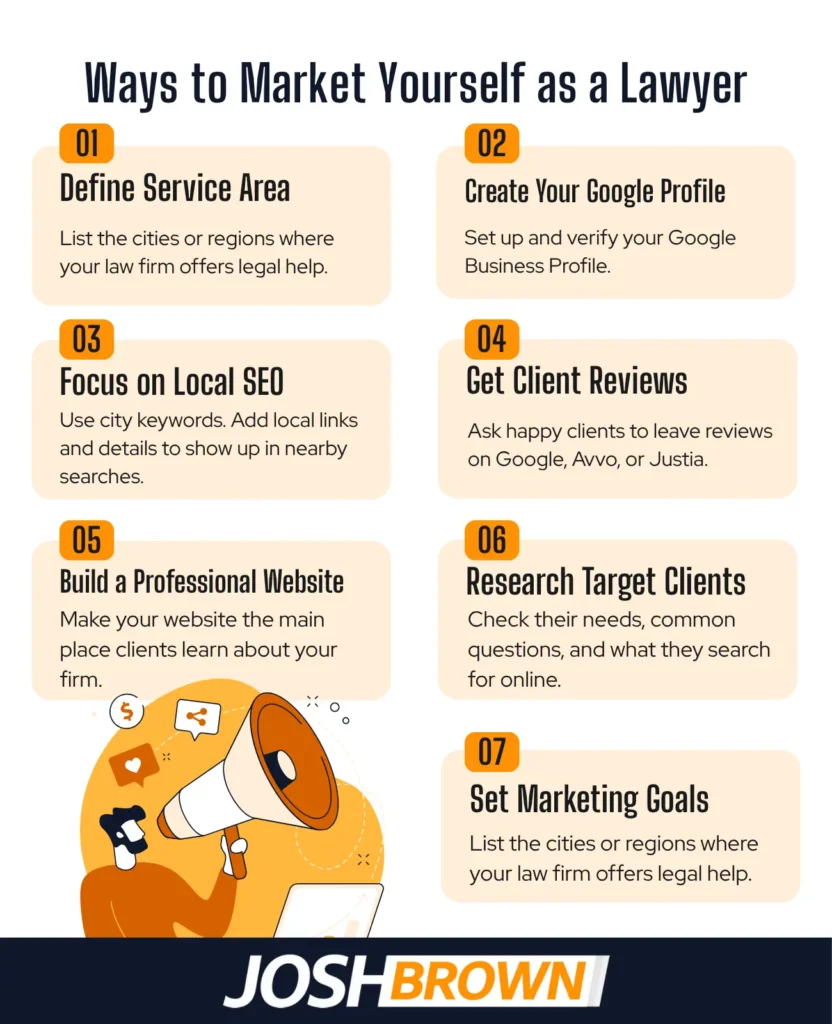
Listed below are 14 ways to market yourself as a lawyer.
1. Define service area
2. Create a Google profile
3. Focus on local seo
4. get client reviews
5. Build a professional website
6. Research target clients
7. Set marketing goals
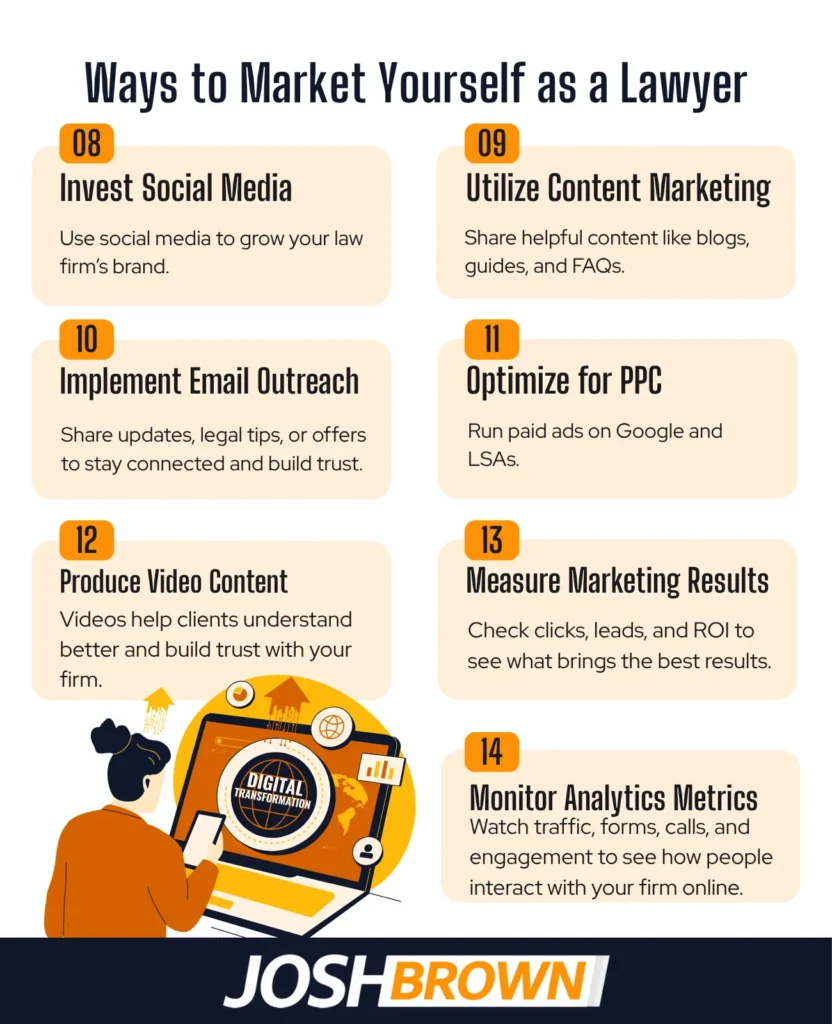
8. Invest in social media
9. Utilize content marketing
10. Implement email outreach
11. optimize for ppc
12. Produce video content
13. measure marketing results
14. monitor analytics metrics
1. Define Service Area
Service area strategy involves identifying the geographic regions where legal services are offered. This step sets the foundation for targeted local SEO, ad placement, and client communication. Defining specific city names, counties, or zip codes improves local marketing accuracy and avoids wasted outreach beyond your target zone. A clear service area improves search relevance, maps visibility, and supports geotargeted lead generation.
Use location-based landing pages, city-specific keywords, and update all digital profiles with service area tags to boost relevance and conversion.
2. Create Google Profile
Google Profile Optimization means building and verifying a Google Business Profile with complete and accurate firm details. This profile increases visibility in Google Maps and local packs. Displaying office hours, categories, and contact info helps convert searchers into clients by establishing digital trust. Verified profiles boost online growth and ensure lead generation from mobile and location-based searches.
Keep NAP details consistent, upload professional photos, and enable messaging to increase engagement.
3. Focus Local SEO
Local SEO targets search engine visibility within a defined region using location-specific content and links. Law firms benefit from better local rankings through optimized service pages, citation management, and structured data. Local SEO supports lead generation by aligning with how potential clients search for nearby legal help.
Use tools like Google Search Console and Whitespark to audit citations, and ensure schema markup includes city and practice info.
4. Get Client Reviews
Client reviews are public feedback left on platforms like Google, Avvo, and Justia that influence trust and rankings. Reviews improve digital presence and serve as social proof for prospective clients. High volumes of positive reviews boost click-through rates and drive lead generation from local searches.
Request reviews after case closure, respond to all feedback, and link review pages in email or text follow-ups.
5. Build a Professional Website
A professional website serves as the central hub of a law firm’s digital presence. Mobile optimization, speed, legal schema, and conversion-focused design help build trust and increase lead capture. A solid website supports local SEO, houses educational content, and turns visitors into contacts or scheduled appointments.
Include clear CTAs, client testimonials, attorney bios, and optimized service pages by location and case type.
6. Research Target Clients
Target client research involves analyzing demographics, search intent, and pain points of ideal legal prospects. This insight informs digital strategy, ad messaging, and keyword selection. Knowing your audience supports client-centric content and improves ROI across all channels.
Use keyword tools, client surveys, and intake forms to gather behavioral data and adjust outreach accordingly.
7. Set Marketing Goals
Marketing goals define clear benchmarks such as lead volume, call conversions, or intake speed over set periods. Setting specific objectives improves budget allocation and highlights what tactics work. Goal tracking supports online growth and reveals gaps in digital visibility and client acquisition.
Set SMART goals (e.g., 25% call increase in 90 days) and align each with campaigns in PPC, SEO, or email.
8. Invest Social Media
Social media investment involves using platforms like LinkedIn, Facebook, and Instagram to increase engagement and brand visibility. These platforms help attorneys distribute legal tips, build trust, and stay visible to local audiences. Social engagement supports referral generation and strengthens digital presence.
Post consistently, use hashtags tied to location and practice area, and respond to comments to build credibility.
9. Utilize Content Marketing
Content marketing includes legal blogs, guides, FAQs, and case explainers designed to inform and attract leads. Educational content builds authority and supports search rankings for service-related keywords. Good content increases time on site, repeat visits, and conversion potential.
Focus on answering high-intent legal queries, use structured headings, and link internal pages for SEO support.
10. Implement Email Outreach
Email outreach nurtures leads, maintains contact with past clients, and delivers educational or promotional content directly. This channel supports relationship building and drives repeat engagements. Consistent email campaigns help small law firms stay top-of-mind during key decision moments.
Automate email sequences using tools like Mailchimp or Lawmatics and segment lists by case type or contact status.
11. Optimize for PPC
PPC optimization targets ad performance across Google Ads and LSAs to capture bottom-funnel searchers. Paid campaigns appear above organic results, improving visibility for urgent legal queries. Optimized PPC drives lead generation when backed by landing pages and call tracking.
Use negative keywords, location filters, and conversion-focused ad copy to maximize ROI.
12. Produce Video Content
Video content presents legal topics visually to build trust and clarify complex subjects. Videos increase engagement across websites, YouTube, and social media—supporting both brand presence and lead generation. They allow lawyers to speak directly to client concerns, improving credibility.
Start with FAQ-based explainers, include subtitles, and add videos to service pages and emails.
13. Measure Marketing Results
Marketing measurement tracks the effectiveness of campaigns, content, and channels using metrics like clicks, leads, and ROI. Data reveals what attracts clients and helps law firms refine their strategy for consistent growth. Measuring success ensures resources are targeted at high-return activities.
Use dashboards in Google Analytics and CRM tools to visualize source-to-conversion paths.
14. Monitor Analytics Metrics
Analytics monitoring involves continuous tracking of site traffic, form submissions, calls, and engagement rates. These metrics inform decisions, catch drops early, and align performance with goals. Real-time insight improves local marketing precision and lead quality.
Check bounce rates, mobile traffic trends, and conversion flow weekly to adjust campaigns quickly.
What Are the Most Effective Online Marketing Strategies for Lawyers?
The most effective online marketing strategies for lawyers include SEO, PPC advertising, content marketing, email campaigns, and social media to drive visibility and generate qualified legal leads.
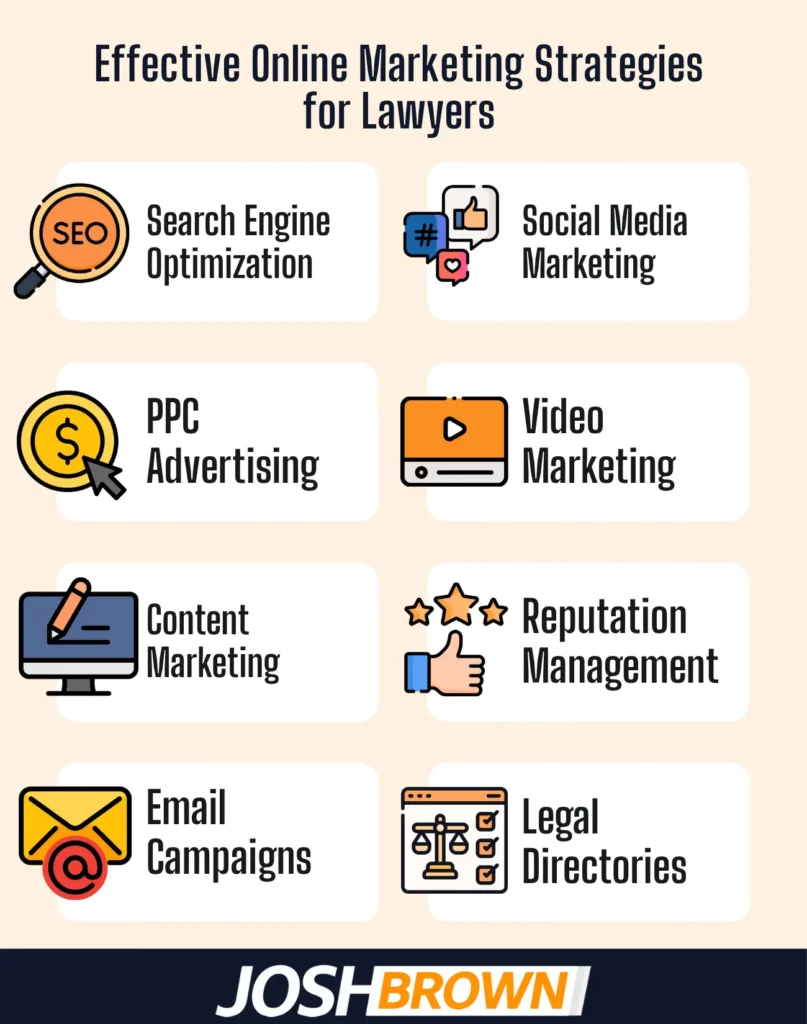
Listed below are 8 proven strategies for law firm online promotion and digital lead generation.
- SEO (Search Engine Optimization): Improves organic visibility by targeting legal keywords, optimizing service pages, and building local citations.
- PPC Advertising (Google Ads and LSAs): Places your firm at the top of search results for high-intent queries, capturing urgent leads fast.
- Content Marketing: Uses blogs, legal guides, and FAQs to build authority, educate prospects, and rank for long-tail keywords.
- Email Campaigns: Automates lead nurturing and client retention through segmented email sequences and newsletters.
- Social Media Marketing: Builds brand presence and community trust by sharing updates, legal tips, and engaging visual content.
- Video Marketing: Adds credibility and engagement through explainers, testimonials, and Q&A videos shared on YouTube and your website.
- Reputation Management: Encourages client reviews on Google and legal directories to improve rankings and trust signals.
- Legal Directories and Listings: Expands reach by placing your firm in trusted platforms like Avvo, FindLaw, and Justia.
How Can Law Firms Use Internet Marketing to Increase Client Leads?
Law firms can use internet marketing to increase client leads by combining SEO, targeted ads, optimized landing pages, and CRM integration into a unified lead generation system. SEO helps firms appear in organic search results when potential clients seek legal help, while landing pages built around specific services and locations improve conversion by matching user intent.
Pay-per-click campaigns and Local Services Ads allow precise ad targeting based on keywords, location, and device, capturing high-intent users. CRM systems track lead sources, automate follow-ups, and score client interest, ensuring fast response and higher conversion rates. Together, these digital marketing conversion tools create a consistent law firm lead generation pipeline.
What Services Do Marketing Agencies Offer for Law Firms?
Law firm marketing agencies offer services such as website design, SEO, PPC, content development, branding, and analytics to increase digital visibility and client acquisition.
Listed below are 8 core offerings provided to attorney clients.
- Website Design & Landing Page Development: Build fast, mobile-responsive sites for conversion and optimized for SEO and client intake.
- Search Engine Optimization (SEO): Improve local and organic search rankings through keyword-targeted legal content, citation management, and technical audits.
- Pay‑Per‑Click Advertising (PPC & LSAs): Manage Google Ads and Local Services Ads to recruit users searching for service-area legal help.
- Content Development: Produce legal blogs, guides, FAQs, attorney bios, and educational resources to build authority and engage prospects.
- Branding & Messaging Strategy: Craft brand identity, tone, and campaign messaging aligned with practice area and client audience.
- Reputation & Review Management: Automate review requests, monitor client feedback on Google and Avvo, and publish testimonials.
- Social Media Marketing: Create and manage posts, ads, and engagement campaigns on LinkedIn, Facebook, and Instagram.
- Performance Analytics & Reporting: Track conversion rates, campaign ROI, and lead sources using analytics dashboards.
Studies show legal marketing agencies using PPC, SEO, and content strategies report up to 80% higher conversion rates and $42 return per email dollar spent. Partnering with expert legal marketing agencies supports scalable, data-driven growth through targeted outreach, professional brand development, and consistent lead generation.
Where to Get SEO for Lawyers’ Services
You can get SEO for lawyer services from legal SEO specialists who offer technical SEO, local SEO, keyword targeting, link building, legal content creation, mobile optimization, and performance tracking. Law firm SEO providers deliver services that fix site speed, apply schema, optimize Google profiles, manage citations, and create content that ranks for legal keywords. Verified strategies generate up to 526% ROI in three years and increase organic traffic by 21–29% annually.
Legal SEO accounts for 66% of inbound traffic to law firm websites, with 70% of mobile-optimized sites driving direct call leads from search results. Local optimization leads to fast contact: 78% of mobile legal searches result in a client action within 24 hours, and firms with 20+ Google reviews see 30% more clicks.
Specialized SEO providers ensure law firms rank higher, attract qualified leads, and measure conversions with precision.
What Are the Best Online Advertising Channels for Lawyers?
The best online advertising channels for lawyers include Google Ads, Local Services Ads, Facebook Ads, LinkedIn, and YouTube, each offering targeted reach and high lead intent.
Listed below are 5 commonly used legal advertising channels.
- Google Ads: Pay-per-click platform where law firms bid on legal keywords to appear at the top of search results for relevant queries.
- Local Services Ads (LSAs): Google-backed ads that display verified lawyers with reviews and direct call buttons, ideal for urgent legal searches.
- Facebook Ads: Visual ads targeting custom audiences based on demographics, interests, or behaviors, useful for brand awareness and remarketing.
- LinkedIn Ads: Professional ad platform suitable for targeting business clients, corporate legal services, or high-value referral networks.
- YouTube Ads: Video ad placements that increase brand visibility and allow lawyers to explain services, FAQs, or success stories to engaged viewers.
How Should Lawyers Choose a Law Firm Internet Marketing Provider?
When choosing the right law firm internet marketing provider, lawyers should look for agencies with legal niche expertise, proven case studies, ethical marketing standards, and clear communication processes. Agencies experienced in lawyer internet marketing understand bar advertising rules, legal terminology, and conversion-driven strategies tailored for law practices.
Verified results, such as ranking improvements, lead growth, or ROI, from past clients prove campaign effectiveness. Ethical practices include transparent billing, no misleading ad tactics, and compliance with advertising regulations. Strong communication ensures the provider offers regular performance updates, listens to firm goals, and aligns strategies with practice needs. Selecting the right partner ensures long-term visibility and measurable lead acquisition.
What Is the Difference Between Digital Marketing and Internet Marketing for Lawyers?
The difference between digital marketing and internet marketing for lawyers is that digital marketing includes both online and offline digital tactics, while internet marketing focuses only on online channels. The term digital marketing includes display ads, email, mobile apps, SMS, and connected TV. The phrase internet marketing refers specifically to channels like SEO, PPC, social media, and web-based email.
Listed below are the differences between digital marketing and internet marketing.
| Feature | Digital Marketing | Internet Marketing |
| Channels Included | Online and offline tools (e.g., SMS, digital TV, mobile apps) | Online-only tools (e.g., SEO, PPC, social media) |
| Tactics Used | Broad: display, mobile, email, app ads | Narrow: keyword ads, blogs, content marketing |
| Goal | Multi-platform brand visibility | Direct online client acquisition |
| Scope | Online and offline integration | Internet-exclusive efforts |
| Example Methods | Mobile retargeting, app ads, digital billboards | Google Ads, LinkedIn Ads, legal SEO |
A 2025 study by Gitnux titled Law Firm Marketing Statistics found that 79% of lawyers ranked SEO as the most effective digital marketing channel, while 80% of firms using PPC reported strong lead acquisition performance.
This difference matters in lawyer marketing because a legal practice that integrates both digital and internet strategies gains broader visibility and stronger conversion performance.
What Are the Best Practices for Lawyer Website Marketing?
The best practices for lawyer website marketing include mobile responsiveness, clear CTAs, SEO integration, and legal trust signals to increase visibility and client conversion.
Listed below are the best practices for lawyer website marketing.
- Mobile Responsiveness: Ensure the site loads fast and adapts to all screen sizes to support user access and search engine ranking.
- Clear Call-to-Actions (CTAs): Use visible, action-oriented buttons like “Schedule Consultation” or “Call Now” to guide user behavior.
- SEO Integration: Optimize page titles, headers, metadata, and content for relevant legal keywords to boost organic traffic.
- Legal Trust Signals: Display bar memberships, client reviews, awards, and security badges to build credibility.
- Fast Load Speed: Use optimized images and caching to reduce bounce rate and improve experience.
- Content Structure: Organize service pages, FAQs, and legal resources with clear headings and internal links for better SEO and readability.
- Conversion Forms: Use short, accessible forms on key pages to capture leads without friction.
- Secure HTTPS Protocol: Protect user data and comply with privacy standards using SSL encryption.
- Accessible Design: Follow ADA guidelines for readability and navigation to ensure compliance and usability.
- Analytics Tracking: Monitor traffic, behavior, and lead sources to adjust strategy and improve ROI.