


Josh Brown
CEO & Founder, Josh Brown Consulting

Local listings matter for law firm SEO and Google visibility because they drive the majority of client interactions through maps and local search results. Businesses featured in Google’s Local 3‑Pack receive approximately 44% of clicks and build trust with 68% of searchers, compared to much lower engagement from organic or paid listings.
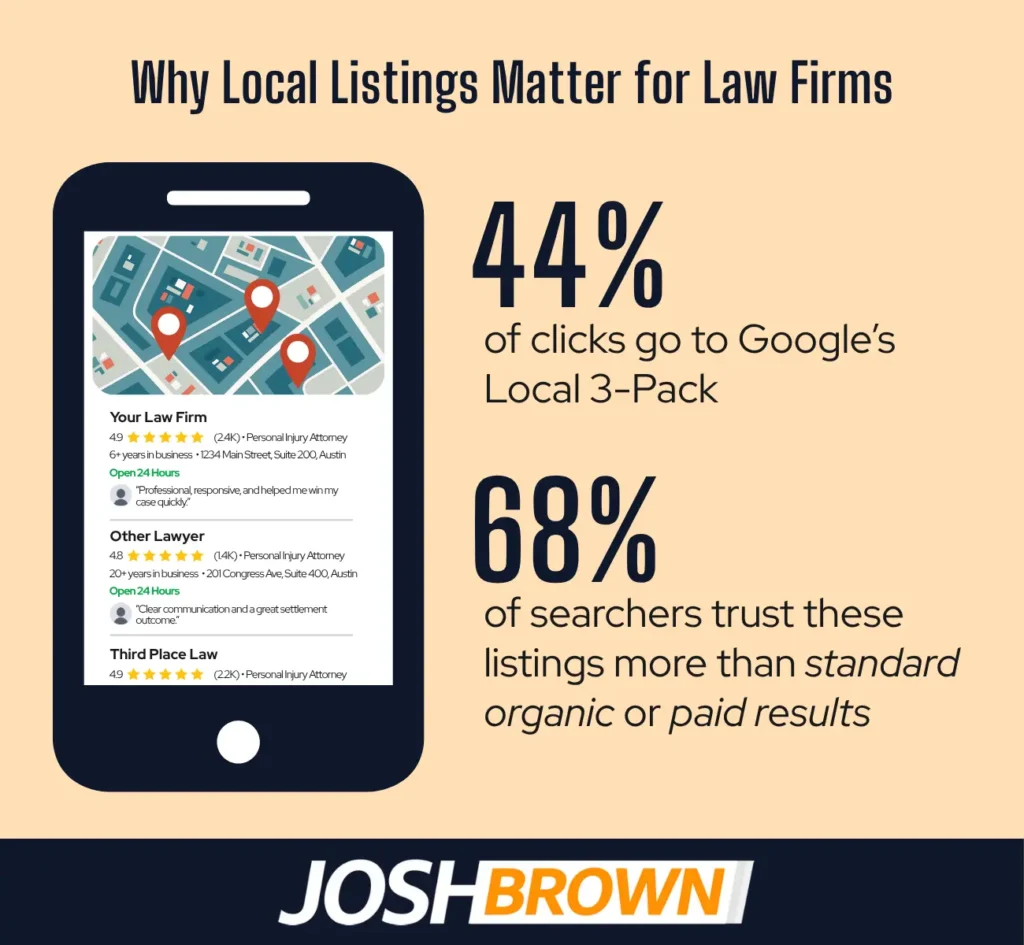
Optimizing the Google Business Profile (GBP) is foundational to local SEO for law firms. Verified GBP listings that use accurate legal service categories, geo‑targeted descriptions, and high‑quality photos improve Google Maps ranking. Consistent 4–5 star reviews further bolster credibility and search performance.
Effective local SEO strategies include creating city-based landing pages, implementing LegalService schema markup, building local backlinks, and ensuring mobile-friendly website performance. These measures help attorneys appear in local search results and reinforce relevance to specific service areas. For instance, personal injury lawyers gain visibility by targeting accident-related long-tail keywords and publishing locally focused case content.
Geographic consistency, uniform NAP (Name, Address, Phone) data across directories, and embedding local maps on websites also enhance search engine trust. Tools like BrightLocal, Semrush, Ahrefs, and LawLytics support citation tracking, keyword audits, and website optimization. Local listings amplify law firm credibility, client engagement, and visibility in competitive regional markets.
What is the Best Local SEO Strategy for Law Firms?
The best local SEO strategy for law firms is optimizing the Google Business Profile (GBP), building citations, earning local backlinks, and creating geo-targeted content to dominate local search results and Google Maps visibility.
Listed below are the best local SEO strategies for law firms.
- Google Business Profile (GBP) Optimization: Claim and verify your GBP, select accurate legal categories such as “Personal Injury Attorney, add photos, business hours, services, and update regularly with posts.
- Citation Building: Ensure consistent NAP (Name, Address, Phone) details across directories like Avvo, Justia, Yelp, and local business listings.
- Local Link Acquisition: Earn backlinks from regional chambers of commerce, bar associations, legal blogs, and trusted local media.
- Geo-Targeted Content Creation: Build city- or neighborhood-specific landing pages with unique legal service content tailored to each area.
- Client Review Generation: Actively request client reviews on GBP and legal-specific platforms like Martindale-Hubbell or Lawyers.com, aiming for 4–5 star ratings.
- Schema Markup for Legal Services: Use the LegalService schema to help search engines understand your business type and improve rich results.
- Mobile and Speed Optimization: Ensure fast load times and mobile responsiveness to meet Google’s Core Web Vitals standards.
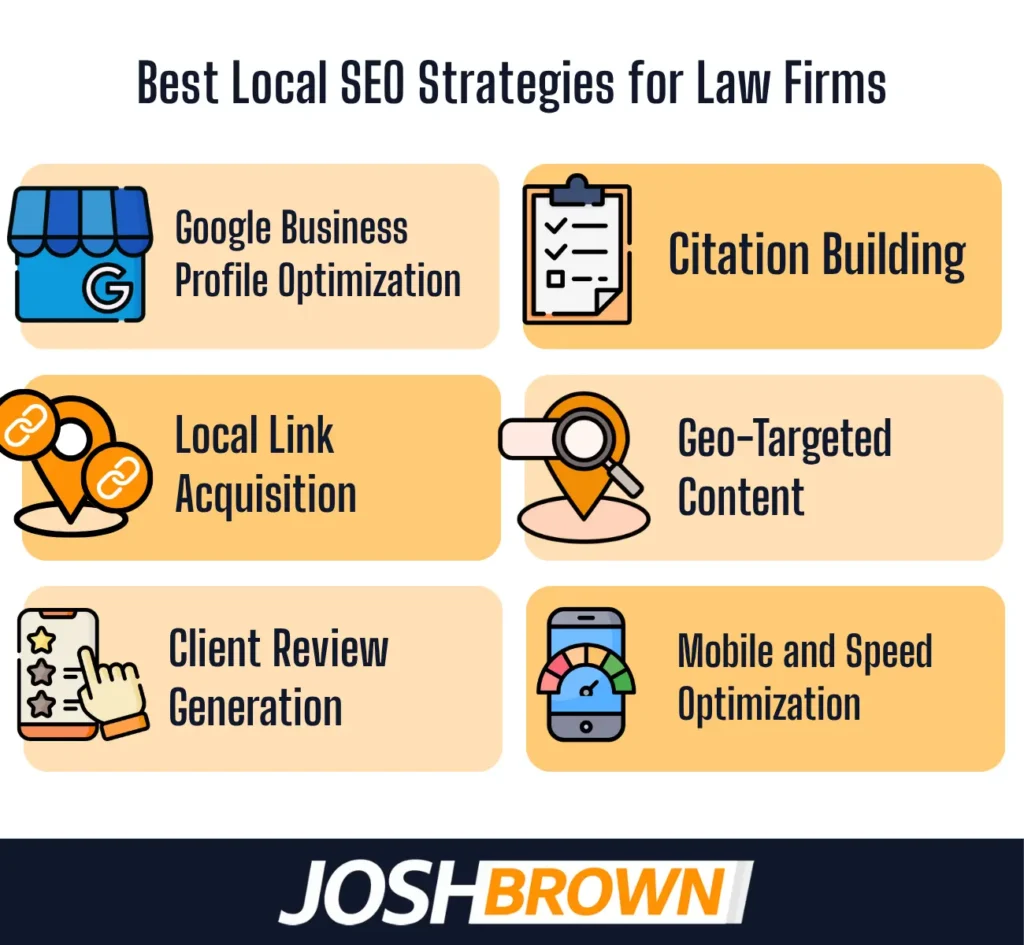
These strategies, when combined, help law firms dominate local search and convert more qualified leads.
How Can Lawyers Improve Their Google Maps Ranking Through Local SEO?
Lawyers can improve their Google Maps ranking through Local SEO by verifying their Google Business Profile (GBP), gathering consistent 4–5 star reviews, embedding their office map location on their website, maintaining consistent NAP (Name, Address, Phone number) across directories, and implementing local schema markup. These efforts enhance Google’s trust in a law firm’s geographic relevance and service accuracy, which boosts placement in the 3-Pack. High authority citations, strong page load performance, and geo-targeted legal content also play a critical role in Google ranking through local SEO by helping search engines associate the law firm with the exact location and legal service areas it targets.

What are the Most Effective SEO Techniques for Attorneys and Legal Practices?
The most effective SEO techniques for attorneys and legal practices are On-Page SEO Optimization, Local SEO Tactics, Authoritative Link Building, Content Marketing, and strategies that improve online visibility, drive organic traffic, and help law firms rank in competitive legal searches.
Listed below are the most effective SEO techniques for attorneys and legal practices.
- On-Page SEO Optimization: Includes optimizing title tags, headers, and content with legal keywords such as “divorce lawyer in Miami” to increase search relevancy.
- Local SEO Tactics: Verifying and optimizing the Google Business Profile, embedding maps, and using consistent NAP citations improve local search presence. According to Moz 2023, local signals account for over 25% of Google’s local pack ranking factors.
- Authoritative Link Building: Acquiring backlinks from legal directories, bar associations, and high-authority publications boosts domain authority and search engine trust.
- Content Marketing: Creating location-specific blog posts, FAQs, and service pages targeting long-tail legal keywords helps attract traffic with high intent.
- Technical SEO Improvements: Fast page speed, mobile responsiveness, SSL encryption, and clean site structure enhance user experience and crawling.
- Legal Schema Markup: Implementing the “LegalService” schema helps Google understand your practice area and location, boosting visibility in rich results.
These strategies, when combined, improve a law firm’s digital presence, helping capture more clients through organic search.
How is SEO for Solicitors Different from General Legal SEO?
The difference between SEO for solicitors and general legal SEO is based on geography, terminology, and user search behavior. SEO for solicitors focuses on UK-specific platforms like Yell and ReviewSolicitors, and uses terms like conveyancing or family solicitor, while general legal SEO, common in the U.S., relies on directories like Avvo and uses terms like attorney or lawyer. User intent also varies, with UK users seeking solicitor-based services under the UK legal system.
As shown in a 2023 study by BrightLocal titled Local Consumer Review Survey, 87% of UK consumers read reviews for local services, reinforcing the need for solicitors to optimize their presence on region-specific directories and review platforms
What Services are Included in Local SEO for Lawyers?
Local SEO services for lawyers include local keyword research, Business directory listings, Reputation management, Geo-targeted content creation, Google Maps optimization, etc, tailored to improve geographic visibility and client acquisition in competitive legal markets.
Listed below are 8 Local SEO services for lawyers.
- Local keyword research, such as divorce lawyer in [city], to target high-intent regional search terms.
- Business directory listings across platforms like Google Business Profile, Yelp, Justia, and Avvo.
- Reputation management to monitoring, collecting, and responding to client reviews across local platforms.
- Geo-targeted content creation, including city-specific landing pages and blog posts addressing local legal issues.
- Local schema markup setup, such as LegalService and LocalBusiness schema, for enhanced search engine interpretation.
- NAP consistency optimization ensures your Name, Address, and Phone Number match across all listings.
- Google Maps optimization through verified listings, legal category selection, and photo uploads.
- Mobile and speed optimization to align with local search behavior and Google’s Core Web Vitals.
What are the Top SEO Strategies for Personal Injury Lawyers?
The top SEO strategies for personal injury lawyers include creating content hubs, developing geo-targeted location pages, targeting medical and injury-related keywords, etc, techniques designed to increase visibility in high-intent, location-based search queries relevant to accident and injury law.
Listed below are the top SEO strategies for personal injury lawyers.
- Create content hubs focused on accident types (car, slip and fall, wrongful death) to build topical authority.
- Develop geo-targeted location pages for each city or neighborhood served.
- Target medical and injury-related keywords such as “spinal cord injury lawyer” or “traumatic brain injury attorney.”
- Earn high-authority backlinks from legal directories, local news sources, and health organizations.
- Collect and manage local reviews to improve trust and prominence in Google’s local pack.
- Add the AQ schema and LegalService schema to enhance search snippets and indexability.
- Optimize for mobile-first indexing and Core Web Vitals to meet technical SEO standards.
- Embed maps and ensure consistent NAP to support local SEO accuracy and ranking.
What are the Top Law Firm SEO Tactics in 2023?
The top law firm SEO tactics in 2023 are E‑E‑A‑T Optimization, Core Web Vitals Improvements, Mobile‑First Indexing, Voice Search Readiness, etc, strategies that align with Google’s evolving emphasis on trust, user experience, and content depth.
Listed below are the most effective methods backed by research.
- E‑E‑A‑T Optimization (Experience, Expertise, Authoritativeness, Trustworthiness): Law firms showcasing attorney bios, credentials, and awards saw improved rankings as Google prioritizes E‑E‑A‑T signals for YMYL topics.
- Core Web Vitals Improvements: Enhancing metrics like LCP, FID/INP, and CLS boosts user experience and search performance; Google recommends meeting these standards for higher ranking.
- Mobile‑First Indexing: With mobile devices accounting for over 60% of visits, a responsive site layout is essential for ranking and usability.
- Voice Search Readiness: Optimizing for natural language queries and featured snippets caters to voice-based searches like “best divorce lawyer near me.”
- Topical Authority Building: Creating pillar pages and related blog clusters (e.g., “personal injury”) establishes depth and boosts content authority across practice areas.
Combining these tactics helps law firms enhance credibility, improve technical health, and gain trust signals necessary to compete in 2023’s digital legal landscape.
What Tools and Platforms are Best for Attorney Search Engine Optimization?
Lawyers can use tools like SEMrush, Ahrefs, BrightLocal, Google Search Console, and Screaming Frog to improve their attorney search engine optimization through keyword tracking, site auditing, local visibility, and technical performance analysis.
Listed below are the 7 Best tools for Attorney Search Engine Optimization.
- SEMrush: For keyword research, backlink audits, and content performance in legal markets.
- Ahrefs: To analyze competitors’ link profiles, keyword gaps, and authority signals.
- BrightLocal: Best for tracking local rankings, citations, and Google Business Profile accuracy.
- Google Search Console: Monitors indexing issues, site errors, and user engagement from Google.
- Screaming Frog: Performs technical site crawls to fix SEO problems like broken links or metadata issues.
- LawLytics: A legal-specific platform offering SEO-friendly web management and content tools.
- Clio Grow: Supports lead tracking and integrates with SEO campaigns to nurture client conversions.

How Should Lawyers Optimize for Local Google Search Engine Visibility?
Lawyers optimize for local Google search engine visibility by refining their Google Business Profile, maintaining accurate citations, producing geo-targeted legal content, and acquiring backlinks from authoritative local sources. According to the 2023 Local Search Ranking Factors Study by Whitespark, Google Business Profile signals, on-page signals, and review signals are the top three local ranking factors.
Lawyers further improve their local SEO performance by selecting precise legal categories, encouraging high-quality client reviews, and embedding Google Maps on their practice area pages, common practices followed by those where lawyers optimize for maximum local visibility.