
Josh Brown
CEO & Founder, Josh Brown Consulting
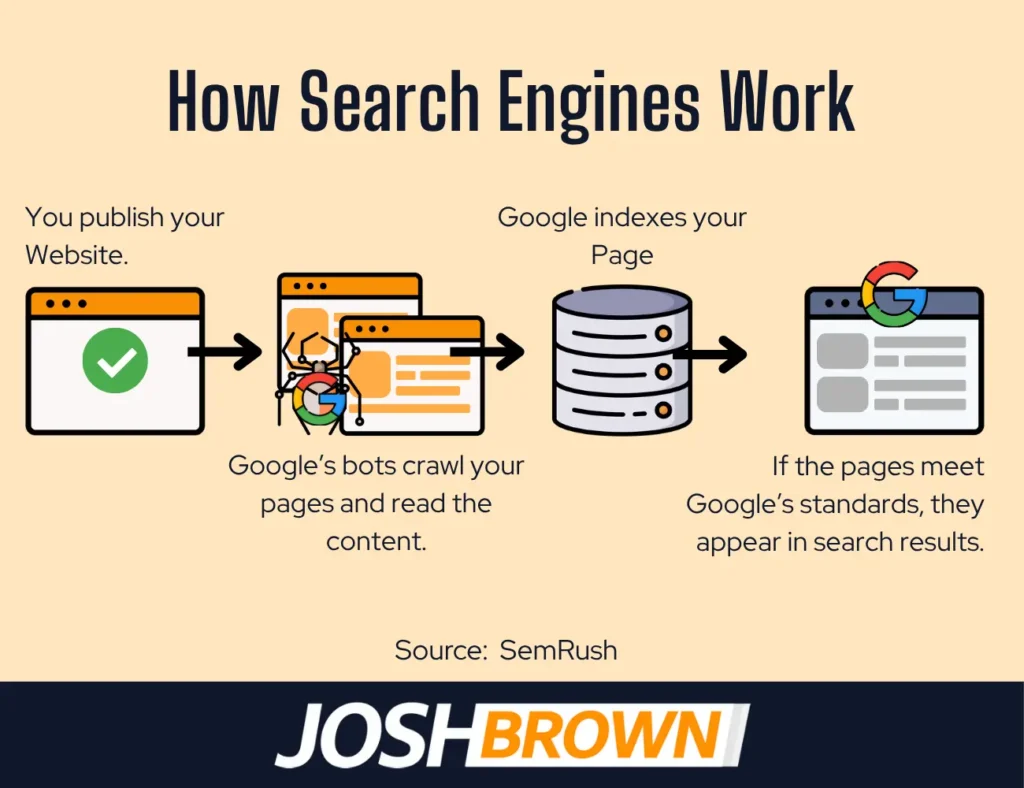
Legal SEO is the process of optimizing a law firm’s website to appear in search results for relevant legal services and locations. Proper Google indexing involves submitting an XML sitemap, using clean URL structures, fixing crawl errors, and applying robots.txt and canonical tags correctly. Google Search Console must be used regularly to monitor indexing status, structured content, and errors.
Technical SEO for law firms includes mobile-first design, HTTPS security, fast load speeds, clean code, schema markup, and avoiding duplicate pages. A study by Databox in 2023, titled “How Updating Old Blog Posts Boosts SEO,” found that refreshing content with new text and images increases organic traffic by up to 106%.

Civil litigation SEO builds authority on practice area pages, earns backlinks from credible legal sources, and targets dispute resolution keywords. Keyword research with Google Keyword Planner, Ahrefs, and Semrush identifies long-tail and local terms. Core SEO services for lawyers include on-page optimization, local SEO, backlink building, content creation, and technical audits.
Content creation, blogs, FAQs, case studies, and service pages support rankings and client trust. Personal injury lawyers gain from city-specific landing pages, Google Business Profile optimization, and targeted injury-related content.
What Is the Best Index Guide For Lawyers?
The best index guide for lawyers is a structured process that ensures a law firm’s website is fully crawlable, properly indexed, and optimized for search engine visibility. An effective setup includes a well-organized XML sitemap to help search engines find important pages, a correctly configured robots.txt file to control crawler access, and crawl budget optimization to prioritize high-value content.
Applying noindex tags to low-value or duplicate pages prevents ranking dilution, while regular use of Google Search Console verifies index coverage, detects errors, and monitors page visibility. Proper indexing directly impacts rankings by ensuring that search engines discover, understand, and rank the firm’s most important legal service pages in relevant search results.
What Are the Key Technical SEO Practices for Law Firm Websites?
The key technical SEO practices for law firm websites are site speed optimization, mobile responsiveness, HTTPS security, structured data use, and fixing crawl errors, all of which improve site infrastructure, crawlability, and search performance.
Listed below are the main technical SEO practices for law firm websites.
- Site Speed Optimization: Reduce load times through image compression, caching, and efficient code.
- Mobile Responsiveness: Ensure pages display and function correctly on all devices.
- HTTPS Security: Use SSL certificates to protect user data and signal trustworthiness.
- Structured Data Use: Implement schema markup to help search engines understand legal service details and support rich results.
- Fixing Crawl Errors: Identify and resolve broken links, redirect issues, and blocked resources to maintain accessibility.
Following these key technical SEO practices for law firm websites ensures that both users and search engines navigate and understand important legal content effectively.
How Does Search Engine Optimization Work for Civil Litigation Law Firms?
Search engine optimization (SEO) for civil litigation law firms works by deploying targeted content strategies based on legal case types, focusing on service-based local keywords, and optimizing practice area pages to rank effectively for relevant search queries. Content strategies emphasize jurisdiction-specific topics such as contract disputes, employment litigation, or personal injury defense, directly responding to user search intent. Incorporating phrases like “civil defense attorney in [city]” into headings, metadata, and main text ensures alignment with how potential clients search. Practice area pages gain traction through structured layout, internal linking, and schema markup, boosting crawlability and visibility.
Law firms that implemented localized, targeted keyword strategies witnessed performance improvements. In one study, firms using location-based terms achieved an average 35% increase in organic traffic.
How Can Attorneys Perform Effective Keyword Research for Legal SEO?
Attorneys can perform effective keyword research for legal SEO by using Google Keyword Planner, analyzing competitor terms, targeting long-tail legal queries, and aligning keywords with user intent.
Listed below are ways to perform effective keyword research for legal SEO.
- Use Google Keyword Planner: Identify search volumes, trends, and competition for relevant legal terms.
- Analyze Competitor Terms: Review competitor websites to uncover high-performing keywords they rank for.
- Target Long-Tail Legal Queries: Focus on specific phrases like “family law attorney for custody in [city]” to capture qualified traffic.
- Align Keywords with User Intent: Select terms that match informational, navigational, or transactional search goals.
A 2023 study by Markitors titled “SEO Statistics That Prove Its Effectiveness” found that long-form content over 3,000 words gets 3× more traffic, 4× more shares, and 3.5× more backlinks than average-length content, confirming the power of detailed, keyword-rich pages.
What Are the Best SEO Services Available for Lawyers?
The best SEO services available for lawyers are on-page optimization, content writing, link building, local SEO, and analytics reporting, all tailored to improve a legal website’s visibility, authority, and client acquisition. These services involve technical, on-page, and off-page optimization for legal markets. Firms that implement the best SEO services for lawyers gain competitive advantages by targeting relevant legal keywords, optimizing site performance, and building authority through reputable sources.
Listed below are the best SEO services available for lawyers.
- On-Page Optimization: Improves meta tags, headings, content structure, and keyword placement.
- Content Writing: Produces jurisdiction-specific articles, blog posts, and service pages to attract targeted traffic.
- Link Building: Acquires backlinks from authoritative legal directories, publications, and local news outlets.
- Local SEO: Enhances Google Business Profile, local citations, and map rankings to attract nearby clients.
- Analytics Reporting: Tracks rankings, traffic, and conversion metrics to refine ongoing strategies.
How Important Is Content Creation in Legal SEO Strategy?
Content creation in legal SEO strategy is important because it drives rankings, attracts qualified traffic, and converts visitors into clients. High-quality blog posts address common legal questions and establish the firm’s authority. FAQs provide quick, targeted answers that improve user experience and capture featured snippets. Case studies showcase successful outcomes, building trust with prospective clients. Practice area pages explain specific legal services in detail, improving keyword relevance and search visibility. Examples of content that converts include jurisdiction-specific guides, step-by-step legal process explanations, and articles answering time-sensitive legal concerns, all of which encourage contact form submissions and phone inquiries.
What Are the Local SEO Tactics for Personal Injury Lawyers?
The local SEO tactics for personal injury lawyers are Google Business Profile optimization, local citations, reviews management, location-based keywords, and creating location landing pages.
Listed below are the 5 local SEO tactics for personal injury lawyers.
- Google Business Profile Optimization: Complete all business details, add service categories, and upload high-quality images.
- Local Citations: Ensure consistent name, address, and phone number across legal directories and business listings.
- Reviews Management: Request client reviews, respond promptly, and maintain a positive reputation.
- Location-Based Keywords: Use terms like “personal injury lawyer in [city]” in headings, meta descriptions, and content.
- Location Landing Pages: Create pages targeting each city or region served, with unique content and contact information.
What Is Legal SEO Marketing?
Legal SEO marketing refers to the practice of promoting law firms online through technical setup, content strategy, backlink development, and local search visibility tailored to legal audiences. The process includes optimizing website infrastructure for crawlability, creating jurisdiction-specific legal content that matches client search intent, acquiring backlinks from reputable legal and local sources to build authority, and improving visibility in Google Maps and local search results. This approach increases organic rankings, drives targeted traffic, and positions the firm as a trusted authority in its practice areas.
Why Is Legal SEO Important for Lawyers?
Legal SEO is important for lawyers because it provides cost-effective client acquisition, improves local search rankings, and builds authority through sustained organic visibility. By targeting relevant legal keywords and optimizing for local search, law firms attract qualified leads without ongoing advertising costs.
Higher rankings in Google Maps and local results increase visibility to clients actively seeking legal services. Consistently publishing optimized content and earning reputable backlinks enhances the firm’s credibility, positioning it as a trusted source within its practice areas.
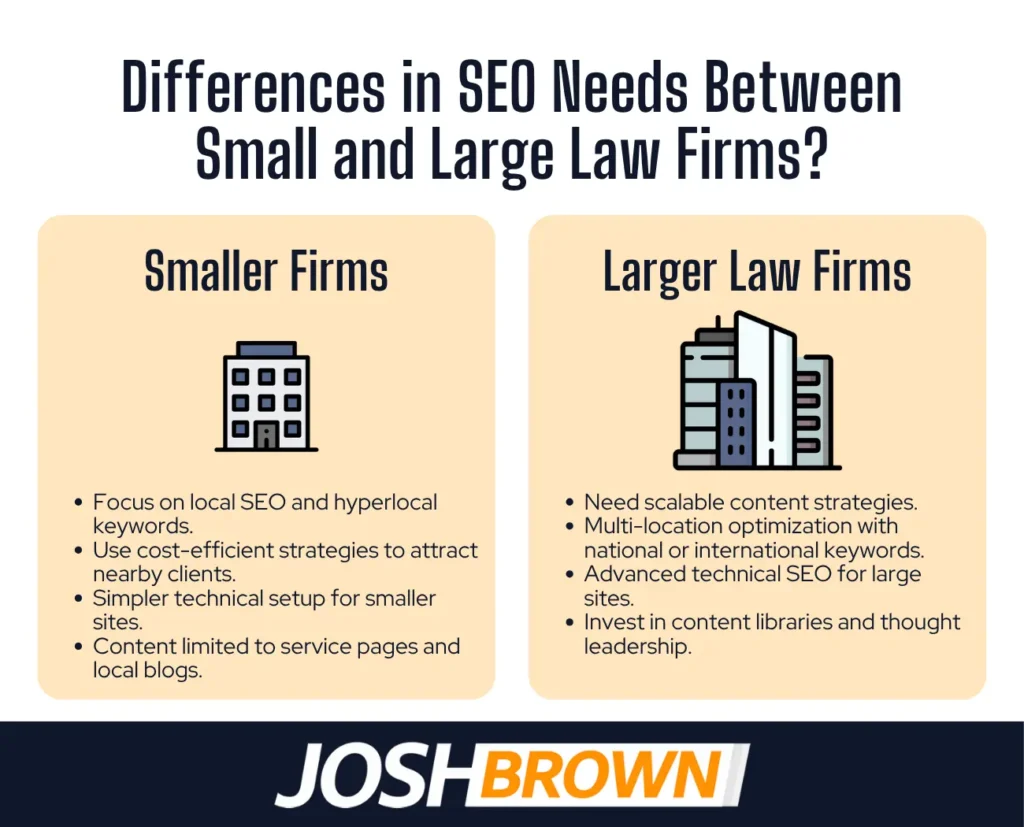
What Are the Differences in SEO Needs Between Small and Large Law Firms?
The differences in SEO needs between small and large law firms are that small firms focus on local SEO, hyperlocal keywords, and cost-efficient strategies, while large firms require scalable content, multi-location optimization, national keyword targeting, and advanced technical SEO. Understanding the SEO differences between small and large law firms helps match strategies to business size and goals.
Listed below are the 4 differences in SEO needs between small and large law firms.
- Small Law Firms: Focus on local SEO, hyperlocal keywords, and cost-efficient strategies to attract nearby clients.
- Large Law Firms: Require scalable content strategies, multi-location optimization, and national or international keyword targeting.
- Technical Requirements: Small firms maintain simpler site structures, while large firms need advanced technical SEO to manage large websites and multiple practice areas.
- Content Scope: Small firms prioritize service pages and local blog content; large firms invest in high-volume content libraries and thought leadership resources.