


Josh Brown
CEO & Founder, Josh Brown Consulting
Family law marketing is the practice of promoting family law services through SEO, content marketing, and PPC to attract and convert clients. Family law covers divorce, child custody, adoption, and related family disputes, making client acquisition dependent on trust and visibility. Effective family law firm marketing strategies include SEO, Google Business Profile optimization, local ads, reviews, and referral partnerships.
SEO benefits family law attorneys by improving search visibility, attracting local clients, and building credibility. A BrightEdge study titled “Organic Share of Traffic Increases to 53%” in 2019 found that about 53% of trackable website traffic comes from organic search. Unlike other fields, SEO for family law attorneys requires empathetic messaging to match the sensitive nature of client needs.
Content marketing strategies include blogs, FAQs, guides, and video content that address client concerns. PPC for family law firms uses paid ads with keywords like “divorce lawyer near me” to generate immediate leads. Family lawyers run PPC campaigns with geo-targeting, optimized ad copy, and landing pages for conversions. Marketing services come from legal marketing agencies or freelance consultants.
Effective family law advertising channels include Google Ads, local SEO, social media, and legal directories. Family law marketing supports long-term growth through consistent visibility, referrals, and client trust. Best practices include ethical compliance, transparent messaging, and consistent publishing. Success tracking uses KPIs like rankings, inquiries, cost per lead, and ROI. Attorneys avoid mistakes like poor mobile optimization, ignoring reviews, targeting broad keywords, or relying only on referrals.
What Is Family Law Marketing?
Family law marketing is the promotion of divorce, custody, adoption, and related services through SEO, PPC, referrals, content strategies, and reputation building. Family law marketing drives attorney promotion by improving visibility in search results, generating qualified client acquisition, and strengthening credibility.
Marketing combines legal advertising with digital tactics such as service-page SEO, paid search campaigns, referral partnerships, and consistent publishing of guides or blogs to position family lawyers as trusted advisors during sensitive legal disputes.
What Is Family Law?
Family law is a legal practice area that governs issues related to family relationships, such as divorce, child custody, adoption, and spousal support. Family law addresses both contested and uncontested matters, including property division, parenting time, guardianship, and domestic agreements. The practice provides legal frameworks for resolving disputes, protecting rights, and ensuring fair outcomes in sensitive family-related cases.
What Are the Best Family Law Firm Marketing Strategies?
The best family law firm marketing strategies are Local SEO, Google Ads, client reviews, content marketing, and social media presence.
Listed below are the 6 best family law firm marketing strategies.
- Local SEO: Improves visibility for divorce and custody searches with location-based keywords and map listings.
- Google Ads: Targets high-intent terms like “divorce lawyer near me” to generate immediate client inquiries.
- Client reviews: Builds trust and reputation by showcasing positive experiences on Google and legal directories.
- Content marketing: Uses blogs, FAQs, and guides on adoption, custody, or spousal support to attract and educate clients.
- Social media presence: Connects with families through consistent updates, educational posts, and community engagement.
- Referral networks: Strengthens client acquisition through partnerships with professionals and past clients.

How Does SEO Benefit Family Law Attorneys in Attracting Clients?
SEO benefits family law attorneys in their clients by improving online visibility, driving local search rankings, and generating qualified leads. Strategies such as local keywords, blog content, citations, and optimized service pages demonstrate how SEO helps family law attorneys attract clients through a stronger presence in search results. High rankings build credibility, while consistent content publishing and directory listings increase client attraction for divorce, custody, and adoption cases.
How Can SEO for Family Lawyers Increase Local Visibility?
SEO for family lawyers can increase local visibility by using location-based keywords, optimizing Google Business Profile listings, and building local citations. These strategies ensure that divorce and custody services appear in map results and local search queries, driving qualified leads in the lawyer’s geographic area. A study by Advice Local titled “Which Local Search Ranking Factors Matter in 2023” in 2023 reported that for Local Pack / Finder rankings: Google Business Profile signals accounted for ≈ 32%, On‑Page Signals ≈ 19%, Review Signals ≈ 16%, Backlink/Inbound Link Signals ≈ 11%, Behavioral Signals ≈ 8%, Citation Signals ≈ 7%, and Personalization ≈ 6%.
How Does SEO for Family Law Attorneys Differ From Other Fields?
SEO for family law attorneys differs from other fields because it requires trust-building, localized targeting, and sensitive messaging that reflects the nature of divorce, custody, and adoption cases. Unlike personal injury SEO, which focuses on highly competitive keywords and large-volume lead generation, family law SEO emphasizes empathetic content and client trust.
Compared to corporate SEO, which covers broad business-related terms, SEO for family lawyers targets niche practice areas with localized keywords, service-specific pages, and client-focused resources to address immediate legal needs.
What Are Content Marketing Strategies in Family Law Lead Generation?
Content marketing strategies in family law lead generation are Divorce FAQs, blog posts on custody laws, video explainers, and client guides.
Listed below are 5 Content marketing strategies in family law lead generation.
- Divorce FAQs: Answer common client questions on divorce timelines, costs, and procedures to capture search traffic.
- Blog posts on custody laws: Provide updates and insights into custody arrangements, modifications, and parental rights.
- Video explainers: Simplify complex topics like adoption steps or spousal support through short, informative videos.
- Client guides/checklists: Offer structured resources on divorce preparation, custody hearings, or settlement planning.
- Case study summaries: Showcase past outcomes to build credibility and demonstrate family law expertise.

What Is PPC for Family Law Firms?
PPC for family law firms is a paid advertising strategy where attorneys use Google Ads to bid on keywords like “divorce lawyer near me” and pay per click to generate qualified leads. PPC for family law firms works by placing ads above organic results, driving immediate visibility and inquiries for divorce, custody, and adoption services. A study by WordStream titled “Google Ads Industry Benchmarks for 2023” in 2023 found that the average cost-per-click (CPC) in the Attorneys & Legal Services industry is $9.21, making it one of the highest across all sectors due to intense competition and high lead value.
How Can Family Lawyers Use PPC Campaigns to Generate Leads?
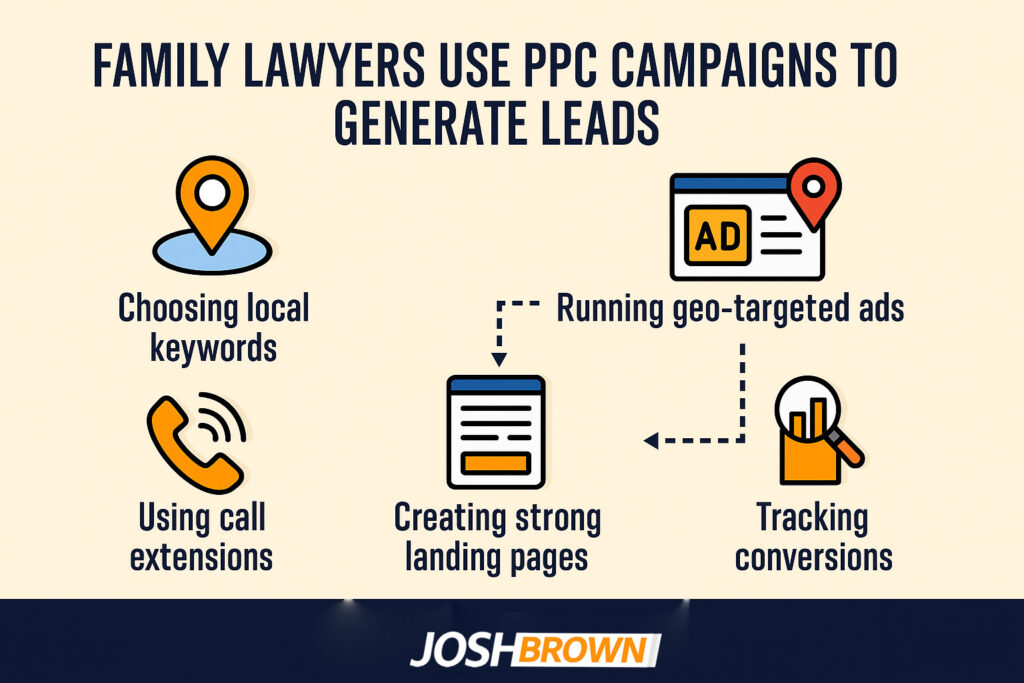
Family lawyers can use PPC campaigns to generate leads by choosing local keywords, running geo-targeted ads, using call extensions, and creating strong landing pages.
Listed below are the 4 steps Family lawyers use PPC campaigns to generate leads.
- Choosing local keywords: Target high-intent terms like “divorce lawyer near me” to reach clients in the service area.
- Running geo-targeted ads: Limit ads to specific cities or regions where family lawyers practice to increase relevance.
- Using call extensions: Add phone numbers to ads so potential clients can call directly from search results.
- Creating strong landing pages: Build pages with clear service details and calls-to-action to convert clicks into inquiries.
Tracking conversions: Measure calls, form submissions, and consultations through Google Ads and call tracking tools.
Where to Get Family Law Marketing Services
To get family law marketing services at Josh Brown, attorneys work with a legal marketing agency that provides SEO, PPC, content, and local advertising tailored to law firm growth. Agencies customize strategies for family and divorce law practices by focusing on client acquisition and reputation building.
Services include website audits, Google Business Profile optimization, paid campaign management, and content development. Costs vary by campaign size, but most agencies or consultants offer flexible pricing models to fit firm budgets while ensuring measurable results.
What Are the Most Effective Family Law Advertising Channels?
The most effective family law advertising channels are Google Ads, Local SEO, Facebook Ads, and referral networks.
Listed below are the 5 most effective family law advertising channels.
- Google Ads: Drives immediate visibility for divorce and custody services through high-intent keyword targeting.
- Local SEO: Improves search rankings with map listings, citations, and location-specific keywords.
- Facebook Ads: Reaches families with demographic targeting and educational content promotion.
- Referral networks: Generate consistent client leads through partnerships with past clients and professionals.
- Community sponsorships: Build awareness by supporting local organizations and events tied to family services.
Does Family Law Marketing Support Long-Term Growth?
Yes, family law marketing supports long-term growth by compounding the effects of SEO, client reviews, and brand authority. Consistent SEO builds online visibility, positive reviews strengthen client trust, and authoritative content increases credibility. Over time, these strategies generate sustainable referrals and repeat inquiries, ensuring steady growth for family law practices.
What Are the Best Practices for Family Law Attorney Marketing Online?
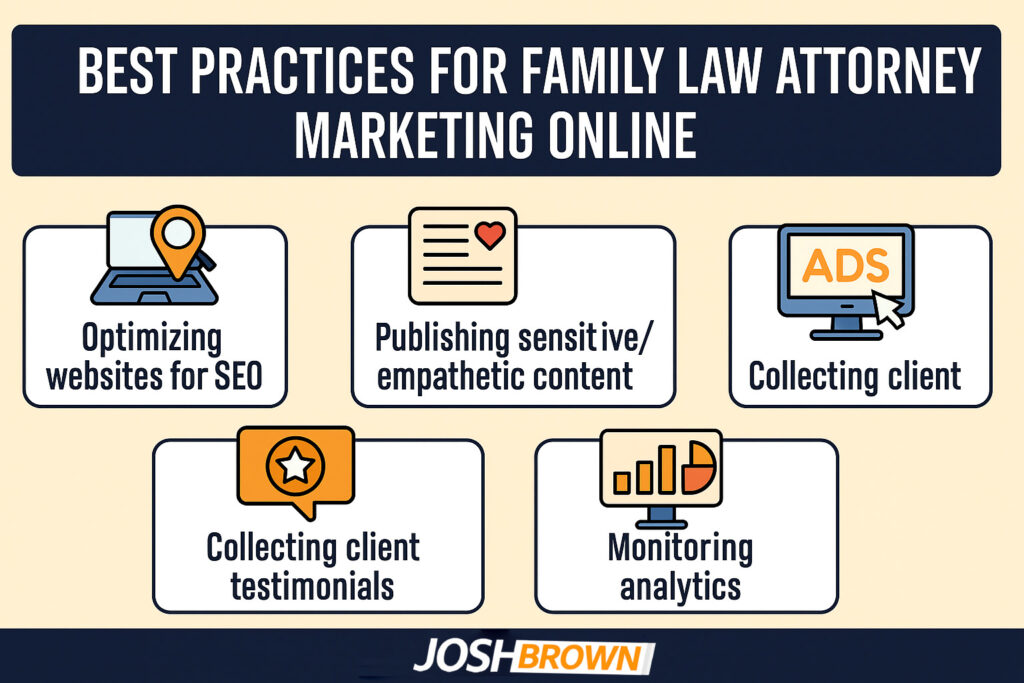
The best practices for family law attorney marketing online are optimizing websites for SEO, publishing sensitive content, collecting client testimonials, and running paid ads.
Listed below are the 5 best practices of family law.
- Optimizing websites for SEO: Improve visibility with local keywords, structured pages, and mobile-friendly design.
- Publishing sensitive/empathetic content: Address divorce, custody, and adoption topics with client-focused messaging.
- Collecting client testimonials: Build trust by showcasing positive experiences on Google and legal directories.
- Running paid ads: Use Google Ads and Facebook Ads to capture immediate family law inquiries.
- Monitoring analytics: Track keyword rankings, inquiries, and ROI through Google Analytics and ad dashboards.
How Do Family Lawyers Track Success in Digital Marketing Campaigns?
Family lawyers track success in digital marketing campaigns by monitoring keyword rankings, traffic, and conversions.
Listed below are the 5 steps of tracking success in digital marketing.
- Tracking keyword rankings: Measure visibility for divorce, custody, and adoption-related search terms.
- Measuring organic traffic: Use Google Analytics to track visits from SEO-driven content and service pages.
- Monitoring conversions: Record form submissions and consultation bookings from websites and ads.
- Reviewing call tracking: Analyze inbound client calls from PPC campaigns and local listings.
- Analyzing ROI: Compare marketing costs with new client revenue to evaluate profitability.
What Mistakes Should Family Law Attorneys Avoid in Online Marketing?
Mistakes family law attorneys should avoid in online marketing include ignoring local SEO, using generic ad copy, overlooking mobile optimization, and neglecting reviews.
Listed below are the 5 common family law firm marketing errors.
- Ignoring local SEO: Weakens visibility in map results and local searches for divorce and custody services.
- Using generic ad copy: Reduces click-through rates by failing to address client-specific concerns.
- Overlooking mobile optimization: Causes a poor user experience for clients searching on smartphones.
- Neglecting reviews: Damages credibility and lowers rankings on Google and legal directories.
- Failing to track ROI: Prevents attorneys from understanding which campaigns generate profitable leads.