


Josh Brown
CEO & Founder, Josh Brown Consulting

Estate planning marketing for lawyers uses SEO, content, and PPC strategies to attract clients and build authority. SEO tools like SEMrush, Ahrefs, Google Analytics, Google Search Console, and Moz support keyword research, performance tracking, and optimization. Estate planning lawyers improve SEO by creating keyword-rich service pages, FAQs, blogs, and client guides, while ensuring websites remain mobile-friendly.
Estate planning content includes checklists, wills and trusts guides, blog posts, videos, and case studies that educate prospects and convert them into clients. PPC for estate planning lawyers works through high-intent keywords such as “estate planning attorney near me,” geo-targeted ads, optimized landing pages, and conversion tracking.
Estate planning SEO companies provide website audits, local SEO, content creation, Google Business Profile optimization, and PPC campaign management. Attorneys use SEO marketing to rank higher with local keyword targeting, backlinks, optimized metadata, and consistent publishing. Digital marketing supports estate planning lawyers by increasing visibility, building trust, and generating qualified leads. Effective estate planning advertising strategies include Google Ads, local SEO, email newsletters, webinars, and structured client referral programs.
What are Estate Planning Marketing Lawyers?
Estate planning marketing lawyers are legal professionals who promote estate planning services through targeted digital strategies such as SEO, content, and PPC to promote wills, trusts, and probate services.
Estate planning marketing for lawyers helps attorneys drive client acquisition by making law firm promotion visible in local search results and positioning lawyers as trusted advisors.
Marketing builds authority through educational content, service pages, and a consistent online presence. Estate planning lawyers need marketing to compete effectively, reach families searching for legal help, and create strong branding that generates qualified leads.
What SEO Tools Are Used for Estate Planning Marketing for Lawyers?
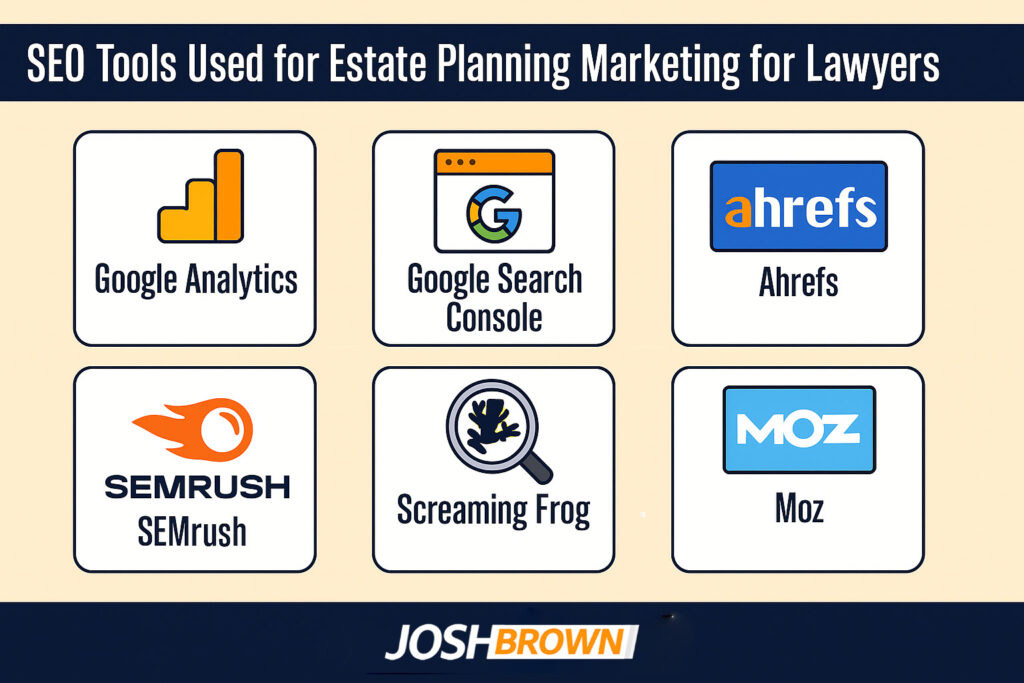
SEO tools used for estate planning marketing for lawyers are Google Analytics, Google Search Console, Ahrefs, SEMrush, and Screaming Frog. These tools help optimize websites, track performance, and improve search visibility.
Listed below are the 6 SEO tools used for estate planning marketing for lawyers.
- Google Analytics: Tracks website traffic, visitor behavior, and conversions for estate planning marketing performance.
- Google Search Console: Monitors search rankings, index coverage, and keyword visibility for law firm SEO.
- Ahrefs: Provides backlink analysis, competitor research, and keyword tracking for estate planning lawyers.
- SEMrush: Offers keyword research, site audits, and PPC insights to support law firm SEO campaigns.
- Screaming Frog: Crawls law firm websites to detect broken links, technical errors, and SEO issues.
- Moz: Delivers keyword research, domain authority tracking, and local SEO tools for estate planning attorneys.
How Should Estate Planning Lawyers Update Their Website Content for SEO?
Estate planning lawyers update their website content for SEO by adding practice-area keywords, updating local content, refreshing FAQs, and optimizing blogs for new laws.
Listed below are the 5 most effective updates.
- Adding practice-area keywords: Integrate estate planning terms, such as wills, trusts, and probate, into service pages for enhanced keyword relevance. A study by Ahrefs titled “Do Higher Content Scores Mean Higher Google Rankings?” in 2025 found that content scores have a weak but meaningful correlation with Google rankings, i.e., pages with higher content/topic coverage tend to rank better.
- Updating local content: Include geo-specific terms, such as “estate planning lawyer [city],” to capture local search traffic and enhance law firm promotion.
- Refreshing FAQs: Update FAQ sections with client-focused questions on probate, trusts, and wills to increase long-tail keyword reach.
- Optimizing blogs for new laws: Publish updated blogs when estate planning regulations change to build authority and improve topical relevance. A study by N. Krstić titled “The relationship between website management and search engine optimisation” in 2019 found that websites that performed weekly content updates had higher SEO scores compared to those that didn’t.
- Checking meta tags and headers: Ensure meta descriptions, titles, and headers reflect estate planning services and include high-intent keywords for better click-through rates.
What Tools Are Best for Tracking SEO and PPC Performance?
The tools best for tracking SEO and PPC performance are Google Analytics, Google Ads dashboard, Ahrefs, SEMrush, and CallRail.
Listed below are the 6 functions.
- Google Analytics: Tracks website traffic, user behavior, and conversions to measure SEO and PPC effectiveness.
- Google Ads dashboard: Monitors ad performance, click-through rates, and cost-per-click for PPC campaigns.
- Ahrefs: Provides backlink analysis, keyword tracking, and competitor research for SEO performance.
- SEMrush: Offers keyword monitoring, site audits, and integrated PPC tracking for estate planning lawyers.
- CallRail: Tracks phone call leads from PPC ads and organic searches to measure client acquisition.
- HubSpot: Integrates SEO and PPC data with CRM to track lead sources, conversions, and client pipelines.

How to Do PPC for Estate Planning Lawyers?
You can do PPC for estate planning lawyers by researching estate-related keywords, creating ad groups, writing targeted ad copy, setting geo-targeting, and designing landing pages.
Listed below are the 6 steps.
- Researching estate-related keywords: Identify high-intent search terms such as “estate planning attorney near me” to target qualified leads.
- Creating ad groups: Organize PPC campaigns into groups focused on services like wills, trusts, and probate for better relevance.
- Writing targeted ad copy: Use direct messaging that highlights estate planning expertise and client benefits.
- Setting geo-targeting: Focus ads on specific locations where estate planning lawyers serve clients.
- Designing landing pages: Build optimized pages with clear calls-to-action and service details to increase conversions.
- Tracking conversions: Use Google Ads and call tracking software to measure form submissions, phone calls, and client inquiries.
What Services Do Estate Planning SEO Companies Usually Provide?
Estate planning SEO companies usually provide a set of digital marketing services that help lawyers increase visibility and client acquisition. These agencies support attorneys with keyword research, technical SEO, content marketing, local SEO, backlink building, and analytics reporting.
SEO companies align strategies with practice areas such as wills, trusts, and probate while integrating PPC strategies for estate planning lawyers to ensure campaigns reach qualified leads across search and paid channels.
How Can Estate Planning Attorneys Use SEO Marketing to Rank Higher?
Estate planning attorneys can use SEO marketing to rank higher by targeting long-tail keywords such as “living trust lawyer near me,” optimizing local profiles, publishing authoritative content, and encouraging client reviews. SEO marketing for estate planning attorneys improves visibility through consistent content publishing, backlinks, and optimized metadata. According to BrightLocal’s Local Consumer Review Survey 2023, 87% of consumers used Google to evaluate local businesses in 2022 (up from 81% in 2021).
How Does Digital Marketing Support Estate Planning Lawyers in Client Growth?
Digital marketing supports estate planning lawyers in client growth by increasing website traffic, generating qualified inquiries, and converting consultations into retained clients. SEO and PPC campaigns drive visibility for wills, trusts, and probate services, while content marketing builds trust through guides and blogs. Consistent lead generation from search and paid ads ensures measurable growth in client pipelines and steady law firm promotion.
What Are the Most Effective Estate Planning Advertising Strategies?
The most effective estate planning advertising strategies are Google Ads, Local SEO, Facebook Ads, educational webinars, and community sponsorships.
Listed below are the 6 most effective estate planning advertising strategies.
- Google Ads: Targets high-intent searches for estate planning services and drives immediate client inquiries.
- Local SEO: Optimizes law firm listings, maps, and reviews to attract nearby clients searching for wills and trusts support.
- Facebook Ads: Reaches families and individuals interested in estate planning with targeted demographic campaigns.
- Educational webinars: Provide value by teaching probate and trust basics while converting attendees into clients.
- Community sponsorships: Build law firm visibility through partnerships with local organizations and events.
- Referral marketing: Encourages satisfied clients to recommend estate planning attorneys, generating consistent new leads.