


Josh Brown
CEO & Founder, Josh Brown Consulting

Backlinks are inbound links from external websites pointing to a law firm’s site, helping Google evaluate authority and topic relevance. A backlink becomes authoritative when it comes from a trusted, high-domain-authority source such as legal publications, government pages, or major news outlets. Referring domains are the unique websites sending those backlinks. One site can send multiple backlinks, but it still counts as one referring domain. Referring domains differ from backlinks in that Google favors link diversity; multiple links from a single domain carry less weight than links from different trusted sources. A study by Ahrefs titled ‘’How Backlinks Influence Rankings in 2023’’ found that pages with more referring domains consistently rank higher in search results.
Lawyers can track and analyze referring domains using SEO tools like Ahrefs, SEMrush, or Moz to evaluate authority, relevance, and trustworthiness. Bad backlinks, those from spammy, irrelevant, or penalized sites, often originate from PBNs, link farms, or unvetted directories and can result in penalties, ranking drops, and loss of algorithmic trust. High-quality referring domains come through guest posts on legal blogs, listings on directories like Justia or Avvo, digital PR efforts, and bar association collaborations. Backlinks signal trust, authority, and relevance to Google based on topical alignment and domain power.
What is a Backlink in the context of legal SEO?
A backlink in the context of legal SEO is a hyperlink from an external website that points to a law firm’s website, signaling authority and trust to search engines. Backlinks help law firms rank higher by passing hyperlink authority, especially when the source is relevant, credible, and niche-specific. In legal SEO, quality backlinks from legal directories, trusted publications, or professional organizations support visibility, reinforce domain strength, and improve rankings for high-intent legal keywords.
When is a Backlink considered authoritative?
A backlink is considered authoritative when it comes from a high-domain-authority website that is trustworthy, topically relevant, and editorially placed. Authoritative backlinks originate from sources like legal publications, government sites, or well-established news outlets, and are embedded within related legal content. These links carry strong SEO value because they reflect both credibility and contextual alignment, signaling to search engines that the linked law firm is a reliable source within its field.
What is a Referring Domain for lawyer SEO?
A referring domain for lawyer SEO refers to a unique website that links to a law firm’s website, regardless of how many total backlinks it sends. Unlike backlink count, which includes all individual links, referring domains track how many distinct sources are linking.
This matters in SEO for lawyers because Google values link diversity; multiple backlinks from different domains signal broader authority and trust. More referring domains lead to stronger ranking potential than a high number of links from a single site.
How are Backlinks and Referring Domains different?
Backlinks and referring domains are different in how they measure link signals. Backlinks count total links, while referring domains measure unique linking sources.
Listed below are 5 ways in which backlinks and referring domains are different.
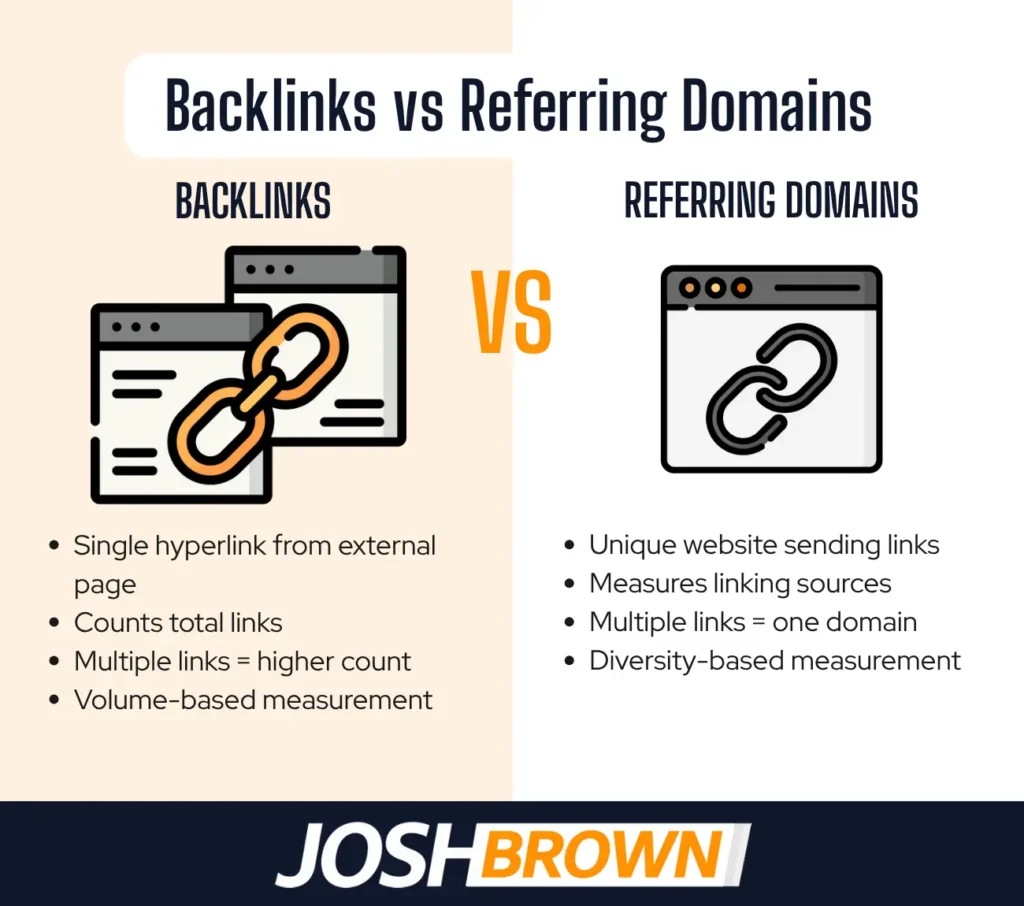
- Backlink: A single hyperlink from one external page to a law firm’s website
- Referring Domain: A unique website sending one or more backlinks
- Measurement: Multiple backlinks from the same site count as one referring domain
- SEO Impact: Google values diverse referring domains more than high backlink volume
- Ranking Influence: Referring domains send stronger trust signals across multiple sources
A study by Ahrefs titled “How Many New Backlinks Do Top-ranking Pages Get Over Time in 2023” found that pages with more unique referring domains ranked higher in SERPs

Why do Referring Domains matter more than total Backlink counts in many cases?
Referring domains matter more than total backlink counts in many cases because Google prioritizes link diversity from unique sources over repeated links from the same domain. For example, if a law firm receives 50 backlinks from one directory, that has less impact than getting 10 backlinks from 10 different legal sites.
Each unique referring domain signals independent validation, which carries more SEO ranking weight. This broader link profile reduces risk, increases credibility, and boosts the backlink value in Google’s algorithm.
How can lawyers identify and analyze their Referring Domains?
Lawyers can identify and analyze their referring domains by using SEO tools such as Ahrefs, SEMrush, Monitor Domain Authority (DA), and Identify Harmful Links that reveal backlink sources, authority metrics, and domain relevance.
Listed below are 7 ways a lawyer identifies and analyzes their referring domains.
- Ahrefs: displays referring domains with domain rating, traffic, and link growth
- SEMrush: shows backlink profiles, anchor text, and toxic link indicators
- Moz Link Explorer: reports domain authority, linking domains, and spam scores
- Monitor Domain Authority (DA): measures the trust level of each referring domain
- Evaluate Topical Relevance: checks if linking sites align with legal services
- Run Competitor Gap Analysis: compares domains linking to competing firms
- Identify Harmful Links: flags low-quality or spammy sources for disavowal

What are bad Backlinks?
Bad backlinks are links from spammy, irrelevant, or low-quality websites that damage a law firm’s SEO rather than help it. These toxic backlinks come from link farms, private blog networks (PBNs), auto-generated directories, or unrelated forums with no contextual relevance. Google penalizes sites associated with such links, leading to ranking drops, trust loss, or manual actions that impact visibility.
What are the risks of bad Backlinks for law firm websites?
The risks of bad backlinks for law firm websites are search ranking drops, manual Google penalties, and long-term damage to domain trust. Short-term effects include sudden visibility loss or traffic dips, while long-term exposure to link spam triggers algorithmic demotion, reduced indexing, and lower credibility with search engines.
What are the best strategies for acquiring high-quality Referring Domains?
The best strategies for acquiring high-quality referring domains are Guest Posting on Legal Blogs, listing on Legal Directories, and Digital PR Campaigns. Successful link-building strategies for law firms prioritize relevance and credibility, leveraging guest posts, authoritative directories, and legal community features to acquire premium referring domains.
Listed below are the 6 best strategies for acquiring high-quality referring domains
- Guest Posting on Legal Blogs: Earn links from niche-relevant publications
- Listing on Legal Directories: secure trusted citations from platforms like Justia and Avvo
- Digital PR Campaigns: gain media mentions through legal insights and news commentary
- Scholarship Outreach: attract edu backlinks by offering academic support
- Expert Contributions to HARO: receive editorial links from journalists
- Bar Association Features: earn backlinks through legal community engagement

How do Backlinks give signals in Google’s algorithm?
Backlinks give signals in Google’s algorithm by conveying authority, relevance, and trust through factors like anchor text, link context, and domain quality. In 2024, Google’s Link Context Algorithm began analyzing the semantic relationship between linking and linked content, emphasizing the importance of contextual relevance over sheer link quantity.

For instance, a backlink from a reputable legal publication to a law firm’s website, with anchor text like “estate planning attorney,” provides a strong signal of relevance and authority. Conversely, links from unrelated or low-quality sites are disregarded or even penalized. Therefore, building a backlink profile with diverse, high-quality, and contextually relevant links is crucial for improving search engine rankings.
What are the Backlink acquisition tips for legal SEO?
The backlink acquisition tips for legal SEO are to avoid link schemes and paid networks, target niche legal directories, create shareable legal content, and offer expert commentary that helps lawyers earn authoritative, relevant links without violating search engine guidelines.
Listed below are 7 backlink acquisition tips for legal SEO.
- Avoid Link Schemes and Paid Networks: maintain compliance and prevent penalties
- Target Niche Legal Directories: secure backlinks from trusted sources like Avvo and Justia
- Create Shareable Legal Content: produce guides, blogs, and FAQs that attract organic links
- Offer Expert Commentary: Contribute insights to legal and news platforms through HARO
- Build Attorney Profiles on Reputable Sites: link from bar associations and professional directories
- Run Digital PR Campaigns: gain backlinks from high-authority media mentions
- Use Internal Linking to Reinforce Authority – guide link equity toward key services and local pages.
How is competitor Backlink analysis for lawyers done?
Competitor backlink analysis for lawyers is done by using SEO tools to review the backlink profiles of top-ranking law firm websites and uncover link-building opportunities. Through strategic competitor analysis for lawyers, firms evaluate rival backlink profiles to identify link-building gaps and replicate high-value domains for improved SEO performance tools like Ahrefs, SEMrush, and Moz allow attorneys to extract referring domains, anchor text, and domain authority of competing firms. This analysis helps identify gaps, replicate high-value links, and develop a legal marketing strategy that improves law firm SEO performance.