

Josh Brown
CEO & Founder, Josh Brown Consulting

Case management software for law firms is digital law practice software that manages cases, clients, documents, billing, deadlines, tasks, and communication in one system. Clio, PracticePanther, Smokeball, and LEAP serve legal practices through matter management, billing, document storage, workflow automation, and remote access. Case management software benefits small law firms through centralized client data, lower administrative workload, secure document storage, billing integration, automated workflows, and scalable cloud access. A study by Fernanda Sobrino et al. from the Zacatecas State Prosecutor’s Office titled Improving criminal case management through Machine Learning system in 2026 confirms that a data-driven case management model achieved a 0.74 mean Precision@300 when prioritizing actionable legal cases from records spanning 2014–2024.

Clio provides cloud case management, dashboards, billing, document management, client communication, and more than 300 software integrations. Smokeball differentiates its practice tools through automatic time tracking and document automation, while LEAP combines matter management with document generation, legal forms, billing, and automatic time recording.
PracticePanther combines matter management with legal billing and payment workflows. Law firms use practice-specific software alongside cloud accounting platforms such as QuickBooks Online, Xero, and Zoho Books for financial management. Cloud case management gives law firms remote access to case data, centralized storage, controlled information access, and lower dependence on local office infrastructure.
Josh Brown helps law firms use AI tools for legal drafting, research, intake, and workflow automation. Contact Josh Brown for law firm AI strategy and implementation support. Josh Brown connects AI tools, legal workflows, staff productivity, and client intake with firm operations.
What is case management software for law firms?
Case management software for law firms is a digital legal tool that organizes cases, clients, documents, deadlines, billing, tasks, and communication in one system. Case management software supports workflow management through document storage, calendaring, task tracking, client records, billing integration, and team collaboration. Law firm technology reduces administrative work and keeps legal matters organized across the practice.

What are the Best Case Management Software for Lawyers?
The best case management software for lawyers includes Clio Manage, MyCase, Filevine, PracticePanther, and Smokeball, billing, deadlines, client communication, and workflows. The best legal software depends on firm size, practice area, accounting needs, workflow structure, and deployment requirements.
Listed below are the 23 case management software options for lawyers.
- 1. Clio Manage: Clio Manage is cloud-based legal case management software for matters, documents, calendars, billing, tasks, and client communication. Clio Manage helps law firms centralize case data and manage daily legal workflows from one platform.
- 2. MyCase: MyCase is cloud law practice management software for case management, intake, billing, documents, calendaring, and client communication. MyCase helps law firms manage clients and matters from initial intake through billing.
- 3. Filevine: Filevine is legal case management software for matters, documents, workflows, client communication, and reporting. Filevine helps law firms configure case processes around practice areas and high-volume legal work.
- 4. PracticePanther: PracticePanther is cloud legal software for matter management, billing, calendaring, documents, intake, and communication. PracticePanther helps law firms connect case activity with administrative and financial workflows.
- 5. Smokeball: Smokeball is legal practice management software for matters, documents, billing, intake, email, and time tracking. Smokeball helps law firms capture billable activity and automate repetitive document work.
- 6. Litify: Litify is a Salesforce-based legal management platform for intake, matters, documents, billing, workflows, and analytics. Litify helps law firms standardize legal operations and manage high-volume case data.
- 7. CASEpeer: CASEpeer is personal injury case management software for intake, treatment tracking, litigation, expenses, and settlement workflows. CASEpeer helps plaintiff firms organize medical information, deadlines, tasks, and case activity.
- 8. CosmoLex: CosmoLex is cloud legal practice management software that combines matter management, billing, trust accounting, and business accounting. CosmoLex helps law firms manage legal work and financial records within one system.
- 9. Zola Suite, now CARET Legal: CARET Legal is the current version of Zola Suite and provides cloud legal practice management software. CARET Legal helps law firms manage cases, billing, accounting, documents, workflows, and client communication.
- 10. Actionstep: Actionstep is cloud legal practice management software built around configurable workflows and matter management. Actionstep helps law firms automate intake, documents, billing, accounting, CRM activity, and recurring processes.
- 11. Rocket Matter: Rocket Matter is cloud law practice management software for matters, billing, documents, tasks, and legal project management. Rocket Matter helps law firms connect casework with time tracking, invoicing, and administrative workflows.
- 12. Legal Files: Legal Files is case and matter management software for law firms, legal departments, and government legal teams. Legal Files helps legal teams organize documents, deadlines, tasks, workflows, contacts, and case records.
- 13. Neos: Neos is legal case management software from Assembly Software with a strong focus on personal injury practices. Neos helps firms manage intake, medical records, deadlines, settlement data, documents, and case timelines.
- 14. SmartAdvocate: SmartAdvocate is legal case management software for litigation and plaintiff-side law firms. SmartAdvocate helps firms manage intake, documents, procedures, deadlines, reporting, and settlement workflows.
- 15. LEAP: LEAP is cloud legal practice management software for case management, document drafting, billing, payments, and time recording. LEAP helps law firms manage matters and generate legal documents from one legal software environment.
- 16. PCLaw: PCLaw is legal practice software focused on matter management, billing, accounting, and trust accounting. PCLaw helps law firms connect financial records with client matters, expenses, calendars, and time entries.
- 17. MerusCase: MerusCase is cloud legal practice management software for cases, email, calendars, documents, billing, and workflows. MerusCase helps law firms connect case activity with practice-specific automation and administrative processes.
- 18. Lawcus: Lawcus is cloud legal practice management software built around CRM functions, case pipelines, and workflow automation. Lawcus helps law firms manage leads, active matters, billing, client portals, tasks, and intake.
- 19. Tabs3: Tabs3 provides legal practice management, billing, accounting, time tracking, and case management software. Tabs3 helps law firms connect financial operations with centralized matter records and workflow management.
- 20. AbacusLaw: AbacusLaw is legal practice management software for matters, calendars, billing, accounting, and document workflows. AbacusLaw helps firms organize client data, deadlines, conflict checks, trust accounts, and case activity.
- 21. CloudLex: CloudLex is cloud case management software built for personal injury law firms. CloudLex helps plaintiff firms manage intake, medical records, documents, deadlines, client communication, and settlements.
- 22. ProLaw: ProLaw is legal practice management software for matters, docketing, billing, accounting, timekeeping, and document operations. ProLaw helps law firms connect legal casework with financial and administrative management.
- 23. Centerbase: Centerbase is cloud law firm management software for matters, documents, billing, accounting, intake, CRM, and workflows. Centerbase helps law firms manage case activity, client relationships, financial operations, and staff workflows from one system.
1. Clio Manage
Clio Manage is cloud-based legal case management software for organizing matters, contacts, documents, calendars, tasks, time entries, and billing. Clio Manage provides centralized matter dashboards, secure client portals, document management, intake connections, billing, and legal AI functions. Clio Manage helps law firms maintain case information in one system and coordinate work across lawyers and support staff.
2. MyCase
MyCase is cloud law practice management software covering client intake, case management, billing, communication, and document workflows. MyCase includes intake forms, eSignatures, legal CRM functions, case records, calendaring, invoicing, and client communication tools. MyCase helps law firms move client information from initial inquiry through case work and billing without repeated data entry.
3. Filevine
Filevine is cloud case management software that centralizes legal matters, documents, tasks, client communication, billing information, and workflows. Filevine includes customizable case templates, document management, two-way texting, email capture, client portals, timekeeping, and workflow automation. Filevine helps law firms configure case processes around different practice areas and manage high document volumes.
4. PracticePanther
PracticePanther is cloud legal case management software for matters, billing, calendaring, documents, client intake, and communication. PracticePanther includes workflow automation, document version control, eSignatures, a client portal, time tracking, and integrations with Google Drive, Dropbox, Box, and OneDrive. PracticePanther helps law firms keep case activity and administrative work connected in one legal platform.
5. Smokeball
Smokeball is legal practice management software for matters, documents, email, calendaring, billing, intake, and time tracking. Smokeball includes automatic activity tracking, document automation, more than 20,000 templates, trust accounting, workflows, and Microsoft Word and Outlook integrations. Smokeball helps solo lawyers and smaller firms capture work activity and reduce repetitive document preparation.
6. Litify
Litify is a cloud legal management platform built around Salesforce technology for intake, matters, documents, billing, workflows, and analytics. Litify includes configurable workflows, AI-supported case operations, dynamic intake questionnaires, reporting dashboards, document management, and matter management. Litify helps larger firms and legal departments standardize processes and manage legal data across high-volume operations.
7. CASEpeer
CASEpeer is personal injury case management software for managing cases from intake through litigation and settlement. CASEpeer includes treatment tracking, case timelines, task management, calendaring, cost tracking, document storage, litigation tools, and AI functions. CASEpeer helps plaintiff firms organize medical treatment, deadlines, expenses, communications, and litigation activity around each personal injury case.
8. CosmoLex
CosmoLex is cloud legal practice management software that combines matter management with billing, trust accounting, business accounting, documents, tasks, and calendaring. CosmoLex includes workflows, client portals, document storage, time tracking, invoicing, payments, reporting, and accounting inside one system. CosmoLex helps law firms reduce dependence on separate practice management and accounting applications.
9. Zola Suite, Now CARET Legal
CARET Legal is the current name of Zola Suite and operates as cloud legal practice management software. CARET Legal includes case management, automated workflows, billing, accounting, payments, time tracking, reporting, calendaring, email, document management, and client communication. CARET Legal helps law firms manage front-office casework and back-office financial operations in one platform.
10. Actionstep
Actionstep is cloud legal practice management software focused on configurable workflows and matter operations. Actionstep includes matter management, client intake, document automation, billing, accounting, calendaring, CRM functions, reporting, and workflow automation. Actionstep helps midsize law firms standardize processes while adapting workflows, fields, and templates to firm requirements.
11. Rocket Matter
Rocket Matter is cloud law practice management software for case organization, billing, document management, tasks, and legal project management. Rocket Matter includes matter dashboards, document assembly, calendars, workflow automation, time tracking, invoicing, electronic payments, and reporting. Rocket Matter helps law firms connect casework with billing and administrative workflows.
12. Legal Files
Legal Files is case and matter management software used by law firms, legal departments, government organizations, and other legal teams. Legal Files includes document management, configurable workflows, task assignments, deadlines, dashboards, reporting, centralized contacts, and cloud or on-premises deployment. Legal Files helps legal teams create structured case processes and maintain documents, communications, and case data in centralized records.
13. Neos
Neos is case management software from Assembly Software focused heavily on personal injury practices. Neos includes intake, deadline tracking, case timelines, medical-record organization, document management, reporting, settlement data, and AI-generated demands and chronologies. Neos helps personal injury firms manage cases from intake through settlement using one connected case record.
14. SmartAdvocate
SmartAdvocate is legal case management software for law firms handling litigation and plaintiff-side matters. SmartAdvocate includes intake tools, automated procedures, document templates, dashboards, reporting, remote browser access, document storage, and built-in AI analysis. SmartAdvocate helps legal teams track matters from intake through settlement and maintain consistent internal processes.
15. LEAP
LEAP is cloud legal practice management software that combines case management, document drafting, billing, payments, and AI-supported legal work. LEAP includes matter management, document automation, legal forms, mobile access, accounting functions, time recording, and cloud access. LEAP helps law firms manage case information and generate frequently used legal documents without maintaining separate drafting systems.
16. PCLaw
PCLaw is legal matter management, billing, and accounting software used by law firms that require integrated financial controls. PCLaw includes trust accounting, billing, general ledger functions, matter records, time tracking, expenses, calendaring, tasks, and forms automation. PCLaw helps firms connect financial records with client and matter information inside one database.
17. MerusCase
MerusCase is cloud legal practice management software that connects cases, calendars, email, documents, billing, and practice-specific workflows. MerusCase includes document automation, batch scanning, electronic payments, case-linked actions, cloud storage, and practice-area functions. MerusCase helps law firms keep case activity connected to each matter and automate recurring administrative work.
18. Lawcus
Lawcus is cloud legal practice management software built around case pipelines, CRM functions, and no-code workflow automation. Lawcus includes client intake, matter management, client portals, time tracking, billing, invoicing, tasks, calendars, trust accounting, and automated workflows. Lawcus helps growing law firms automate repetitive tasks and manage leads and active cases from one system.
19. Tabs3
Tabs3 provides legal practice management through products including Tabs3 Cloud and PracticeMaster. Tabs3 combines billing, accounting, payments, case management, calendaring, document management, conflict checking, workflow automation, and time tracking. Tabs3 helps law firms connect financial operations with electronic case files and centralized matter records.
20. AbacusLaw
AbacusLaw is legal practice management software for client records, matters, calendaring, billing, accounting, and document-related workflows. AbacusLaw includes rules-based calendaring, conflict checks, time and expense tracking, trust accounting, document generation, and centralized case information. AbacusLaw helps firms organize case data and financial activity around each client matter.
21. CloudLex
CloudLex is cloud case management software built for personal injury law firms. CloudLex includes intake management, matter management, documents, deadlines, client communication, medical-record tracking, settlement management, analytics, and AI functions through Lexee AI. CloudLex helps plaintiff firms manage personal injury cases from lead intake through settlement within one connected system.
22. ProLaw
ProLaw is legal practice management software that connects client and matter management with docketing, time entry, billing, accounting, and document operations. ProLaw provides centralized case records, financial management, workflow functions, deadlines, and administrative controls for legal practices. ProLaw helps firms connect legal work with firm financial and operational management.
23. Centerbase
Centerbase is cloud law firm management software covering matters, documents, workflows, billing, accounting, intake, CRM, and timekeeping. Centerbase includes automated workflows, document management, client portals, calendaring, automated time capture, reporting, trust accounting, and integrations with Microsoft 365, QuickBooks Online, NetDocuments, and iManage. Centerbase helps midsize law firms connect casework, financial operations, client intake, and staff activity in one platform.
Does the best legal software help small law firms?
Yes, the best legal software helps small law firms by reducing administrative work, centralizing case data, automating routine workflows, and supporting growth without matching increases in staffing. Cloud-based legal software lowers dependence on on-premises infrastructure and gives lawyers remote access to matters, documents, billing, and client communication. Software scalability for small and mid-size law firms helps practices add users, matters, integrations, and workflow capacity as demand grows. Small law firms gain practice efficiency through automation, centralized data, and subscription-based legal technology.

What are the benefits of Case Management Software?
The benefits of case management software include centralized case files, automated documents, billable-time tracking, client communication, accounting integration, and workflow automation. Case management software improves law practice efficiency by reducing repetitive administrative work and organizing legal operations in one system.
Listed below are 13 benefits of case management software.
- 1. Manages case files: Case management software stores client records, documents, deadlines, notes, evidence, and case history in one matter file. Centralized case files help lawyers access current information faster.
- 2. Automates document management: Case management software automates document creation, storage, naming, filing, and retrieval. Document automation reduces repetitive drafting and keeps documents linked to the correct matter.
- 3. Tracks billable time: Case management software records billable work through timers, activity logs, and matter-based time entries. Billable-time tracking helps law firms capture work accurately and prepare invoices faster.
- 4. Handles client communication: Case management software centralizes emails, messages, calls, and client portal activity within each matter. Centralized communication gives legal teams a searchable record of client interactions.
- 5. Integrates accounting tools: Case management software connects matter records with billing, payments, expenses, trust transactions, and accounting platforms. Accounting integration reduces duplicate financial data entry and links legal work with financial records.
- 6. Customizes workflows: Case management software lets law firms configure tasks, stages, deadlines, forms, approvals, and notifications. Customized workflows help legal teams follow consistent processes across similar matters.
- 7. Provides case automation: Case management software automates recurring tasks, reminders, status updates, document generation, and workflow transitions. Case automation reduces manual work across intake, billing, case preparation, and client follow-up.
- 8. Enables accurate transcription: Case management software integrations transcribe calls, meetings, interviews, depositions, and dictated notes. Transcription tools create searchable records that lawyers review for legal terminology and material statements.
- 9. Ensures data portability: Case management software supports data export, migration, synchronization, and transfer between compatible systems. Data portability helps law firms retain control over contacts, documents, billing records, and matter data.
- 10. Supports reliable customer service: Case management software gives staff access to client history, case status, documents, deadlines, and prior communications. Client portals and centralized records help law firms respond to client inquiries faster.
- 11. Reduces administrative burden: Case management software reduces repetitive work involving scheduling, filing, data entry, billing, reminders, and status updates. Reduced administrative work gives lawyers and staff more time for legal matters and client service.
- 12. Scales for firm growth: Case management software supports additional users, matters, storage, integrations, and workflow capacity as a law firm grows. Scalable software helps firms increase case volume without rebuilding operational systems.
- 13. Maintains compliance standards: Case management software supports permission controls, audit trails, secure storage, deadline tracking, and document retention. Compliance controls help law firms manage confidentiality, recordkeeping, and internal legal procedures.
1. Manages Case Files
Case management software stores client details, pleadings, evidence, correspondence, deadlines, notes, and case history within a centralized matter record. Law firms implement case file management by assigning documents, tasks, contacts, and calendar events to each matter. Centralized case files give lawyers and authorized staff faster access to current matter information.
2. Automates Document Management
Case management software automates document creation, storage, naming, filing, version control, and retrieval. Document automation integrated into case management uses templates and matter data to generate recurring legal documents with fewer manual entries. Document automation reduces repetitive drafting and keeps case documents connected to the correct matter.
3. Tracks Billable Time
Case management software records billable work through timers, activity logs, calendar entries, and matter-based time entries. Law firms connect recorded time directly to clients, matters, billing rates, and invoices. Billable-time tracking reduces missed entries and gives firms clearer records of work performed.
4. Handles Client Communication
Case management software centralizes emails, messages, calls, notifications, and client portal activity within each matter. Law firms use communication records to maintain a searchable history of interactions between clients and legal teams. Client communication tools reduce fragmented conversations across separate email, phone, and messaging systems.
5. Integrates Accounting Tools
Case management software integrates billing and accounting tools with matter records, expenses, payments, invoices, and trust transactions. Law firms connect platforms such as QuickBooks Online or other accounting systems to reduce duplicate financial data entry. Accounting integration gives firms clearer links between legal work, client balances, expenses, and financial records.
6. Customizes Workflows
Case management software lets law firms configure tasks, stages, deadlines, approvals, forms, and notifications around specific practice areas. Law firms create workflow templates for recurring processes such as intake, discovery, settlement, or case closure. Customized workflows help legal teams follow the same process across similar matters.
7. Provides Case Automation
Case management software automates recurring tasks, reminders, document generation, status updates, and workflow transitions. Automating tasks across legal workflows reduces manual steps across intake, case preparation, billing, and client follow-up. Case automation improves productivity by moving routine work through predefined rules and triggers.
8. Enables Accurate Transcription
Case management software integrations support transcription of recorded calls, meetings, interviews, depositions, and dictated notes. Law firms attach searchable transcripts to the relevant client or matter record for later review. Automated transcription reduces manual note-taking, though legal teams still verify names, legal terminology, and material statements.
9. Ensures Data Portability
Case management software supports data export, migration, synchronization, and access across compatible systems. Law firms use data portability to move contacts, documents, matter records, billing information, and other structured data when changing platforms. Data portability reduces dependence on one software environment and supports long-term record control.
10. Supports Reliable Customer Service
Case management software gives legal teams centralized access to client history, case status, deadlines, documents, and prior communications. Law firm staff use current matter information to respond to client questions without searching across disconnected systems. Client portals, automated updates, and shared records support faster and more consistent client communication.
11. Reduces Administrative Burden
Case management software reduces repetitive work involving data entry, scheduling, document filing, billing, reminders, and status updates. Law firms shift routine administrative tasks into automated or standardized workflows. Reduced administrative workload gives lawyers and support staff more time for legal analysis, client work, and case preparation.
12. Scales for Firm Growth
Case management software supports firm growth through additional users, matters, storage, workflows, integrations, and permissions. Law firms expand software capacity without rebuilding separate systems for each new lawyer, employee, or practice group. Scalable legal technology keeps operational processes consistent as case volume and staffing increase.
13. Maintains Compliance Standards
Case management software supports compliance through permission controls, audit trails, deadline tracking, document retention, secure storage, and standardized workflows. Law firms use these controls to manage confidentiality, recordkeeping, trust-account processes, and internal policies. Compliance features create documented processes that support legal and professional obligations.
Can Clio improve case management for law firms?
Yes, Clio improves case management for law firms by centralizing matters, documents, billing, calendars, tasks, and client communication in one cloud-based system. Clio supports law firm efficiency through remote access, workflow automation, integrations with legal and business software, and a user-friendly interface. Clio case management software helps legal teams reduce duplicate data entry, access case information from different locations, and connect daily practice tools within one platform.
How does Smokeball compare with Clio?
Smokeball compares with Clio by focusing more heavily on automatic time tracking, document automation, and Microsoft Word and Outlook workflows. Clio offers broader cloud case management and 300+ software integrations. Smokeball AutoTime automatically records matter-related activity and converts tracked work into time entries.
Clio provides centralized matters, billing, documents, client communication, cloud access, and integrations across accounting, email, calendar, and document-storage tools. Smokeball suits law firms prioritizing automatic activity capture and document-heavy workflows, while Clio suits firms prioritizing a broad integration ecosystem and cloud-based practice management.
How does LEAP compare with Clio?
LEAP compares with Clio as a document-automation-focused legal practice platform, whereas Clio provides broader cloud case management, billing, client intake, legal AI, and software integrations. LEAP emphasizes automated legal forms, matter-based document generation, accounting, timekeeping, and Microsoft Office workflows. Clio offers tiered subscription plans covering matter management, billing, client portals, automation, reporting, and AI functions, whereas LEAP uses license-based subscription pricing obtained through its subscription portal or accounts team.
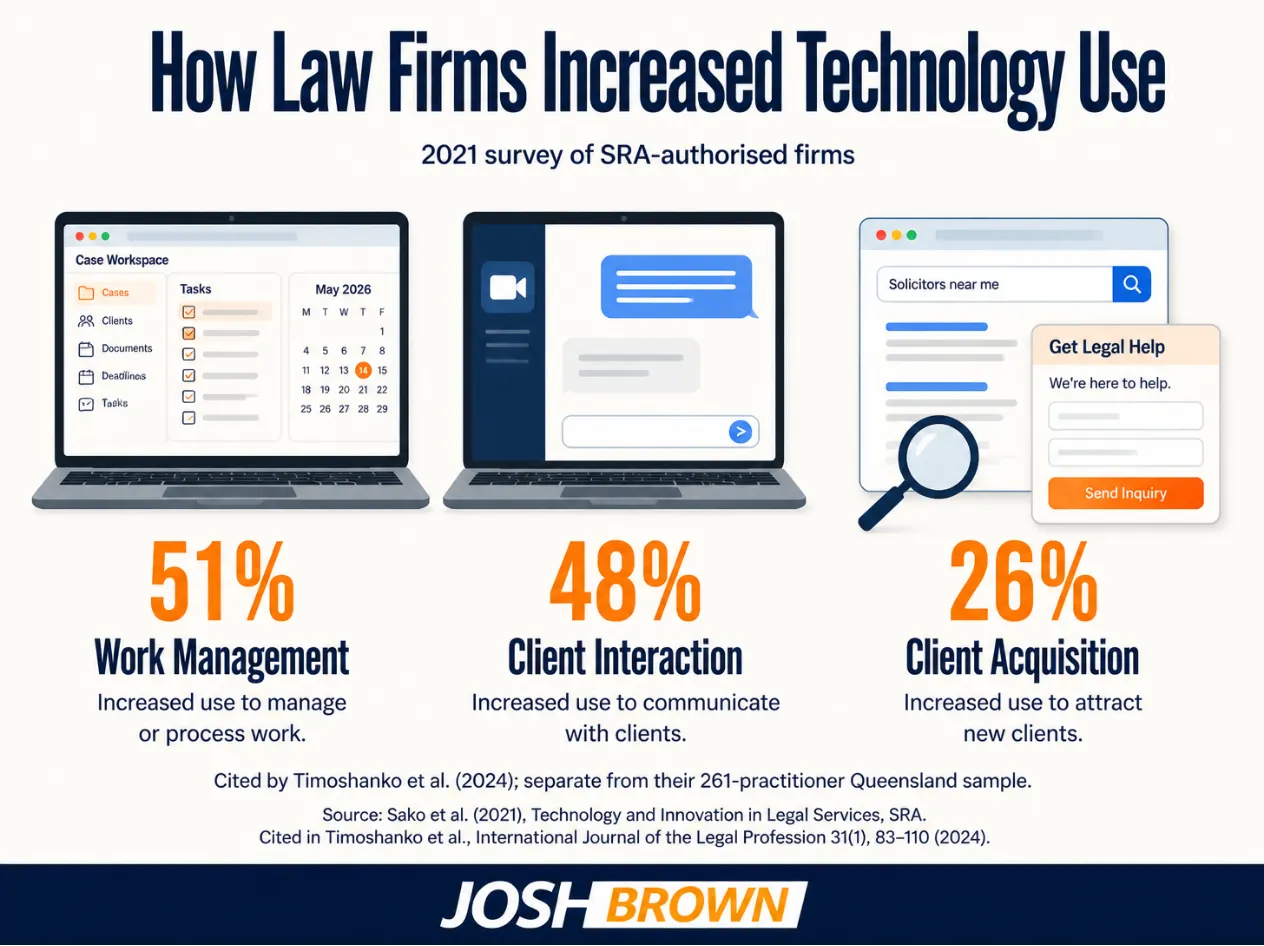
LEAP suits firms prioritizing document-heavy legal workflows and jurisdiction-based forms, whereas Clio suits firms seeking broader integrations and configurable cloud practice management. A study by Aaron Timoshanko, Caroline Hart, Francesca Bartlett, Angus Murray, and Andrea Perry-Petersen from Taylor & Francis (Legal Ethics) titled An empirical study of lawyers’ capability to adapt to disruption in Queensland, Australia in 2024 surveyed 261 legal practitioners and reported legal-sector research showing 51% of surveyed firms increased technology use for work management, 48% increased technology use for client interaction, and 26% increased technology use for client acquisition.
What other software is used by law firms?
Other software used by law firms includes digital legal tools that support eDiscovery, time tracking, communication, and legal research. Law firm tools extend case management systems by handling specialized legal and administrative workflows.
Listed below are the 15 common software types used by law firms.
- eDiscovery software.
- Time tracking software.
- Contract automation software.
- Client intake software.
- Legal billing software.
- Document management software.
- Legal research software.
- Accounting software.
- Customer relationship management software.
- Electronic signature software.
- Legal calendaring software.
- Practice analytics software.
- Secure client portal software.
- Transcription software.
- Cybersecurity software.
What are some cloud-based accounting software?
Some cloud-based accounting software helps law firms manage billing, expenses, trust accounts, payments, and financial reporting online. Cloud accounting tools give legal teams centralized access to financial records and reduce manual bookkeeping.
Listed below are the 10 common cloud-based accounting software options used by law firms.
- QuickBooks Online.
- Xero.
- CosmoLex.
- LeanLaw.
- Clio Accounting.
- Zoho Books.
- FreshBooks.
- Sage Accounting.
- Wave.
- PCLaw.