

Josh Brown
CEO & Founder, Josh Brown Consulting

Black hat SEO uses manipulative tactics that violate Google’s spam policies and risk ranking losses, penalties, traffic declines, or search-result removal. Black hat techniques include keyword stuffing, cloaking, private blog networks, low-quality or scaled content, and repeated violations of search policies. Google states that spam violations are detected through automated systems and, when needed, human review, with affected pages or websites potentially ranking lower or disappearing from results.
Link manipulation represents one of the most established black hat practices. Paid links that pass ranking signals, excessive reciprocal linking, automated backlink generation, low-quality network placements, and artificial anchor patterns attempt to manufacture authority rather than earn it through independent editorial recommendations. Cloaking manipulates another part of the ranking process by presenting search engines with content that differs materially from what visitors receive. Private blog networks combine these ideas by using controlled websites, often built or repurposed mainly for backlinks, to make a target website appear more authoritative than independent publishers actually consider it.
Google’s published anti-spam data shows the scale of automated enforcement. SpamBrain detected 5 times more spam sites in 2022 than in 2021 and detected 50 times more link-spam sites than Google’s previous link-spam system. Google also reported that more than 99% of visits from Search were spam-free in 2022. These figures support the risk associated with building an SEO strategy around tactics intended to escape detection rather than improve a website for users.

JoshBrown.io helps law firms avoid black hat SEO risks by identifying harmful tactics like link schemes, cloaking, and PBNs that damage search visibility and organic growth. Contact JoshBrown.io to build a compliant SEO strategy. JoshBrown.io analyzes SEO practices, improves content quality, builds authority, and implements sustainable AI-powered search strategies.
What Are Some Black Hat SEO Techniques to Avoid?
Some black hat SEO techniques to avoid include keyword stuffing, cloaking, PBNs, low-quality content, hidden text, paid links, manipulative anchor text, site-reputation abuse, sneaky redirects, and other search-policy violations.
Listed below are the 10 black hat SEO techniques to avoid, their risks, and safer approaches.
- Keyword stuffing: Keyword stuffing repeats phrases, services, cities, numbers, or search terms unnaturally to influence rankings. Google classifies keyword stuffing as spam, and severe cases also appear within Search Console’s manual-action system; the safer alternative is useful content that answers the searcher’s question with natural terminology.
- Cloaking: Cloaking intentionally gives search engines information that differs from the content ordinary visitors receive. Google treats this mismatch as deceptive; websites need consistent primary content across crawler and user experiences instead of crawler-specific ranking pages.
- Private blog networks and link farms: PBNs manufacture backlinks through groups of websites whose main purpose is passing ranking signals. Genuine editorial coverage, industry relationships, useful resources, public relations, and independently chosen citations provide safer methods of earning links.
- Low-quality or scaled content: Mass-producing thin, repetitive, scraped, lightly rewritten, or unhelpful pages for rankings falls within Google’s scaled content abuse policy when the primary purpose is search manipulation rather than helping readers. The compliant alternative is original material that adds analysis, evidence, examples, tools, or professional insight.
- Hidden text: Hidden keyword blocks and links attempt to provide search engines with ranking signals that users do not see. Google’s manual-action guidance addresses hidden text and keyword stuffing directly; legitimate accessibility or interactive interface elements differ because their purpose is usability rather than deception.
- Buying or spamming links: Paid PageRank-passing links, automated backlinks, comment spam, low-quality link insertions, and excessive exchanges attempt to manufacture authority. Google identifies unnatural, artificial, deceptive, and manipulative links as potential grounds for a manual action.
- Manipulating anchor text: Repeating exact-match commercial phrases across large numbers of backlinks creates an artificial pattern rather than normal editorial variation. Natural backlinks use a mixture of names, URLs, titles, descriptive phrases, citations, and topic references selected by independent publishers.
- Exploiting established site authority: Publishing unrelated third-party pages mainly to benefit from a respected domain’s existing ranking signals falls within Google’s site reputation abuse policy when the arrangement meets its policy definition. Relevant first-party publishing, legitimate editorial contributions, and transparent partnerships avoid this problem.
- Deploying sneaky redirects: Sneaky redirects send visitors somewhere materially different from the page Google evaluated. Legitimate migrations, URL replacements, HTTPS moves, and page consolidations use redirects to improve navigation rather than deceive users.
- Violating search guidelines repeatedly: Combining manipulative links, hidden elements, cloaking, scaled pages, deceptive redirects, or similar practices increases the website’s exposure to ranking suppression and manual enforcement. Google states that most spam detection is automated, with manual reviewers addressing additional policy violations.
1. Stuffing Keywords
Keyword stuffing is the excessive repetition of search terms, locations, numbers, or phrases for the purpose of manipulating rankings.

Keyword stuffing attempts to increase a page’s perceived relevance by forcing the same terms into headings, paragraphs, metadata, navigation, image descriptions, footers, and other page elements. Google defines the practice as filling a page with keywords or numbers in an attempt to manipulate Search rankings. Examples include blocks of cities inserted mainly to rank locally, repeated commercial phrases that make the text sound unnatural, and lists of numbers that provide little useful information.
A law firm page illustrates the problem clearly. A personal injury page does not improve merely because “personal injury lawyer,” “accident attorney,” and the city name appear in nearly every sentence. Excessive repetition makes the page harder to read, reduces semantic range, gives users less substantive legal information, and creates a visible sign that ranking manipulation has replaced useful communication.
Keyword stuffing also creates a compliance risk. Search Console contains a manual-action category for hidden text and keyword stuffing, meaning a human reviewer can apply action against affected pages or sections when the abuse reaches that level.
A safer approach begins with the main question the page needs to answer. The primary term belongs in the title, H1, opening answer, relevant subheadings, body copy, and internal links where it reads naturally. Related legal terminology, specific procedures, examples, evidence, comparisons, costs, deadlines, risks, and client questions then develop the subject without forcing one phrase into every paragraph.
2. Cloaking Content
Cloaking content means intentionally showing search engines content that differs materially from what human visitors receive in order to manipulate rankings.

Google defines cloaking as presenting different content to users and search engines with the intent to manipulate rankings and mislead users. Examples include showing search engines a page about one subject while visitors see an unrelated commercial offer or inserting keywords only when the requesting user agent is a search crawler.
The technical problem is a lack of rendering parity. Google evaluates one version of the page, but the searcher receives another. Search Console identifies cloaking and sneaky redirects as manual-action categories and instructs site owners to compare the content Google retrieves with the content a human visitor sees.
Legitimate differences do exist. Responsive design changes layout according to device size. Accessibility features expose information to assistive technology. Paywalls, language selection, personalization, and interactive elements alter presentation under defined circumstances. Those implementations are not inherently cloaking when the primary subject and information remain consistent and the technical setup follows applicable Google guidance.
SEO teams need to test crawler rendering, browser rendering, server rules, CDN settings, JavaScript behavior, user-agent conditions, and redirect logic. Search engines and visitors need access to the same primary information without special crawler-only keyword blocks or alternate ranking pages.
3. Building PBNs or Link Farms
Building PBNs or link farms means creating or controlling groups of websites primarily to manufacture backlinks and artificially increase another website’s apparent authority.

A private blog network often uses expired, acquired, or newly created domains with articles linking toward one or more commercial websites. The sites rarely exist because a genuine audience needs them. Their economic purpose is transferring ranking signals.
A link farm takes the same idea further through large numbers of websites or pages participating in artificial linking patterns. Some networks sell placements directly. Others disguise ownership, vary templates, change hosting providers, or spread domains across different accounts in an attempt to make the network appear independent.
Search engines do not need one universal “PBN footprint” to evaluate these links. Interlinking patterns, thin or duplicated content, repeated outbound destinations, artificial anchor-text distributions, abrupt domain repurposing, weak editorial activity, and other signals combine to make the network less credible.
Expired domains create another issue. Google’s spam policies address expired-domain abuse when a domain is acquired and repurposed primarily to manipulate rankings through its previous reputation.
A legitimate backlink strategy works in the opposite direction. The law firm publishes research, legal resources, statistics, commentary, calculators, useful guides, case analysis, community resources, or professional insight that independent publishers decide to cite. Digital PR, professional partnerships, reputable directories, editorial contributions, interviews, and news coverage create links through editorial reasons rather than network ownership.
4. Producing Low-Quality Content
Producing low-quality content means publishing pages that give users little original information, practical help, professional insight, or added usefulness.

Low-quality SEO content often appears as thin service pages, rewritten competitor articles, generic AI copy, keyword-swapped location pages, scraped text, spun articles, repetitive FAQs, or pages that restate search results without adding anything useful.
Google’s scaled content abuse policy addresses large amounts of unoriginal content created mainly to manipulate rankings, regardless of whether people, automation, generative AI, scraping, or combinations of methods produced the pages. Google lists mass AI generation without user benefit, scraped material, stitched content without added benefit, and large groups of pages containing search terms but little meaningful information among the examples.
AI itself is not the deciding issue. A lawyer or marketer can manually produce poor content, and an AI-assisted workflow can contribute to useful content when qualified people verify the material, add professional knowledge, improve organization, correct mistakes, and answer the user’s actual question.
A strong legal page adds material competitors have not merely repeated. Useful additions include jurisdiction-specific rules, filing procedures, real examples, decision criteria, evidence requirements, fee explanations, litigation stages, checklists, current statistics, authoritative citations, diagrams, calculators, timelines, and lawyer-reviewed practical explanations.
Quality also requires maintenance. Legal rules, software features, prices, statistics, court procedures, regulations, and Google policies change. A page that was accurate several years ago becomes low quality when stale information remains presented as current.
5. Using Hidden Text
Using hidden text means concealing words or links from ordinary visitors while making them available to search engines for ranking manipulation.

Hidden text historically included white text placed on a white background, extremely small font sizes, text positioned far outside the visible screen, keyword blocks hidden through CSS, and invisible links embedded in insignificant page elements.
Google’s manual-action guidance instructs website owners to check for text that resembles the background color, CSS-hidden content, repeated phrases, and other concealed material used for ranking manipulation.
The distinction between hidden spam and legitimate interface design comes from purpose. Screen-reader text supports accessibility. Mobile menus hide navigation until the user opens them. Accordion sections reduce visual clutter. Tabs organize complex information. Those elements serve users even when everything is not visible at once.
Black hat hidden text serves search engines rather than users. A law firm gains nothing durable from concealing lists of cities, practice areas, lawyer keywords, or internal links at the bottom of a page.
Website audits need to inspect HTML, CSS, JavaScript, responsive breakpoints, accessibility elements, legacy templates, navigation, and plugins. Useful information belongs within a readable page experience; hidden keyword blocks belong in removal.
6. Buying or Spamming Links
Buying or spamming links means acquiring backlinks through payment, automation, exchanges, low-quality placements, or other arrangements whose main purpose is influencing rankings.

Google defines link spam as creating links to or from a website primarily for ranking manipulation. Search Console also describes unnatural inbound links as artificial, deceptive, or manipulative patterns and states that buying links or participating in link schemes can result in manual action.
Paid link schemes include direct backlink purchases, sponsored articles that pass ranking signals without appropriate treatment, paid link insertions inside existing pages, PBN rentals, packaged guest posts, and marketplace links sold according to domain metrics rather than editorial relevance.
Spam placements include automated profiles, irrelevant directories, blog-comment links, forum spam, hacked pages, low-quality article networks, widgets, and mass submissions created simply because a link can be inserted.
Excessive reciprocal linking also becomes problematic when the purpose is ranking manipulation. A legitimate business partnership might naturally involve links between two organizations. Hundreds of “you link to me and I link to you” arrangements built solely for SEO represent a different pattern.
Law firms evaluating backlinks need to understand natural link building vs. black hat link schemes. A legitimate editorial link exists because another publisher believes the destination benefits its readers. A manipulative link exists mainly because payment, ownership, automation, incentives, or an SEO agreement caused the placement.
Google reported that SpamBrain detected 50 times more link-spam sites in 2022 than its previous link-spam update, showing that automated link-spam detection has continued to expand.
Legitimate link acquisition comes from publicity, useful legal resources, original research, news commentary, professional associations, partnerships, relevant directories, community participation, citations, interviews, and content publishers independently choose to reference.
7. Manipulating Anchor Text
Manipulating anchor text means forcing repetitive keyword-rich wording into backlinks primarily to strengthen rankings for selected queries.

Anchor text gives readers and search engines descriptive information about a linked destination. Natural backlink profiles contain variation because independent publishers write differently. One source uses a law firm’s name, another links the article title, another uses a URL, another writes a descriptive phrase, and another cites a statistic.
Manipulation begins when an SEO campaign controls anchor wording across unrelated publishers. Repeating “Chicago personal injury lawyer,” “best criminal defense attorney,” or another commercial exact-match phrase across dozens of backlinks creates a pattern that reflects optimization rather than independent editorial language.
Manipulative anchor campaigns commonly appear alongside paid links, PBNs, guest-post farms, article syndication, and backlink marketplaces. The link itself and the surrounding placement matter more than hitting an artificial percentage of branded, exact-match, and partial-match anchors.
Internal links deserve natural wording as well. A law firm controls its own internal anchors, so descriptive terms help users move between related pages. Repeating an awkward exact-match commercial keyword hundreds of times provides little benefit to readers.
A safer backlink strategy allows publishers to choose their own wording. A safer internal-linking strategy describes the destination accurately and places the link where the next page answers a related question.
8. Exploiting Domain Authority
Exploiting domain authority means using an established website’s reputation primarily to rank pages that lack a genuine relationship with the site’s own editorial purpose or work.

Third-party SEO tools use metrics such as Domain Authority, Domain Rating, Authority Score, and similar proprietary measurements to estimate website strength. These measurements are not Google ranking metrics. Treating a high third-party score as something that can simply be rented or transferred often leads to manipulative publishing.
Google’s site reputation abuse policy addresses third-party material published mainly to exploit the ranking signals of the host website. Google’s policy does not prohibit all third-party content. Editorial articles, forums, syndicated news, user-generated discussions, and advertising can have legitimate purposes when they serve the site’s audience rather than exist mainly to manipulate Search.
A common abuse model involves an established website publishing large collections of unrelated commercial pages because outside companies want access to the host domain’s reputation. Another version involves acquiring expired domains with strong historical backlinks and replacing the original subject with unrelated commercial content.
Law firms need to evaluate partnerships according to audience relevance, editorial control, disclosure, authorship, subject fit, usefulness, and publishing purpose. A respected news outlet interviewing a lawyer about a current legal issue represents legitimate editorial participation. Renting a section of an unrelated high-metric domain to publish keyword pages represents a different relationship.
Long-term authority comes from the law firm’s own legal expertise, attorney reputation, original information, citations, coverage, professional relationships, useful resources, and earned references.
9. Deploying Sneaky Redirects
Deploying sneaky redirects means sending visitors to a materially different destination from the page shown to or evaluated by search engines for the purpose of manipulating rankings.

Google treats sneaky redirects and cloaking as related forms of deception. Search Console instructs site owners to investigate URLs that send users somewhere other than expected or apply redirects only to visitors from Google Search or particular IP ranges.
A deceptive setup might give Googlebot a legal information page that appears relevant to a search query, then send actual visitors to an unrelated lead-generation page. Another setup might redirect mobile visitors, users from selected countries, or traffic from search engines to content that differs from the indexed page.
Legitimate redirects remain normal technical SEO. A permanent URL change uses a redirect to transfer users from an old address to its genuine replacement. Website migrations, HTTPS changes, duplicate consolidation, deleted pages, and revised URL structures all create legitimate reasons to redirect.
The destination needs to match the user’s expectation. A former /car-accident-lawyer/ page redirected to the current car accident service page makes sense. Redirecting it to an unrelated legal product or generic homepage solely to capture residual rankings provides a weaker user experience.
SEO audits need to inspect server configuration, .htaccess rules, CMS redirect plugins, JavaScript, CDN settings, reverse proxies, old migration mappings, and conditional logic. Redirect chains and loops also need correction because they create crawl and usability problems even when no manipulation was intended.
10. Violating Search Engine Guidelines
Violating search engine guidelines means using practices that deceive users, manipulate ranking systems, or repeatedly conflict with Google’s Search Essentials and spam policies.
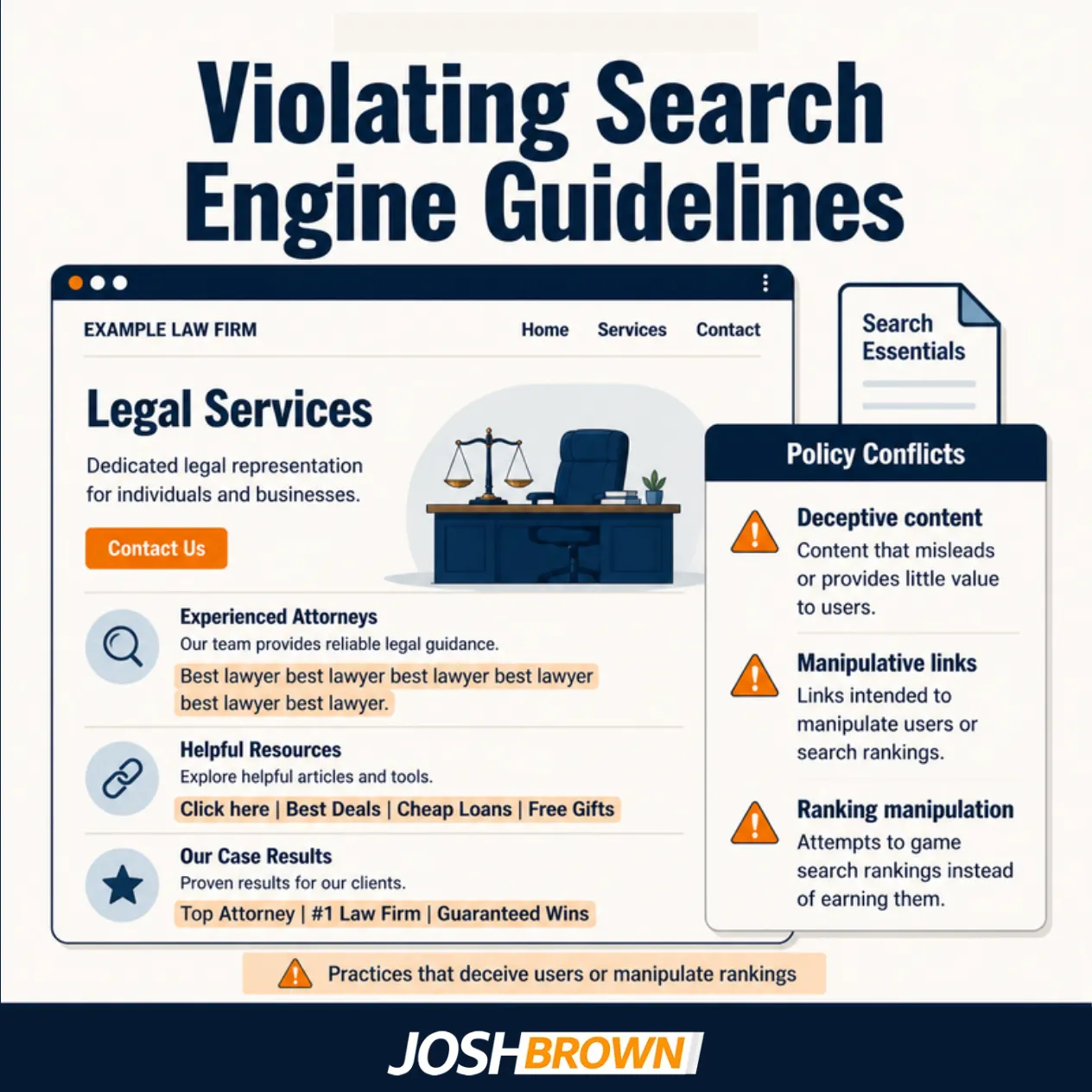
Black hat SEO rarely remains confined to one tactic. A website might publish scaled pages, purchase backlinks to those pages, force exact-match anchors, hide keyword text, and redirect visitors after rankings improve. Each practice increases the broader compliance problem.
Google’s current spam policies cover practices including cloaking, doorway abuse, expired-domain abuse, hidden text, keyword stuffing, link spam, scaled content abuse, site reputation abuse, sneaky redirects, scraped content, and other forms of search manipulation. Google states that violating websites can rank lower or fail to appear in Search.
Manual actions add another layer. Google issues a manual action when a human reviewer determines that pages fail to comply with spam policies. Google states that most manual actions concern attempts to manipulate its search index, and affected pages or websites can rank lower or disappear from results.
A recovery process needs to address the actual violation rather than hide it. Link-related actions require reviewing unnatural backlinks and removing or appropriately treating manipulative links. Cloaking requires matching user and crawler experiences. Keyword stuffing requires removing repeated terms. Scaled content problems require replacing low-value publishing with material that provides useful information.
White-hat SEO follows a different model: accurate technical implementation, useful content, legitimate outreach, natural links, transparent redirects, readable page experiences, and ongoing review of Google Search Console.
What Is Black Hat SEO?
Black hat SEO is the use of deceptive, manipulative, or guideline-violating search practices intended to produce rankings without earning those rankings through useful content, legitimate authority, and transparent website operation.
The goal behind black hat SEO is usually faster ranking growth. Website owners seek backlinks without earning editorial recommendations, publish pages at a scale unsupported by useful information, overuse target keywords, conceal content, exploit existing domain reputation, or show search engines a version of a page visitors never receive.
White-hat SEO seeks sustainable rankings through user-focused content, sound technical SEO, legitimate links, accurate information architecture, transparent page behavior, and useful website experiences. Black hat SEO pursues the ranking signal directly; white-hat SEO builds the conditions that make the signal legitimate.
The risks include manual actions, ranking declines, traffic losses, backlink devaluation, removal of pages from Search, rebuilding costs, damaged publishing standards, and reputational harm. Google states that most spam is handled by automated systems and that sites violating spam policies can rank lower or not appear in results.
Google’s quantitative data demonstrates the scale of enforcement. SpamBrain identified nearly 6 times more spam sites in 2021 than in 2020, and Google reported that more than 99% of searches were spam-free that year. In 2022, SpamBrain detected another 5-fold increase in spam sites compared with 2021. These figures do not mean every black hat tactic receives immediate punishment, but they demonstrate sustained investment in automated spam detection.
What Is Black Hat Link-Earning SEO?
Black hat link-earning SEO refers to acquiring backlinks through paid, incentivized, disguised, automated, exchanged, or controlled placements whose main purpose is manipulating rankings rather than earning independent editorial citations.
The phrase “link earning” normally describes backlinks another publisher chooses to provide because a page deserves citation. Black hat link earning imitates that appearance without the independent editorial decision.
Examples include paid backlinks disguised as ordinary editorial references, reciprocal exchanges arranged only for ranking purposes, sponsored posts that pass ranking signals without appropriate treatment, purchased insertions in existing articles, low-quality guest-post networks, PBN placements, and automated link creation.
The distinction rests on why the link exists. A lawyer quoted by a newspaper earns a link because the journalist considered the lawyer useful to the article. A firm purchasing an exact-match backlink on a website created primarily to sell ranking links does not represent the same editorial relationship.
Legitimate link acquisition uses useful content, professional expertise, public relations, original research, industry commentary, earned citations, partnerships, community activity, reputable directories, and independent editorial coverage.
What Cloaking Practices Should Be Avoided?
Cloaking practices to avoid show search engines content, keywords, links, pages, or destinations that differ materially from what human visitors receive.
Crawler-specific pages are one form of cloaking. A server detects Googlebot and displays text written to rank for a commercial search, but ordinary visitors receive a different offer. Search-engine-only keywords create the same problem at a smaller scale.
Conditional redirects are another form. Google indexes one page, but users arriving from Search are sent to a different URL. Search Console specifically warns about redirects applied according to search referral or IP ranges when the result differs from what Google evaluated.
Content mismatch also appears through JavaScript, server-side rendering, dynamic rendering, or user-agent conditions when they are deliberately configured to provide Google with ranking content users never receive.
Legitimate personalization does not automatically equal cloaking. Device layouts, language preferences, accessibility features, geographic information, login states, paywalls implemented according to Google’s guidance, and interactive components have valid purposes.
The safe rule is rendering parity around the page’s primary subject. Search engines and users need substantially the same meaningful information. Technical SEO work needs to solve rendering problems openly rather than create crawler-specific content.
What PBNs Should Be Avoided in SEO?
PBNs should be avoided in SEO when websites are created, acquired, or repurposed mainly to manufacture backlinks and artificially influence search rankings.
A private blog network often has little genuine audience beyond the websites purchasing or controlling its links. Pages contain thin articles written around backlink opportunities, domains cover unrelated subjects, anchor text follows commercial targets, and publishing activity exists mainly to support outbound links.
Expired domains create another warning sign when their previous reputation becomes the only reason for acquisition. A domain formerly devoted to a local newspaper, technology company, school, nonprofit, or unrelated business might suddenly publish generic legal, gambling, finance, or commercial articles after expiration.
Common PBN patterns include repeated outbound destinations, thin or duplicated articles, extensive commercial anchors, related network structures, overlapping design patterns, abrupt changes in subject matter, weak first-party information, and sites that publish far more sponsored-style content than material intended for a real readership.
No single signal proves that a website is a PBN. Search systems evaluate broader relationships and patterns. Attempting to make a network “footprint-free” does not turn an artificial backlink into an earned citation.
Law firms gain safer links through original legal resources, statistics, professional commentary, interviews, digital PR, reputable guest contributions, bar and professional organizations, community partnerships, citations, local institutions, case studies, and material journalists or publishers independently find worth referencing.
How Does Google Detect Black Hat SEO to Avoid?
Google detects black hat SEO through automated spam systems, ranking systems, link analysis, content analysis, rendering comparisons, pattern detection, and human manual review.
Google states that policy-violating practices are detected through automated systems and, when needed, human review. SpamBrain forms part of Google’s anti-spam infrastructure and has been trained to identify different forms of abuse, including link spam.
Unnatural link activity creates signals through relationships between sites, unusual acquisition patterns, artificial linking networks, repetitive commercial anchors, low-quality sources, and sites built mainly to pass links. Google does not publish a checklist that allows an SEO practitioner to determine exactly when a link profile crosses an internal threshold.
Cloaking creates another measurable discrepancy. Search Console tells website owners to compare the version fetched by Google with the version seen by humans because crawler-user differences reveal the type of mismatch associated with cloaking.
Hidden text creates visible-versus-rendered differences. Scaled content creates large collections of unoriginal or low-benefit pages. Sneaky redirects create abnormal destination behavior. PBNs create relationships between low-value sites and artificial backlinks.
Google also uses human reviewers. A manual action means a reviewer determined that pages violate Google’s spam policies, and Search Console identifies the issue so the site owner can correct it and request review.
Historical systems such as Penguin and Panda remain useful for explaining how Google’s spam and quality enforcement developed, but SEO professionals should not treat them as standalone modern update cycles. Google’s present anti-spam approach uses integrated systems rather than relying on one named historical algorithm.
Law firms reviewing algorithmic detection of manipulative SEO gain more from examining whether links, content, redirects, rendering, and publishing practices genuinely help users than from attempting to reverse-engineer one detection threshold.
Google reported that SpamBrain detected 5 times more spam sites in 2022 than in 2021, 200 times more than when the system first launched, and 50 times more link-spam sites than the previous link-spam update. The scale of those improvements makes an evasion-based SEO strategy increasingly difficult to justify against the long-term cost of rebuilding rankings after manipulation is neutralized.