

Josh Brown
CEO & Founder, Josh Brown Consulting
Lawyer advertising rules regulate how attorneys and law firms promote legal services through websites, search ads, social media, television, radio, print, email, direct mail, directories, video, and other marketing channels. The governing requirements come primarily from each lawyer’s state rules of professional conduct, state-bar advertising rules, applicable court decisions, and other advertising laws. The ABA Model Rules provide an influential framework, but individual jurisdictions modify, supplement, or reject portions of that framework, which means an advertisement that complies in one state does not automatically comply in another. The ABA maintains jurisdiction-by-jurisdiction comparison materials for advertising and solicitation rules because state requirements differ.
Under the current ABA Model Rules, Rule 7.1 prohibits false or misleading communications about legal services, Rule 7.2 governs specific advertising practices, and Rule 7.3 regulates solicitation of prospective clients. Historical references to “Rules 7.1–7.5” require care because the ABA deleted Model Rules 7.4 and 7.5 in 2018 and incorporated parts of their subject matter into the revised advertising framework. States have not adopted those revisions uniformly, so lawyers must check the actual rules in every jurisdiction governing an advertisement.
Lawyers generally may advertise through digital, print, and broadcast media, provided their communications remain truthful and satisfy jurisdiction-specific requirements. ABA Model Rule 7.2 expressly permits lawyers to communicate information about their services through any media, subject to the remaining professional-conduct rules. The same rule restricts payments for recommendations, regulates specialist-certification claims, and requires covered communications to identify at least one responsible lawyer or law firm and provide contact information.
Digital advertising now represents a major part of legal marketing. An ABA publication addressing attorney advertising in the digital age reports that 86% of law firms have a social-media presence, 71% of lawyers report generating new leads through social media, and 65% of law firms identify their website as the marketing channel producing the highest return on investment. Those adoption figures make advertising compliance relevant to websites, search campaigns, Facebook ads, videos, social posts, email, and other online communications rather than only traditional television and newspaper advertising.

Disclaimers become important when an advertisement could otherwise create an unjustified expectation or omit information needed to keep the communication from becoming misleading. A statement such as “Past results do not guarantee a similar outcome” is commonly used around case results and testimonials, although the exact disclaimer requirement differs by jurisdiction and advertisement type. ABA Rule 7.1 does not establish one universal disclaimer sentence for every lawyer advertisement; instead, it prohibits communications that are false or materially misleading, including technically truthful statements that create unsupported expectations.
Testimonials also require careful review. A law firm needs to confirm that a testimonial is genuine, accurately presented, and not edited into a misleading claim. Client confidentiality creates another requirement: ABA Model Rule 1.6 prohibits disclosure of information relating to representation unless the client gives informed consent, disclosure is impliedly authorized to carry out the representation, or another stated exception applies. A lawyer needs appropriate authorization before turning confidential case information into advertising material.
Modern lawyer advertising traces a major legal turning point to June 27, 1977, when the U.S. Supreme Court decided Bates v. State Bar of Arizona, 433 U.S. 350. The Court held that states could not impose a blanket suppression on truthful attorney price advertising merely because lawyers were advertising legal services. The challenged Arizona disciplinary rule had broadly prohibited advertising through newspapers, magazines, radio, television, directories, and other commercial publicity. Bates involved a newspaper advertisement rather than a television commercial, but the decision opened the modern era in which lawyer advertising expanded into television and, later, digital channels.
JoshBrown.io helps law firms improve compliant marketing strategies by creating SEO campaigns that attract clients while aligning website content with legal advertising requirements. Contact JoshBrown.io to build a law firm SEO strategy focused on visibility, trust, and compliant growth. JoshBrown.io optimizes legal content, improves topical authority, analyzes search intent, and supports ethical law firm marketing systems.
What Are Lawyer Advertising Rules?
Lawyer advertising rules govern how lawyers communicate information about their legal services across websites, social media, search ads, television, and other marketing channels. The main rules address advertising content, media, testimonials, fees, specialization claims, referrals, confidentiality, and solicitation.

Lawyers need to review both the ABA framework and the rules of every relevant licensing jurisdiction. Firms operating nationally also need procedures for determining which jurisdiction’s rules apply to a website, campaign, lawyer, office, or targeted audience.
Listed below are 10 legal ethics and advertising compliance rules.
- Advertising must be truthful and not misleading. ABA Model Rule 7.1 governs all communications concerning a lawyer’s services. A statement violates the rule when it is false or when a technically truthful statement omits information or creates a substantial likelihood that a reasonable person will form an unsupported conclusion about the lawyer or legal service.
- Past results must not create unjustified expectations. A law firm may truthfully describe prior achievements, but ABA commentary warns that a truthful statement about previous results becomes misleading when it causes a reasonable person to expect the same result in materially different circumstances. Case-result advertising requires factual accuracy, appropriate qualification, and any disclaimer required by the governing jurisdiction.
- Lawyers may advertise through multiple media. Model Rule 7.2 permits communications regarding legal services through any media. Websites, search ads, Facebook advertisements, television commercials, podcasts, videos, print advertisements, billboards, email campaigns, and other media remain subject to the same truthfulness requirements and any additional state rules.
- Advertisements need responsible-lawyer identification. ABA Model Rule 7.2 requires communications covered by the rule to include the name and contact information of at least one lawyer or law firm responsible for the content. State rules sometimes impose additional office-address, jurisdiction, filing, identification, or disclosure requirements.
- Specialist claims need proper certification. A lawyer cannot state or imply certification as a specialist under Model Rule 7.2 unless the certification comes from an approved state authority, U.S. territorial authority, or ABA-accredited organization, and the communication identifies the certifying organization. General statements about experience still remain subject to Rule 7.1’s prohibition on misleading claims.
- Payments for recommendations are restricted. Model Rule 7.2 prohibits giving or promising something of value for recommending the lawyer’s services except for specified arrangements, including reasonable advertising costs, qualifying legal-service plans and referral services, permitted practice purchases, certain nonexclusive reciprocal referral arrangements, and nominal appreciation gifts that are not compensation for recommendations.
- Live solicitation for financial gain is restricted. Model Rule 7.3 generally prohibits live person-to-person solicitation when a significant motive is the lawyer’s financial gain unless the recipient fits an enumerated exception, such as another lawyer, a person with a family or close prior relationship, or a person who routinely uses that type of legal service for business purposes.
- Coercive or unwanted solicitation remains prohibited. A lawyer must not solicit a person who has stated that the person does not want to receive solicitations, and solicitation cannot involve coercion, duress, or harassment.
- Client confidentiality still applies to advertising. A lawyer needs informed consent or another valid basis under Rule 1.6 before revealing information relating to a client representation. A publicly filed case does not automatically mean every detail of the representation is available for unrestricted advertising use under professional-conduct rules.
- State-specific advertising rules control actual compliance. The ABA Model Rules are models rather than one federal advertising code binding every lawyer. States maintain differing requirements governing disclaimers, solicitation, filing, retention, specialization, targeted communications, fee advertisements, and other advertising practices.
The current ABA rules also require a terminology correction often missed in older legal-marketing articles. Model Rules 7.4 and 7.5 were deleted in 2018, so current ABA analysis focuses primarily on Rules 7.1, 7.2, and 7.3 for ordinary advertising and solicitation, together with other professional rules such as confidentiality, supervision, and jurisdictional authority. A state may still use different numbering or retain provisions resembling the former rules.
How Does Lawyer Advertising Work?
Lawyer advertising works by promoting a lawyer or law firm’s legal services through approved media while ensuring that every claim, testimonial, fee statement, and call to action complies with the professional rules governing the advertisement.

A compliant advertising process begins by identifying where the advertisement will appear and which lawyers, offices, services, and audiences it covers. A Facebook advertisement targeted to residents of one state raises a different jurisdictional review than a law firm website intended to reach clients across 20 states. A television campaign has different practical review requirements from a private direct-mail solicitation to a known accident victim.
The firm then reviews every factual claim. Lawyer names, office locations, years in practice, case results, awards, peer recognition, specialization credentials, practice descriptions, fees, client reviews, and comparative claims need evidentiary support.
Advertising language also needs to avoid implied guarantees. Statements such as “we win every case,” “the best injury lawyers,” “guaranteed settlement,” or an unsupported claim that a lawyer achieves larger recoveries than competing firms create obvious concerns under rules prohibiting false or misleading communications.
The next stage involves disclosure and disclaimer analysis. A law firm needs to identify whether the jurisdiction requires language covering past results, testimonials, actors, dramatizations, contingent fees, costs, specialist status, geographic limitations, responsible lawyers, or the advertisement’s status as advertising material.
The firm also reviews confidentiality. Client names, photographs, settlement figures, quotations, medical information, criminal allegations, family information, business information, and other facts connected to representation require analysis under professional-conduct rules and applicable client authorization.
A final compliance review covers the landing page as well as the advertisement itself. A compliant Facebook ad linked to a misleading landing page does not solve the problem because the complete marketing communication affects what the prospective client understands.
Law firms need ongoing review after launch. Lawyer rosters change, offices move, awards expire, fee structures change, testimonials become outdated, statutes change, marketing platforms alter their formats, and state bars amend advertising rules. Advertising compliance is an operating process rather than a one-time approval.
Can Lawyers Advertise on Facebook?
Yes, lawyers can advertise on Facebook. As long as the advertisement complies with the lawyer’s professional-conduct rules, applicable state advertising requirements, confidentiality duties, and Meta’s advertising policies.
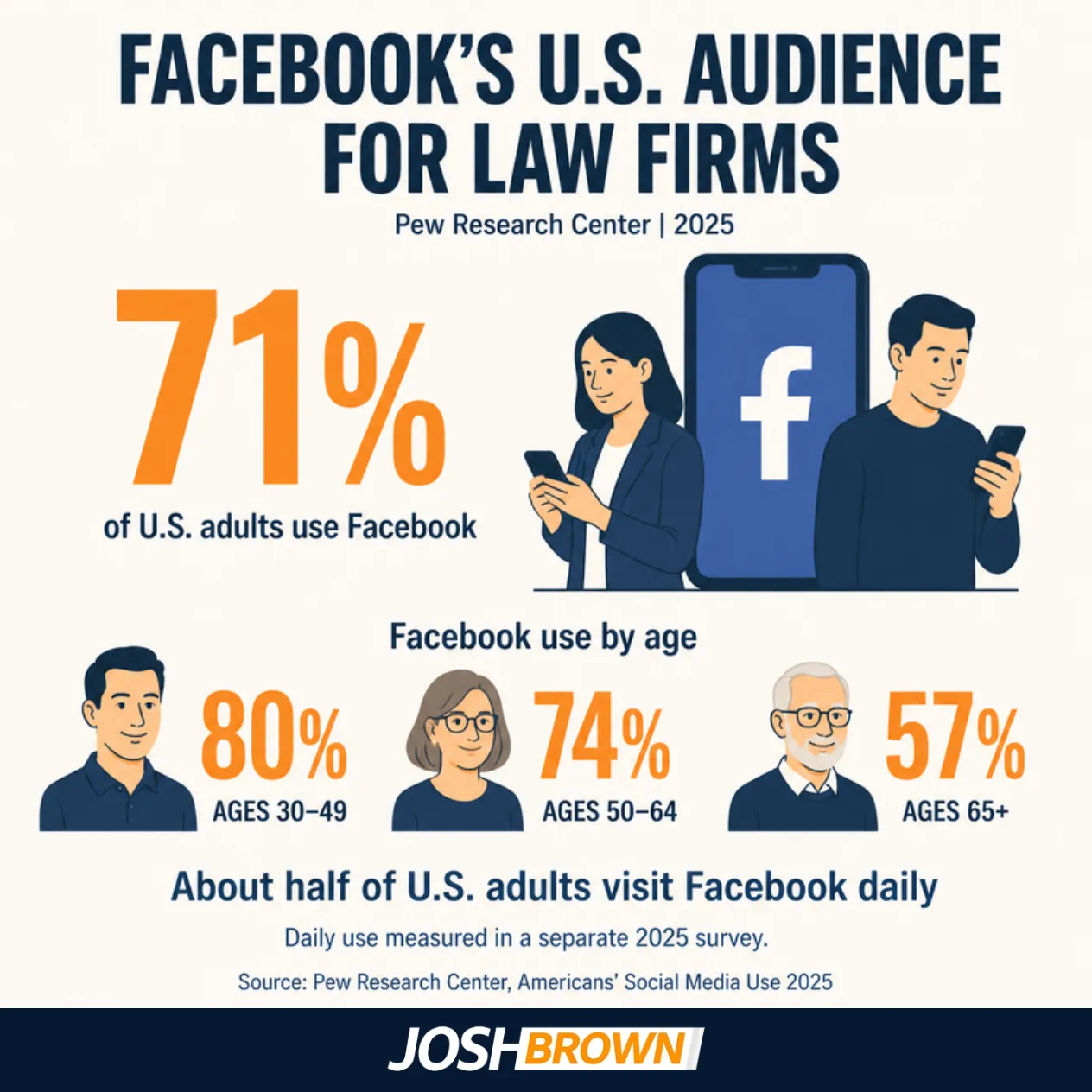
Facebook gives law firms access to a large U.S. audience. Pew Research Center’s 2025 survey found that 71% of U.S. adults use Facebook, including 80% of adults ages 30–49, 74% of adults ages 50–64, and 57% of adults age 65 or older. About half of U.S. adults reported visiting Facebook daily in a separate 2025 Pew survey.
That reach makes Facebook useful for local awareness, practice-area education, video campaigns, remarketing where permitted, community promotion, and directing prospective clients to service pages or consultation forms. The ABA’s 2025 digital-advertising discussion reports that 86% of law firms maintain a social-media presence and 71% of lawyers report generating new leads from social media.
The professional-conduct analysis depends on how the communication reaches the user. ABA Rule 7.3’s commentary states that communications directed to the general public—such as internet banner advertisements, websites, and television commercials—are not ordinarily treated as solicitation under the rule. A private real-time approach to a known individual who needs representation presents a different issue.
Facebook ads require attention to both content and delivery. A broad advertisement stating that a law firm handles motor-vehicle claims differs from a lawyer directly contacting an identified crash victim after learning about the accident.
Listed below are 14 items law firms running social campaigns need to review.
- Accuracy of lawyer and firm claims.
- Office and jurisdiction information.
- Practice-area descriptions.
- Testimonials and client consent.
- Past case results.
- Required disclaimers.
- Fee representations.
- Comparative claims.
- Lead forms and privacy notices.
- Audience targeting.
- Comments and responses controlled by the firm.
- Private-message procedures.
- Agency and marketing-vendor activity.
- Record-retention requirements imposed by the governing jurisdiction.
A Facebook ad also needs a compliant landing page and intake process. Lawyers developing paid social campaigns should connect compliance review with the rules and strategy for Facebook lawyer ads rather than review the advertisement in isolation.
Why Are Disclaimers Required in Lawyer Ads?
Disclaimers are required in lawyer ads when professional rules, state regulations, or the advertisement’s wording require additional information to prevent a reasonable prospective client from receiving a misleading impression.
A disclaimer explains a limitation that the rest of the advertisement could otherwise obscure. Common examples include statements explaining that prior results do not guarantee the same outcome, that a particular result depended on specific facts, that an actor or dramatization appears in advertising, that a stated fee excludes separate costs, or that a lawyer’s described practice does not constitute certification as a specialist.
The need for a disclaimer comes from the prohibition against misleading advertising rather than from one universal national disclaimer rule. ABA Model Rule 7.1 applies even when every individual statement is technically true. A communication is misleading when omitted facts make the overall message materially misleading or when it creates a substantial likelihood that a reasonable person will reach an unsupported conclusion about the lawyer or services.
Past-results advertising provides a clear example. A law firm truthfully stating that it obtained a $10 million verdict has still not established that another client with a different defendant, injury, jurisdiction, policy limit, evidence record, or legal issue is likely to receive $10 million. ABA commentary specifically warns that truthful descriptions of previous client achievements can create unjustified expectations if they are presented without the factual and legal circumstances necessary to understand the result.
A disclaimer such as “Past results do not guarantee a similar outcome” helps address that risk, but the exact language depends on the jurisdiction and the rest of the advertisement.
Placement matters as much as wording. Fine print hidden below a video, low-contrast text, an unreadably fast television disclaimer, or a disclosure separated from the claim it qualifies provides less protection against misunderstanding. State advertising rules sometimes prescribe prominence, wording, location, duration, or font treatment.
Can Disclaimers Make Lawyer Ads Compliant?
Yes, disclaimers can make lawyer ads compliant. Disclaimers make lawyer ads compliant by supplying information needed to prevent misleading impressions. However, a disclaimer cannot cure an advertisement whose underlying claim is false, prohibited, or fundamentally deceptive.
A valid disclaimer clarifies a statement that remains permissible when properly qualified. A disclaimer does not transform “guaranteed $1 million settlement” into a lawful statement merely by adding “results vary” at the bottom.
The same principle applies to comparative claims. A firm cannot publish an unsupported statement that it is “the highest-rated law firm in America” and expect small-print qualification to create a factual basis that does not exist.
Disclaimers work best when they directly address the potential misunderstanding. A case-result advertisement needs a result-related qualification. A contingency-fee advertisement needs to distinguish the attorney fee from costs if applicable under the jurisdiction and actual agreement. A specialist statement needs to comply with the applicable certification rule rather than rely on a generic disclaimer.
Law firms should review advertising in this order:
- Determine whether the underlying claim is permitted.
- Verify the factual basis.
- Identify the jurisdiction governing the advertisement.
- Determine whether a specific disclosure is required.
- Place the disclaimer where the audience reasonably notices it.
- Review the advertisement as a whole for the impression it creates.
How Should Testimonials Be Used in Lawyer Advertising?
Testimonials in lawyer advertising should be used only when they are genuine, accurate, authorized where client information is disclosed, and presented without implying guaranteed or universally repeatable results.
A law firm should first verify the source of every testimonial. The firm needs to know who made the statement, whether the reviewer was actually a client when represented as one, whether the quotation reflects the original review, and whether editing has changed its meaning.
Client consent requires separate attention. Rule 1.6 protects information relating to a representation and generally requires informed consent before a lawyer voluntarily discloses protected information for advertising. A signed authorization describing how the testimonial, name, image, case information, and result will be used creates stronger documentation than relying on an informal verbal approval.
Testimonials also need to avoid unsupported expectations. A review saying “They got me $2 million in six weeks” becomes problematic when the advertisement presents the experience as a normal outcome for similar clients. The firm should preserve the individual nature of the testimonial and use any result disclaimer required by the governing rules.
Lawyers need to distinguish between client opinion and objective claims. A client saying “I felt supported throughout my case” describes personal experience. A testimonial stating “This is the highest-winning law firm in the state” makes a measurable comparative claim that requires a factual basis independent of the client’s enthusiasm.
Compensated endorsements, influencer arrangements, referral relationships, and review-generation programs need additional review. Payment does not erase professional-conduct rules simply because the statement appears on a social-media account rather than the law firm’s own website.
Is Testimonial Use Restricted in Lawyer Advertising?
Yes, testimonial use is restricted in lawyer advertising because testimonials can become misleading, disclose protected client information, create unjustified expectations, or violate state-specific advertising requirements.
Restrictions vary substantially between jurisdictions. Some jurisdictions require specific disclaimers around past results or testimonials. Others regulate whether dramatizations, actors, endorsements, comparison statements, client statements, or compensated reviews require additional disclosure.
The ABA’s central rule remains truthfulness. Rule 7.1 applies to testimonials in the same way it applies to lawyer-written advertising because the law firm remains responsible for the overall communication about its services.
Confidentiality applies independently. A client might voluntarily post a public Google review, but the lawyer should not assume that the public post gives unrestricted permission to disclose additional case information in a responsive comment or advertisement. Rule 1.6 remains relevant to the lawyer’s own disclosure.
Law firms using testimonials should maintain a record containing the original statement, reviewer identity or approved display format, client authorization where required, publication date, advertisement version, supporting result information where applicable, disclaimer used, and jurisdictions in which the material is approved.
What Compliance Issues Affect Lawyer Advertising?
Compliance issues that affect lawyer advertising include misleading statements, unverified testimonials, missing disclosures, and multijurisdictional advertising.
Listed below are the 15 main risks.
- False statements: Advertising cannot contain fabricated results, credentials, years of experience, office locations, lawyer biographies, awards, ratings, or other false facts.
- Misleading truthful claims: A statement can be literally accurate and still violate Rule 7.1 when its overall presentation causes a reasonable person to draw an unsupported conclusion.
- Unverified testimonials: Fabricated reviews, edited testimonials, fake client identities, or endorsements presented without a factual basis create advertising and reputational risk.
- Missing disclaimers: Case results, fees, testimonials, actors, specialties, or other claims sometimes require disclosures under state rules.
- Improper guarantees: Statements guaranteeing victory, settlement, dismissal, acquittal, or another legal outcome create misleading expectations because future legal results depend on facts and law.
- Improper solicitation: Live person-to-person solicitation for pecuniary gain is generally prohibited by ABA Model Rule 7.3 unless an exception applies.
- Harassment or coercion: Even an otherwise permissible solicitation becomes prohibited when the recipient has requested no further contact or the communication involves coercion, duress, or harassment.
- Confidentiality violations: Testimonials, case studies, videos, screenshots, settlement announcements, and social posts can reveal information connected to representation without valid client authorization.
- Unsupported comparative claims: Statements such as “best,” “number one,” “highest rated,” or “most successful” require jurisdiction-specific review and substantiation.
- Specialization claims: Lawyers must comply with applicable certification rules before stating or implying that they are certified specialists. ABA Model Rule 7.2 expressly regulates such representations.
- Fee misrepresentation: Advertising a low fee without disclosing material conditions, excluded costs, or limited scope can create a misleading impression.
- Improper payments for recommendations: Lawyers need to distinguish permitted advertising expenses and qualified referral arrangements from prohibited compensation for recommendations.
- Marketing-vendor conduct: Lawyers remain responsible for ensuring that marketers, lead-generation businesses, intake vendors, and other nonlawyers working on their behalf do not use prohibited solicitation or misleading advertising practices.
- Multi-state advertising: State requirements differ. A firm with lawyers in several states needs to determine which rules govern the advertisement, lawyer, office, audience, and solicitation method.
- Platform compliance: Facebook, Google, television networks, directories, and other publishers impose additional advertising policies beyond bar rules.
Law firms that do not have an internal review process benefit from dedicated compliance support for ad disclaimers and content before campaigns go live.
What Are the Best Practices That Ensure Ethical Lawyer Advertising?
The best practices that ensure ethical lawyer advertising include factual verification, jurisdiction review, appropriate disclaimers, and documented approval procedures.
Listed below are the 14 main practices.
- Review the applicable jurisdiction before publication. Identify every state in which the lawyer is licensed, every office advertised, and every geographic audience the campaign targets.
- Verify every factual claim. Maintain support for years in practice, attorney count, office locations, case results, awards, review ratings, certifications, memberships, and fee statements.
- Review the overall impression. Do not evaluate sentences in isolation. Consider what a reasonable prospective client is likely to believe after seeing the complete advertisement.
- Use disclaimers where required or needed to avoid misunderstanding. Place disclosures close to the claim they qualify and make them readable or audible.
- Avoid guarantees. Describe services, experience, and verified prior work without promising an outcome that depends on future facts.
- Verify testimonials before publication. Preserve the original review and avoid edits that change the reviewer’s meaning.
- Obtain appropriate client consent. Use documented permission when advertising reveals information relating to representation.
- Separate public advertising from direct solicitation. General Facebook advertising, television campaigns, websites, and billboards receive different treatment from live approaches to identified people with known legal problems under Model Rule 7.3.
- Review fee statements carefully. Explain material conditions rather than advertising a headline fee that hides other relevant terms.
- Verify referral and lead-generation arrangements. Determine what the marketing provider is being paid for and whether the arrangement complies with rules governing recommendations and solicitation.
- Maintain advertising records. Preserve the advertisement, publication dates, targeting, testimonials, authorizations, disclosures, and approval documents according to applicable state requirements and firm policy.
- Supervise marketing vendors. Agencies and intake vendors need written instructions covering prohibited claims, client contact, confidentiality, lead handling, and advertising review.
- Monitor published material. Update ads when lawyers leave, offices close, awards change, fees change, landing pages move, or rules are amended.
- Create a formal approval workflow. Marketing prepares the campaign, a designated lawyer reviews factual and ethics issues, required revisions are recorded, and the final version receives documented approval before publication.
When Did Lawyers Start Advertising on TV?
Lawyers started advertising widely on TV after the U.S. Supreme Court’s 1977 decision in Bates v. State Bar of Arizona established constitutional protection for truthful lawyer advertising. This also ended the era of blanket professional bans on attorney advertising.
The Court decided Bates on June 27, 1977, at 433 U.S. 350. The two Arizona lawyers in the case operated a legal clinic and published a newspaper advertisement listing fees for routine services, including uncontested divorces, uncontested adoptions, simple bankruptcies, and name changes. Arizona’s disciplinary rule prohibited lawyers from promoting themselves through newspapers, magazines, radio, television, directories, and other commercial publicity.
The Supreme Court held that truthful attorney price advertising received First Amendment commercial-speech protection and rejected blanket suppression of such advertising. The Court did not hold that every form of attorney advertising was immune from regulation. False, deceptive, misleading, or certain forms of solicitation remained subject to regulation.
Bates itself concerned a newspaper advertisement, so stating that the case directly involved a television commercial would be inaccurate. The decision instead removed the broad constitutional barrier that had supported bans encompassing television and other media. Television lawyer advertising expanded as states revised their professional rules following the decision.
The advertising environment later expanded again through websites, search engines, social media, streaming video, online directories, and other digital channels. The ABA’s current Model Rule 7.2 now states broadly that lawyers may communicate information about their services “through any media,” subject to the remaining professional rules.
What Is a Legal Advertisement Letter?
A legal advertisement letter is a written communication from a lawyer or law firm promoting legal services to prospective clients under applicable advertising and solicitation rules.
A general brochure mailed to thousands of residents differs from a letter sent specifically to a homeowner known to face foreclosure, an accident victim identified from a police report, or a business owner known to face a lawsuit. The second category moves from general advertising toward targeted solicitation because the lawyer knows or reasonably should know that the specific recipient needs legal services in a particular matter.
The Supreme Court addressed targeted direct-mail advertising in Shapero v. Kentucky Bar Association, 486 U.S. 466 (1988). Kentucky had refused to permit a lawyer to send letters to people known to face foreclosure. The Supreme Court rejected the blanket prohibition on truthful targeted direct-mail solicitation based solely on the fact that the recipient was known to need a particular legal service.
That decision does not mean all advertisement letters are unrestricted. States retain authority to regulate misleading communications, harassment, required labeling, filing procedures, retention, waiting periods, and other aspects of lawyer solicitation.
Personal-injury advertising illustrates that distinction. In Florida Bar v. Went For It, Inc., 515 U.S. 618 (1995), the Supreme Court upheld Florida’s 30-day restriction on targeted direct-mail solicitation to accident or disaster victims and their relatives. The decision demonstrates why lawyers cannot assume that a solicitation letter lawful in one jurisdiction or at one time after an event is lawful everywhere.
A compliant legal advertisement letter requires review of the recipient, reason for contact, timing, wording, disclaimer or labeling requirements, client vulnerability, state rules, and whether continued contact becomes unwanted or harassing.
Can a Lawyer Solicit Clients?
Yes, a lawyer can solicit clients through permitted forms of communication. However, ABA Model Rule 7.3 generally prohibits live person-to-person solicitation for financial gain when the lawyer directly approaches a person known to need legal services and no stated exception applies.
Model Rule 7.3 defines solicitation as a lawyer-initiated communication directed to a specific person whom the lawyer knows or reasonably should know needs legal services in a particular matter and that offers to provide those services.
The Model Rule prohibits live person-to-person contact when a significant motive is the lawyer’s or law firm’s pecuniary gain, unless the recipient is:
- Another lawyer.
- A person with a family, close personal, or prior business or professional relationship with the lawyer or firm.
- A person who routinely uses the type of legal services offered for business purposes.
ABA commentary defines live person-to-person contact as face-to-face communication, live telephone calls, and other real-time visual or auditory communications in which the recipient faces a direct encounter without meaningful time for reflection. The same commentary states that ordinary text messages, chat-room communications, and other written communications recipients can easily disregard do not fall within that definition merely because they are electronic.
General advertising does not ordinarily qualify as solicitation under the Model Rule. A billboard, website, internet banner advertisement, Facebook campaign directed to the public, or television commercial is general advertising rather than an individualized direct approach to a known prospective client.
Written solicitation receives different constitutional treatment from live solicitation. Shapero protects truthful targeted direct mail against a blanket prohibition, while Florida Bar v. Went For It confirms that states can impose narrower restrictions such as Florida’s 30-day protection period for accident victims and relatives when the restriction satisfies constitutional standards.
Lawyers also must stop or avoid solicitation when the recipient has made known a desire not to be solicited, or when the communication involves coercion, duress, or harassment.
The practical rule is not “lawyers cannot solicit clients.” The more accurate rule is that lawyers can advertise broadly and use permitted targeted communications, while live financially motivated solicitation and state-regulated approaches to vulnerable or recently injured people face substantially greater restrictions.